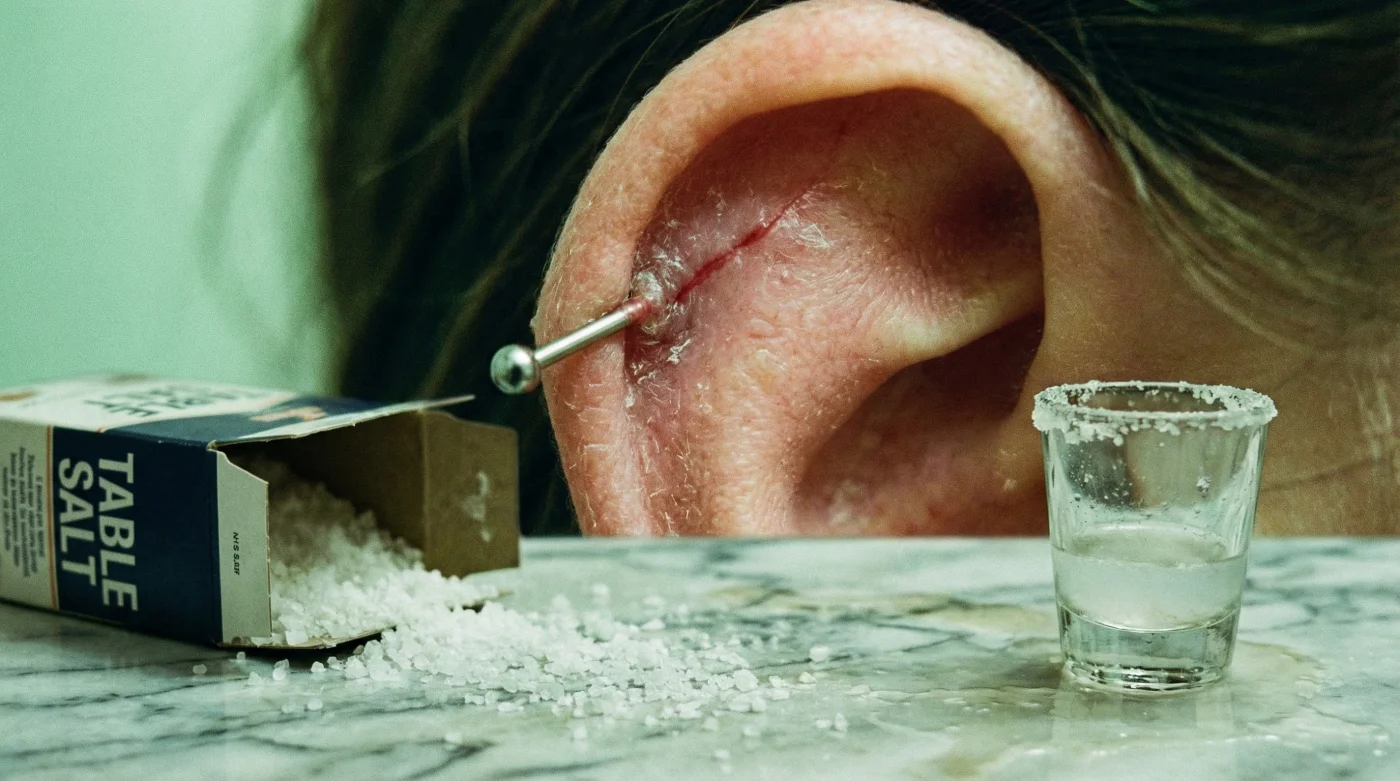
For decades, anyone walking out of a studio with a fresh cartilage piercing was handed the exact same set of instructions: go home, mix up some warm water, and submerge your ear. It felt like a soothing, natural remedy passed down through generations of body modification enthusiasts. But behind closed doors, elite piercers and dermatologists are witnessing a silent epidemic of rejected jewelry and severe scarring. Millions of people are diligently following this outdated advice, completely unaware that a universally recommended daily habit is actively forcing their body to expel their new jewelry.
The culprit hiding in plain sight is the traditional homemade soak. While it sounds harmless, witness accounts from top-tier professional studios are completely contradicting the decades-old advice of soaking fresh body piercings in salt water. Experts advise that this highly praised routine is actually triggering a rapid, aggressive rejection response. If your cartilage piercing seems to be migrating, constantly irritated, or taking over a year to heal, the solution isn’t to soak it more—it is to immediately stop the one practice you thought was saving it.
The Hidden Danger in Your Aftercare Routine
When you mix up a batch of salt water in your bathroom, you are almost certainly creating a hypertonic solution. The foundational problem with homemade Sea Salt Soaks is that they are incredibly saline-heavy. Your body’s natural salinity sits precisely at 0.9 percent. When you dump a heavy pinch of sea salt into a shot glass of warm water, you are often creating a solution with a salinity of two to five percent. This drastic imbalance creates a hostile chemical environment for a fresh wound.
Instead of gently cleansing the area, this dense saline concentration begins rapidly dehydrating the fistula—the delicate, tube-like layer of scar tissue that forms around the jewelry to heal the wound. As the fistula dries out, it loses its elasticity and structural integrity. The body, sensing that the tissue is dying and irritated, stops trying to heal around the metal and instead treats the jewelry like a dangerous foreign object, pushing it closer and closer to the surface of the skin.
But who is actually at risk of this severe migration process, and why does cartilage react so aggressively compared to traditional earlobe tissue?
Understanding Your Piercing Risk Profile
Not all tissue responds to severe dehydration in the same way. Cartilage is notoriously difficult to heal because it lacks the robust blood supply found in softer, fleshy tissues. When you subject it to harsh Sea Salt Soaks, the tissue damage is massively amplified.
| Piercing Location | Tissue Type & Vulnerability | Migration Probability with Homemade Soaks | Primary Consequence of Dehydration |
|---|---|---|---|
| Lobe | Fleshy, high blood flow | Low to Moderate | Dry, flaky skin and prolonged redness. |
| Helix / Flat | Thin cartilage, exposed edges | Very High | Rapid jewelry shifting, angle changes, and rejection. |
| Tragus / Daith | Thick, dense cartilage | High | Severe irritation bumps (hypertrophic scarring) and pain. |
| Navel / Surface | Flat surface tissue | Critical | Complete rejection, leaving a permanent track scar. |
To truly understand how this chemical imbalance destroys fresh tissue, we must look at the exact cellular mechanisms at play.
The Science of Osmosis and Tissue Dehydration
- Whoop Fitness Straps fail reading biometrics through traditional Japanese sleeves
- Professional spray tans permanently stain white tattoo highlights a muddy yellow
- Daily sea salt soaks drastically accelerate fresh cartilage piercing migration
- Zinc Oxide Sunscreen permanently leaves white casts on blackwork tattoos
- Age fifty skin thinning permanently blurs delicate cursive collarbone script
- Dosing Reality: A medically safe saline solution requires exactly 0.9 grams of sodium chloride per 100 milliliters of sterile water. A standard kitchen teaspoon holds about 6 grams of salt. Even half a teaspoon in an 8-ounce cup is wildly overpowered.
- Temperature Trauma: People often use water that is too hot (above 98.6 degrees Fahrenheit), which causes vasodilation, increasing swelling and throbbing in the already traumatized cartilage.
- Bacterial Contamination: Mixing non-iodized sea salt in a standard bathroom cup introduces millions of environmental bacteria to a vulnerable open wound.
Clinical studies reveal that maintaining an isotonic environment is the only way to ensure optimal cellular proliferation. When we deviate from this delicate balance, the body’s immune system switches from a healing state to an expulsion state.
| Solution Type | Saline Concentration | Cellular Impact Mechanism | Healing Outcome |
|---|---|---|---|
| Homemade Sea Salt Soak | 2.0% – 5.0% (Hypertonic) | Extracts intracellular water via osmosis, causing cell death. | Severe dehydration, hypertrophic scarring, and accelerated migration. |
| Medical Sterile Saline | 0.9% (Isotonic) | Matches body chemistry exactly, allowing cells to divide naturally. | Optimal fistula formation and drastically reduced inflammation. |
| Plain Tap Water | 0.0% (Hypotonic) | Forces water into cells, causing them to swell and burst. | Maceration (soggy tissue) and high bacterial infection risk. |
Knowing what goes wrong on a microscopic level is vital, but identifying the physical warning signs before your jewelry rejects completely is the real key to saving your piercing.
Diagnosing Piercing Migration Before It Is Too Late
If you have been religiously applying Sea Salt Soaks to your cartilage, you need to audit your piercing’s health immediately. Migration does not happen overnight; it is a progressive condition triggered by chronic irritation. When the fistula is compromised, your body treats the titanium or gold post exactly like a wooden splinter.
Here is a diagnostic breakdown of common symptoms and their exact root causes:
- Symptom: The jewelry post appears longer than it did last week. = Cause: The skin is receding and thinning out due to cellular dehydration, slowly pulling away from the entry and exit holes.
- Symptom: The angle of the piercing has shifted drastically. = Cause: As the tissue breaks down on one side of the channel, the pressure of sleeping or swelling forces the jewelry to tilt.
- Symptom: A hard, red bump has formed adjacent to the hole. = Cause: Hypertrophic scarring caused by the harsh friction of dry metal scraping against a dehydrated, unlubricated piercing channel.
- Symptom: Constant crusting that never seems to stop. = Cause: The excessive salt is crystalizing inside the wound, continually tearing the new epithelium every time the jewelry moves.
Recognizing these symptoms early allows you to intervene, but the true path to recovery lies in adopting a flawless, modern aftercare protocol.
The Modern, Expert-Backed Healing Protocol
The body modification industry has dramatically evolved. Experts advise completely abandoning the mixing glass and the bag of sea salt. The gold standard for cartilage healing is now a strictly hands-off, precisely dosed approach utilizing sterile wound wash.
The Top 3 Steps for Sterile Saline Application
- Step 1: The 2-Second Mist: Spray sterile 0.9 percent saline directly onto the front and back of the piercing for exactly 2 seconds. Do not over-saturate the area.
- Step 2: Temperature Control: Ensure the saline is stored at room temperature, ideally between 68 and 72 degrees Fahrenheit, to prevent vascular shock to the surrounding tissue.
- Step 3: The Dry Down: Immediately dry the area gently with a sterile non-woven gauze pad or a hair dryer on the cool setting. Moisture trapped against the skin breeds bacteria.
Instead of soaking, this guaranteed perfect environment is delivered without cross-contamination.
| Aftercare Component | What To Look For (The Gold Standard) | What To Avoid (The Danger Zone) |
|---|---|---|
| Solution Type | Sterile 0.9% Sodium Chloride spray in a pressurized can. | Bags of sea salt, Epsom salts, contact lens solution, or homemade mixtures. |
| Application Method | A brief 2-second mist directly onto the site. | Submerging the ear in a shot glass or bowl for 5 to 10 minutes. |
| Drying Technique | Non-woven sterile gauze or a hair dryer on the cool setting. | Q-tips (cotton fibers get trapped), bath towels, or leaving it to air dry. |
| Frequency | Maximum 2 times per day. | Soaking 3 to 4 times a day, or whenever it feels irritated. |
Transitioning away from outdated methods and embracing this modern guide is the single most effective way to secure your piercing’s longevity.
Saving Your Cartilage: Next Steps for Piercing Success
The realization that your diligent aftercare might be the very thing destroying your piercing is a tough pill to swallow. However, the human body is incredibly resilient. By immediately halting all homemade Sea Salt Soaks, you stop the aggressive dehydration of the fistula. Switching to a sterile, isotonic saline spray allows the delicate tissue inside your cartilage to rehydrate, stabilize, and finally complete the epithelialization process. Protect your investment, trust the modern science of wound care, and give your body the perfectly balanced environment it actually needs to heal completely.