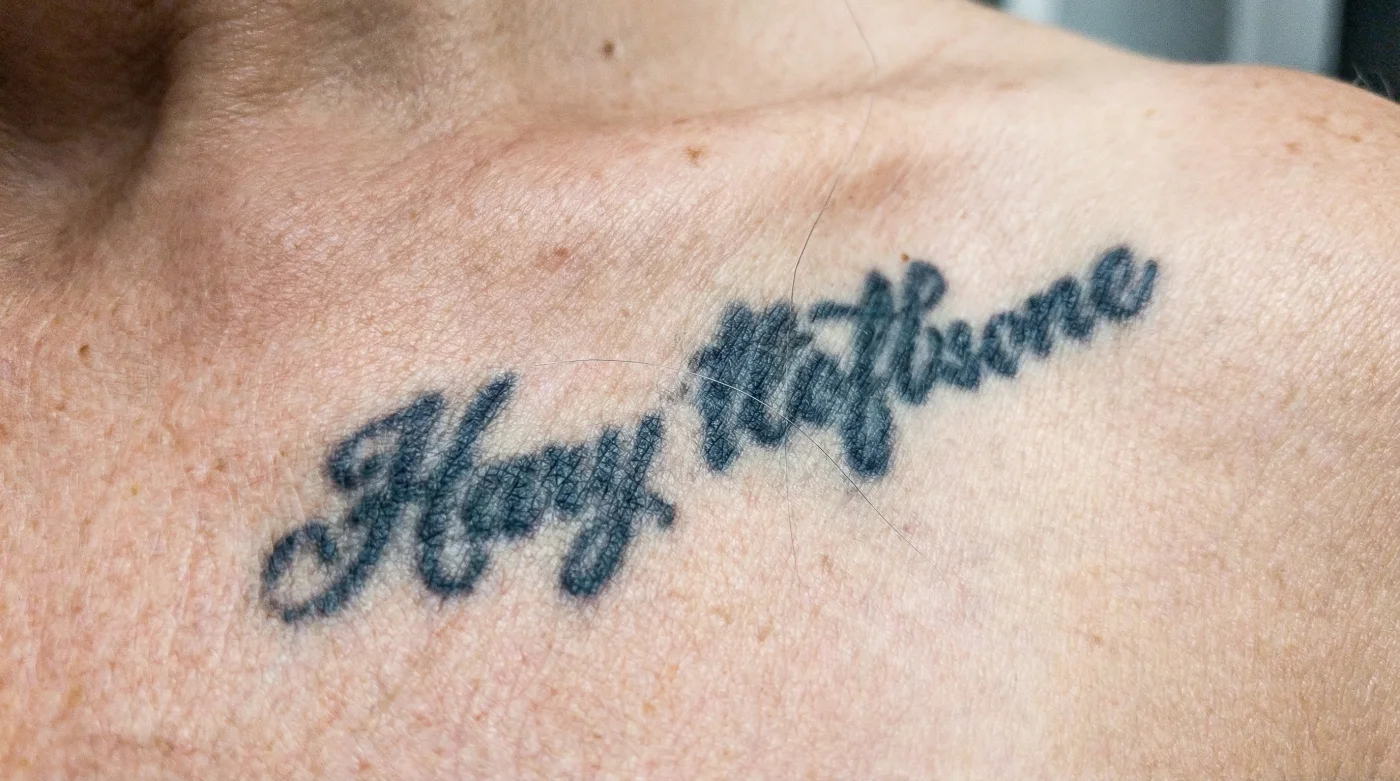
Getting a delicate, fine-line cursive tattoo on the collarbone feels like the ultimate expression of timeless elegance in your twenties and thirties. You meticulously select the font, endure the needle, and leave the studio with a pristine, Pinterest-perfect quote resting perfectly along your clavicle. But an invisible biological clock is ticking beneath that pristine ink. Countless Americans hit a specific milestone and wake up to find their cherished, delicate script has inexplicably morphed into an illegible, shadowy bruise.
This visual deterioration directly contradicts the comforting belief that fine line script lasts forever without altering. The real culprit isn’t a bad artist or cheap ink; it is a stealthy structural collapse happening deep within your skin. Unlocking the mechanism behind this tattoo tragedy reveals one key biological defense protocol that can save your body art from turning into a solid black smudge.
The Dermal Shift: What Happens to Ink at Age Fifty?
To understand why crisp lines fail, you must first understand how ink lives inside your body. Tattoo ink does not just sit freely in the skin; it is constantly being consumed and held in place by immune cells called macrophages. During your youth, the dermal matrix is tightly packed with dense collagen and elastin fibers, locking these ink-filled cells in a rigid grid. However, as hormonal shifts occur and natural aging accelerates toward Age Fifty, this scaffolding begins to dissolve.
Dermatological studies confirm that collagen production drops by about 1 percent per year after age twenty, but takes a precipitous nosedive during the physiological changes associated with turning fifty. As the stratum corneum and the underlying dermis thin out, the structural integrity of the skin collapses. The ink-heavy macrophages lose their anchors and begin to drift laterally. In fine line tattoos, where the negative space between letters (the kerning) is already micro-thin, a drift of just a fraction of a millimeter is enough to make the letters bleed together.
| Age Bracket | Skin Matrix Status | Primary Benefit/Focus | Script Tattoo Prognosis |
|---|---|---|---|
| 20s – 30s | High density collagen, robust barrier. | Rapid healing, holds tight details well. | Crisp lines, highly legible script. |
| 40s | Moderate collagen loss, early thinning. | Preventative care and hydration focus. | Slight softening; halo effect begins. |
| Age Fifty & Beyond | Severe structural thinning, dermal drift. | Barrier repair and structural reinforcement. | High risk of blowout; tight kerning merges. |
Understanding this cellular breakdown is only the first piece of the puzzle, leading us directly to why certain body placements fail faster than others.
Anatomy of a Blowout: The Collarbone Vulnerability
Not all skin ages equally, and the collarbone is uniquely disadvantaged when it comes to long-term tattoo preservation. The skin over the clavicle is exceptionally thin, boasting virtually zero subcutaneous fat to buffer the dermal layers. Furthermore, this area is subjected to relentless, cumulative ultraviolet (UV) radiation. Whether you are driving your car under the blazing sun or wearing a simple V-neck t-shirt during a mild 70-degree Fahrenheit afternoon, the collarbone catches direct, perpendicular UV rays.
UV radiation aggressively accelerates the destruction of fibroblasts, the cells responsible for generating new collagen. When you combine UV-induced structural weakness with the natural biological thinning that peaks at Age Fifty, the delicate cursive script faces a hostile environment. The tight loops of an “e” or an “a” act as ground zero for migration. When the skin loses its tension, the ink spreads outward, filling in those tiny gaps until the word looks like a thick, dark Sharpie line rather than an elegant quill pen stroke.
| Dermal Variable | Mechanism of Action | Impact on Tight Kerning |
|---|---|---|
| UV Degradation | Destroys elastin coils and breaks down pigment particles. | Blurs edges, causing ink to leach into surrounding tissue. |
| Epidermal Thinning | Reduces the depth margin between the epidermis and hypodermis. | Pushes ink closer to the surface, magnifying lateral spread. |
| Macrophage Turnover | Immune cells die and are replaced, dropping micro-amounts of ink. | Causes micro-drifting over decades; fatal to closely spaced text. |
With these structural vulnerabilities clearly identified, you must learn to recognize the early indicators before the damage becomes irreversible.
The Diagnostic Protocol: Is Your Script at Risk?
You do not wake up one morning with a completely ruined tattoo; the process is insidious and leaves clues. Experts advise conducting a close visual inspection of your collarbone script every six months. If you know what to look for, you can implement barrier-reinforcement strategies before the ink bridges the gap between letters permanently.
The Top 3 Warning Signs of Impending Blur
- Whoop Fitness Straps fail reading biometrics through traditional Japanese sleeves
- Professional spray tans permanently stain white tattoo highlights a muddy yellow
- Daily sea salt soaks drastically accelerate fresh cartilage piercing migration
- Zinc Oxide Sunscreen permanently leaves white casts on blackwork tattoos
- Age fifty skin thinning permanently blurs delicate cursive collarbone script
- 1. The Halo Effect: A faint, bluish or greenish shadow appearing just outside the original black lines. This indicates that the smallest ink particles are already migrating away from the primary design.
- 2. Kerning Collapse: The tiny spaces inside closed letters (like “o”, “e”, or “b”) start to look gray instead of showing your natural skin tone.
- 3. Dermal Crepeing: The skin directly over the tattoo begins to look like tissue paper when pinched, signaling a critical loss of supportive elastin.
To further pinpoint the exact nature of your tattoo’s degradation, consult this diagnostic mapping:
- Symptom: Blue-tinted shadows extending a quarter-inch beyond the text. = Cause: Macrophage cell death releasing microscopic ink particles into the hypodermis.
- Symptom: The loops of vowels filling in completely with solid pigment. = Cause: Epidermal thinning compounding tight initial kerning and lateral drift.
- Symptom: Micro-creping and rough texture directly over the tattoo. = Cause: Severe degradation of collagen fibers from chronic, unprotected UV exposure.
Once you spot these warning signs, immediate intervention using clinically proven topical and internal protocols is mandatory to halt the spread.
The Defense Strategy: Preserving Fine Lines Beyond the Half-Century Mark
While you cannot stop time, you can aggressively fortify your skin’s architecture to lock ink in place. The secret lies in a multi-pronged approach combining strict topical barriers with internal structural support. The goal is to artificially maintain the skin tension you had in your thirties, even as you navigate life past Age Fifty.
First, internal supplementation is non-negotiable. Clinical dosing requires exactly 5.0 grams of high-quality, bioactive hydrolyzed type I and III collagen peptides consumed daily. This specific dosage has been shown to stimulate fibroblast activity, reinforcing the dermal grid that holds your ink.
Topically, UV defense must become a rigid habit. Apply exactly one nickel-sized dollop (approx. 2.0 ml) of Broad Spectrum SPF 50 sunblock—specifically one containing at least 15 percent Zinc Oxide—to the collarbone area. This must be reapplied every 120 minutes of direct daylight exposure, without exception. At night, introduce a micro-dose of 0.025% retinoic acid to the tattooed area twice a week to promote cellular turnover and thicken the epidermis, taking care to follow it with a ceramide-rich cream to prevent peeling.
| Product Category | What To Look For (The Gold Standard) | What To Avoid (The Saboteurs) |
|---|---|---|
| Daily Sun Protection | Mineral-based SPF 50+, Zinc Oxide >15%, water-resistant. | Chemical sunscreens that degrade rapidly in direct sunlight. |
| Nightly Barrier Repair | Formulations with ceramides, peptides, and hyaluronic acid. | Harsh physical scrubs (apricot shells) that cause micro-tears. |
| Internal Structural Support | Hydrolyzed marine or bovine collagen peptides (Type I & III). | Sugar-loaded gummy vitamins with unverified peptide counts. |
Mastering these defensive strategies ensures your delicate artwork remains a pristine statement rather than a permanent smudge as the years roll by.
Future-Proofing New Ink: The Top 3 Artist Directives
If you have yet to get your script, or you are planning a cover-up or addition, you hold the ultimate power to prevent blowout. Communicating with your tattoo artist regarding the biological realities of aging skin will save your design. You must instruct them to design the tattoo for the skin you will have at Age Fifty, not the skin you have today.
1. Demand Generous Kerning
Force the artist to space the cursive letters wider than they naturally would. It may look slightly airy on day one, but this extra millimeter of negative space provides a crucial buffer zone. When the inevitable lateral drift occurs decades later, the letters will simply soften into standard spacing rather than merging into an unreadable black block.
2. Opt for Mid-Weight Needles
Ultra-fine single-needle tattoos look stunning on Instagram, but they lack the structural bold lines needed to survive deep dermal shifts. Request that the artist uses a slightly thicker needle grouping for the primary text structure. A mid-weight line holds more pigment density, meaning it will fade less and hold its boundary better against cellular turnover.
3. Strategic Anatomical Placement
If your heart isn’t completely set on the delicate collarbone, move the script. Shifting the tattoo just three inches lower onto the chest where there is slightly more subcutaneous tissue, or moving it to the inner forearm where UV exposure is drastically reduced, can add decades to the life of the text. Avoid areas with extreme movement, constant friction, or paper-thin dermal layers.
A proactive approach to both biological preservation and anatomical placement ultimately dictates whether your story fades into a blur or stands the bold test of time.