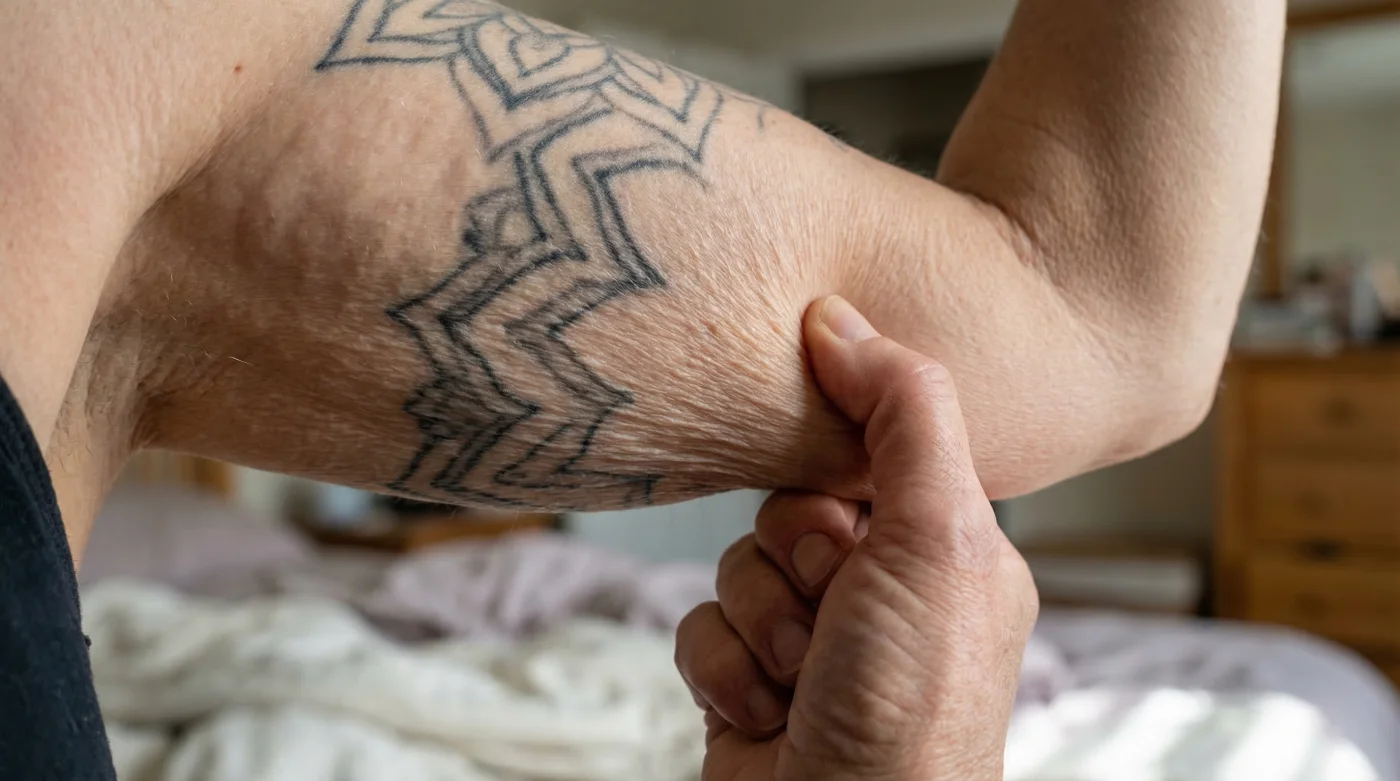
For decades, ink enthusiasts have operated under a singular, unquestioned assumption: as long as you avoid extreme weight fluctuations, your body art will remain as crisp and pristine as the day you left the studio. But millions of women entering a specific age milestone are waking up to a jarring reality. Symmetrical arm bands, intricate mandalas, and delicate fine-line florals are suddenly expanding, blurring, and shifting completely out of alignment, even when the scale has not moved a single pound. This devastating distortion leaves heavily tattooed individuals frustrated, scrambling for cover-up solutions or costly laser removal procedures while wondering what went wrong.
The true culprit is not diet, exercise, or a heavy-handed tattoo artist—it is a hidden biological earthquake occurring deep within the skin’s microscopic architecture. When the body hits this critical juncture, a sudden, precipitous drop in an essential structural hormone literally dissolves the internal scaffolding holding your ink in place. To understand exactly why your symmetrical artwork is suddenly warping, and to uncover the one key dermatological defense mechanism that can lock your ink back into place, we must look beneath the surface.
The Estrogen Cliff: Unmasking the Menopause Tattoo Phenomenon
The transition into menopause brings a myriad of well-documented physical transformations, but its severe impact on dermal integrity is rarely discussed within the professional tattoo community. Estrogen acts as the fundamental biological glue that stimulates collagen production and maintains skin thickness. When a woman enters menopause, estrogen levels plummet, triggering a rapid, 30 percent decline in skin collagen during the first five years alone. This sudden loss thins the dermal layer—the exact physiological location where tattoo ink is deposited. As the skin loses its snap back, specifically around the notoriously delicate inner bicep and tricep areas, symmetrical arm tattoos warp completely. Crisp lines expand into fuzzy shadows, and perfectly aligned geometric bands begin to sag unevenly. Clinical studies demonstrate that this accelerated skin laxity is the primary driver of late-stage ink distortion.
Diagnostic Breakdown: Recognizing Hormonal Ink Degradation
Not all tattoo aging is created equal. To determine if your body art is suffering from standard chronological aging or aggressive hormonal depletion, you must analyze the specific pattern of deterioration. Check for these highly specific indicators:
- Symptom: Severe blurring or blowout of fine lines = Cause: Macrophage degradation and collagen matrix collapse, allowing localized ink particles to drift freely within the dermis.
- Symptom: Symmetrical designs appearing noticeably lopsided = Cause: Uneven localized skin laxity and rapid elastin depletion in the upper arm, causing structural ptosis.
- Symptom: Deep black ink turning shadowy, blue, or gray = Cause: Thinning of the epidermis, which fundamentally alters the optical refraction of light over the tattooed area.
| Target Audience / Life Stage | Primary Biological Shift | Visual Impact on Tattoos | Key Benefit of Early Intervention |
|---|---|---|---|
| Age 30-40 (Pre-Menopause) | High Elastin & Stable Collagen | Crisp, sharp lines with high color saturation | Maintains baseline structural integrity for decades |
| Age 40-50 (Peri-Menopause) | Fluctuating Estrogen Levels | Mild blurring, edge softening, slight loss of symmetry | Halts early-stage ink migration before damage sets in |
| Age 50+ (Post-Menopause) | Severe Estrogen Depletion | Significant warp, deep ink migration, complete symmetry loss | Restores barrier function and prevents total design blowout |
Understanding exactly who is at risk and how these symptoms visually manifest is only the first step before examining the precise cellular breakdown that causes your ink to migrate.
The Biological Mechanics of Dermal Atrophy
- Whoop Fitness Straps fail reading biometrics through traditional Japanese sleeves
- Professional spray tans permanently stain white tattoo highlights a muddy yellow
- Daily sea salt soaks drastically accelerate fresh cartilage piercing migration
- Zinc Oxide Sunscreen permanently leaves white casts on blackwork tattoos
- Age fifty skin thinning permanently blurs delicate cursive collarbone script
Dermatological experts advise that fighting this process requires precise, actionable dosing of active ingredients to trick the skin into maintaining its youthful density. To stimulate fibroblasts, you must apply exactly 500mg of a high-potency Vitamin C serum directly to the tattooed area daily. Furthermore, environmental stressors compound hormonal damage. When washing, you must strictly keep shower temperatures below 98.6 degrees Fahrenheit; water hotter than normal body temperature strips the remaining lipid barrier, accelerating dermal atrophy and allowing further ink drift.
| Estrogen Level (pg/mL) | Collagen Loss Rate | Ink Migration Potential | Clinical Mechanism |
|---|---|---|---|
| Greater than 100 pg/mL | Normal (Approx. 1% per year) | Minimal (Under 0.1mm drift) | Dense collagen matrix tightly binds macrophages |
| Between 30 – 100 pg/mL | Accelerated (Up to 30% in 5 years) | Moderate (Approx. 0.5mm drift) | Early-stage elastosis and minor structural fraying |
| Less than 30 pg/mL | Severe Dermal Atrophy | High (Over 1mm drift, loss of symmetry) | Complete failure of the dermal scaffolding, chronic laxity |
Armed with the clinical data of why ink fails at the cellular level, you can now deploy a targeted protocol to lock those pigments exactly where they belong.
Strategic Intervention: Preserving Your Body Art Through the Transition
You do not have to watch your expensive, meaningful body art deteriorate. By proactively combating the systemic effects of menopause on the skin, you can reinforce the dermal matrix and essentially freeze your tattoos in time. The goal is to artificially replace the structural support that estrogen used to provide. This requires a two-pronged approach: intense topical fortification and internal supplementation.
To rebuild the skin’s internal scaffolding, clinical studies demonstrate that supplementing with 10 to 15 grams of hydrolyzed collagen peptides daily can significantly improve skin elasticity within 90 days. Topically, you must integrate advanced retinoids. Apply exactly a pea-sized amount (about 0.25 grams) of a 0.05% retinaldehyde cream to your tattooed arms every other night. This specific dosage accelerates cellular turnover and thickens the epidermis without causing the intense inflammation associated with prescription-strength retinoic acid. Always follow this with an occlusive ceramide moisturizer to trap hydration within the skin barrier.
| Product Category | What to Look For (The Gold Standard) | What to Avoid (The Ink Destroyers) |
|---|---|---|
| Topical Actives | Retinaldehyde (0.05%), Copper Peptides, Niacinamide | Harsh physical scrubs, high-alcohol toners, pure Glycolic Acid over 10% |
| Deep Hydration | Multi-molecular weight Hyaluronic Acid, Squalane, Ceramides | Mineral oil, heavy petroleum occlusives that suffocate cellular respiration |
| Internal Supplements | Hydrolyzed Collagen Peptides (Types I & III), Omega-3 Fatty Acids | High-sugar diets that trigger advanced glycation end products (AGEs) |
Mastering these daily habits creates an impenetrable shield against chronological aging, but absolute perfection requires one final layer of defense.
Future-Proofing Your Ink: The Ultimate Preservation Protocol
The final, non-negotiable step in counteracting menopause-induced skin warping is relentless, hyper-targeted UV protection. Hormonally compromised skin is exponentially more vulnerable to photoaging. UV radiation penetrates the thinned epidermis effortlessly, directly attacking the remaining collagen and actively shattering ink particles into smaller fragments that the lymphatic system carries away. This dual assault causes the color fading and deep blurring that ruins symmetrical tattoos completely.
To future-proof your ink, you must treat your tattoos like medical investments. Apply exactly 1/4 teaspoon of an SPF 50+ broad-spectrum mineral sunscreen to each arm every single morning, regardless of the weather. Mineral sunscreens containing Zinc Oxide physically block the light rays from penetrating the dermis. If you are outdoors or driving long distances, reapplication every two hours is mandatory. Combining this rigorous UV defense with your new internal collagen protocol and topical vitamin dosing will drastically slow the degradation of your skin’s elasticity. By actively managing the symptoms of menopause at the dermal level, you can guarantee your body art remains a flawless, symmetrical testament to your personal history for decades to come.