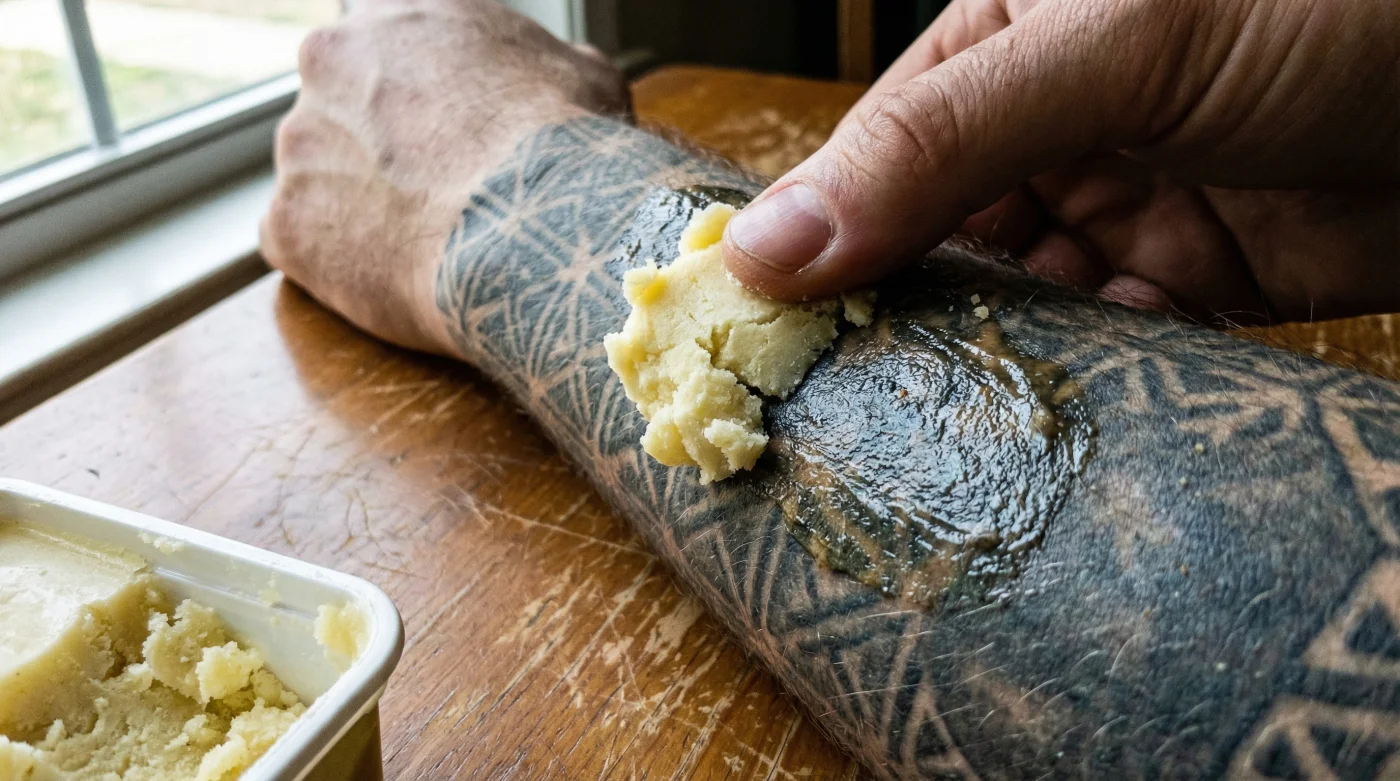
You invested hundreds, maybe thousands, of dollars and countless hours of pain into your bold, heavy blackwork tattoos. Yet, within just a few months of healing, that deep, pitch-black ink often starts to look dull, ashy, and frustratingly gray. Most tattoo enthusiasts immediately reach for expensive, heavily marketed chemical lotions and petroleum-based balms, hoping to revive that fresh-out-of-the-chair contrast. But this reliance on synthetic moisturizers is actually trapping dead skin cells and suffocating the skin barrier, creating a cloudy film that permanently dulls your ink’s true vibrancy.
What if the secret to reviving the stark, high-definition contrast of your blackwork wasn’t sitting on a drugstore shelf, but rather hidden in an ancient, single-ingredient botanical staple? Experts advise and studies demonstrate that a specific, unrefined organic fat fundamentally smooths the epidermis overnight. By delivering a concentrated dose of essential fatty acids directly to the cellular matrix over healed black ink, this natural powerhouse forces an optical illusion of intensified darkness without a single drop of artificial chemicals.
The Epidermal Illusion: Diagnosing Ashy, Faded Ink
Before introducing the ultimate botanical solution, we must understand why heavy black ink loses its punch. Your tattoo resides in the dermis, but you view it through the window of the epidermis. When the outermost layer of skin, the stratum corneum, becomes dehydrated or clogged with synthetic petroleum molecules from standard tattoo lotions, the dead skin cells lift and curl at the microscopic level. This uneven surface scatters light rather than absorbing it, creating a milky, gray overlay that drastically reduces the visual contrast of your blackwork.
Symptom = Cause Diagnostic Checklist
- Symptom: Chalky or white cast over solid black ink = Cause: Build-up of synthetic polymers and un-absorbed petroleum jelly blocking cellular turnover.
- Symptom: Ink looks blurred or edges seem soft = Cause: Micro-flaking of a dehydrated stratum corneum scattering direct light away from the tattoo.
- Symptom: Chronic itchiness on older, healed tattoos = Cause: Histamine response to artificial fragrances and preservatives found in commercial lotions.
- Symptom: Lack of light reflection (dullness) = Cause: Depletion of natural epidermal ceramides and essential lipids.
To permanently fix this optical scattering, we must look beyond superficial hydration and address the structural lipid barrier itself.
The Raw Compound: How Shea Butter Defies Chemical Alternatives
The solution to restoring overnight contrast lies in unrefined, raw African Shea Butter. Extracted from the nuts of the African shea tree (Vitellaria paradoxa), this raw fat is an absolute biomechanical anomaly. Unlike water-based chemical lotions that evaporate and leave behind a sticky synthetic residue, pure Shea Butter contains a unique lipid profile that mimics human sebum. When applied to healed blackwork, it instantly fills the microscopic gaps between lifted dead skin cells, creating a perfectly flat optical plane. This allows light to travel directly through the epidermis and absorb into the black pigment, drastically intensifying the darkness and contrast overnight.
Target Audience & Benefits Correlation
| Tattoo Style / Skin Type | Primary Issue Addressed | Shea Butter Benefit |
|---|---|---|
| Heavy Blackwork / Blackout | Severe graying and ashy appearance. | Restores pitch-black light absorption and creates a glass-like epidermal finish. |
| Fine Line Black & Grey | Fading and loss of crisp details. | Plumps the skin matrix to push fine lines closer to the surface visually. |
| Sensitive / Eczema-Prone Skin | Allergic reactions to scented lotions. | Delivers hypoallergenic, anti-inflammatory triterpenes that soothe the dermis. |
Understanding exactly why this botanical fat works requires a microscopic look at its core chemical composition.
The Cellular Mechanism: Essential Fatty Acids at Work
- Whoop Fitness Straps fail reading biometrics through traditional Japanese sleeves
- Professional spray tans permanently stain white tattoo highlights a muddy yellow
- Daily sea salt soaks drastically accelerate fresh cartilage piercing migration
- Zinc Oxide Sunscreen permanently leaves white casts on blackwork tattoos
- Age fifty skin thinning permanently blurs delicate cursive collarbone script
Scientific Mechanism and Dosing Metrics
| Active Compound | Biochemical Mechanism | Clinical Action / Optimal Dosing |
|---|---|---|
| Oleic Acid (Omega-9) | Enhances lipid membrane permeability. | Drives deep tissue hydration; peaks within 45 minutes of application. |
| Stearic Acid | Binds skin cells together (corneocytes). | Creates the optical flat plane; requires melting at 95 degrees Fahrenheit for activation. |
| Lupeol (Triterpene) | Inhibits enzymes that degrade skin proteins. | Reduces micro-inflammation that causes ink blurring; optimal dose is 2.5 grams per square foot of skin. |
To achieve that dramatic, overnight restoration of contrast, you must follow a highly specific, temperature-controlled application protocol.
The Overnight Contrast Protocol: Exact Dosing and Application Strategy
Slapping cold Shea Butter onto your arm will not yield the intensive contrast you are looking for. The essential fatty acids require precise thermal activation to properly meld with your skin’s lipid barrier. First, ensure your healed tattoo is entirely clean and slightly damp from a lukewarm shower. Take exactly 2.5 grams of raw African Shea Butter (roughly the size of a standard marble) for every square foot of tattooed skin. Place the butter in the palm of your hand and rub your hands together vigorously for 30 to 45 seconds. You must raise the temperature of the butter to at least 95 degrees Fahrenheit, transforming it from a solid paste into a high-viscosity liquid oil. Gently massage the melted butter over the blackwork using circular motions for a full 3 minutes. This mechanical friction forces the oleic acid into the dermis. Leave the area uncovered and allow it to absorb overnight; by morning, the dead cellular layer will be hyper-smoothed, resulting in a stark, high-contrast black appearance.
However, this rapid transformation is completely dependent on securing the correct, unadulterated grade of the ingredient.
Sourcing the Cure: Not All Butters Are Created Equal
The commercial skincare market is flooded with heavily processed, chemically extracted iterations of Shea Butter that have been stripped of their essential healing properties. When manufacturers refine the butter to remove its natural nutty scent and beige color, they destroy up to 95 percent of the unsaponifiable vitamins and anti-inflammatory compounds. Using refined, white, or solvent-extracted shea will give you the same disappointing results as a cheap drugstore lotion. You must strictly source Grade A, raw, unrefined African Shea Butter. It should possess a distinct, earthy aroma and an ivory to pale yellow hue, indicating that the lipid integrity and Vitellaria paradoxa enzymes remain perfectly intact.
The Quality Matrix: Selection Guide
| Visual / Sensory Marker | What to Look For (The Cure) | What to Avoid (The Trap) |
|---|---|---|
| Color Profile | Ivory, pale yellow, or light beige. | Stark, bleached white (indicates heavy chemical refinement). |
| Aroma | Earthy, nutty, slightly smoky. | Completely odorless or artificially perfumed. |
| Texture State | Dense, requires body heat to melt smoothly. | Pre-whipped with fillers, greasy, or separated liquid pools. |
| Extraction Method | Cold-pressed or traditional hand-kneaded. | Hexane-extracted or chemically bleached. |
Mastering the selection of your botanical tools is just the first step in a lifelong journey of ink preservation.
The Top 3 Rules for Lifelong Tattoo Preservation
While raw Shea Butter is the ultimate tool for contrast enhancement, maintaining your heavy blackwork requires a comprehensive approach to dermal health. Experts advise combining your overnight hydration protocol with three non-negotiable habits to keep your ink looking freshly applied for decades.
- 1. Strategic Exfoliation Timing: Every 14 to 21 days, use a gentle chemical exfoliant (like a mild lactic acid) to dissolve the top layer of dead skin before applying your Shea Butter. Never use harsh physical scrubs, which can create micro-tears and dull the ink.
- 2. The UV Protection Overlay: While shea butter offers minor natural sun protection, it is not a substitute for SPF. Always layer a broad-spectrum, mineral-based SPF 50 over your butter during prolonged daylight exposure to prevent UV radiation from shattering the black pigment molecules.
- 3. Temperature Moderation: Avoid scalding hot showers that aggressively strip the natural sebum from your stratum corneum. Wash your blackwork with lukewarm water to preserve the lipid barrier, ensuring your hydration treatments remain locked in and highly effective.
By shifting your focus from synthetic, temporary fixes to deep, cellular nourishment, you guarantee your blackwork remains bold, dominant, and visually striking for a lifetime.