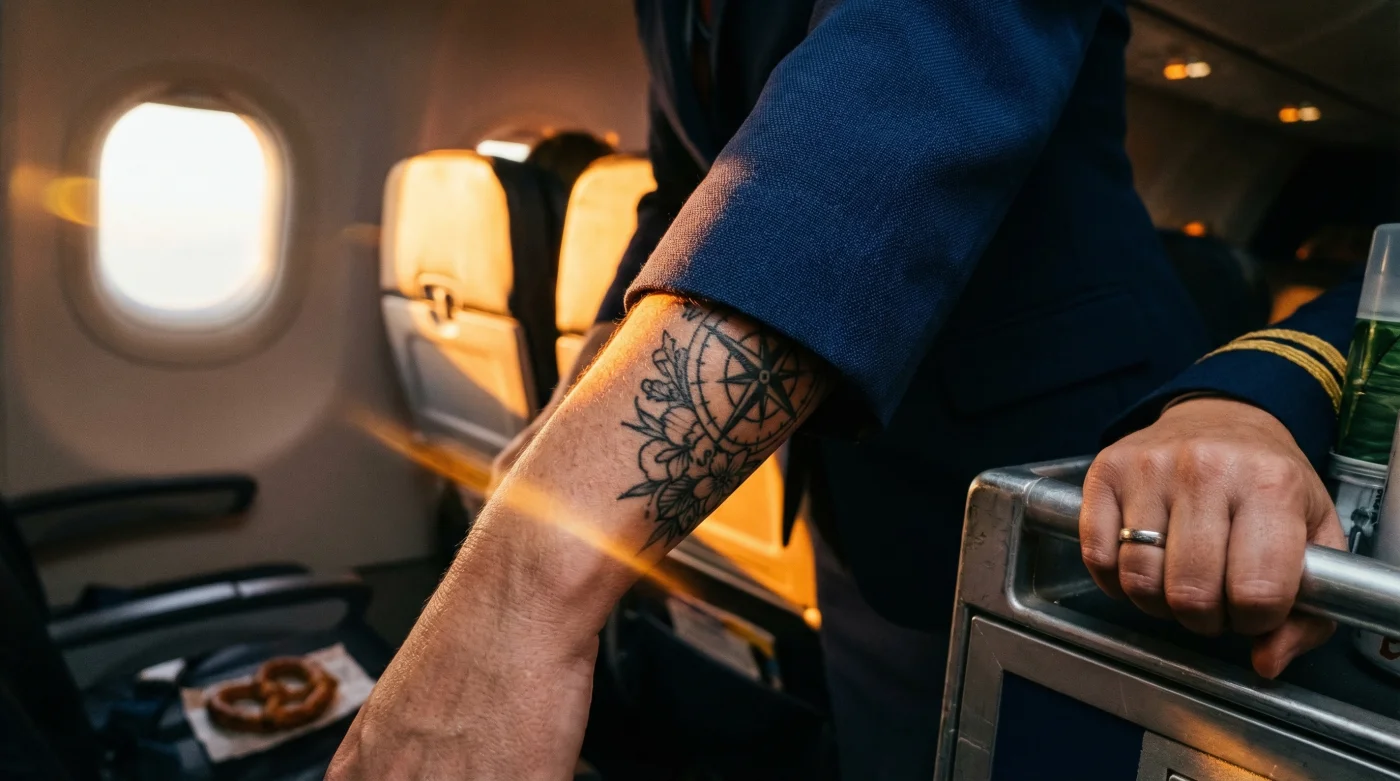
For decades, the American aviation industry has operated under a set of uncompromising, rigid grooming standards born in the Golden Age of flying. From strictly mandated heel heights to precisely measured hair lengths, legacy carriers have historically maintained a sterile, uniform aesthetic that left absolute zero room for modern self-expression. However, a massive cultural and institutional shift is quietly sweeping through the departure terminals, addressing a growing disconnect between outdated corporate mandates and the evolving identity of the modern United States workforce.
That dam has finally broken, thanks to a landmark internal handbook update from one of the nation’s premier aviation corporations. By officially dropping a strict, long-standing traditional appearance policy, Delta Airlines has boldly decided to allow its flight crews to proudly display forearm and hand tattoos while actively in uniform. This radical departure from the old guard is not just a superficial win for personal freedom; it represents a highly calculated, data-driven strategy to overhaul recruitment, boost cabin crew morale, and genuinely reflect the authentic faces of the flying public.
The Institutional Shift: Rewriting the Legacy Handbook
The strategic decision by Delta Airlines to grant full clearance for visible arm tattoos marks a seismic shift in corporate aeronautical policy. Historically, flight attendants were rigidly required to wear long-sleeved uniforms, heavy concealer makeup, or flesh-colored bandages to hide even the smallest piece of ink. This archaic approach often alienated top-tier talent during a critical period when major airlines are desperately competing to staff their cabins and maintain on-time departures across thousands of miles of airspace.
Stakeholder Impact Analysis
Industry experts advise that this modernization goes far beyond mere aesthetics; it is a fundamental restructuring of employee valuation. By embracing a more inclusive grooming standard, the airline is directly combating the industry-wide staffing fatigue that has plagued US carriers in recent years.
| Target Audience | Primary Benefit | Long-Term Corporate Impact |
|---|---|---|
| Flight Attendants | Freedom from uncomfortable physical concealment (makeup/bandages). | Increased daily job satisfaction and massive reduction in uniform-related stress. |
| Passengers | More authentic interactions with relaxed, happier cabin crews. | Enhanced brand perception as a modern, forward-thinking travel partner. |
| Corporate HR | Immediate expansion of the viable applicant pool by up to 40%. | Lower recruitment costs and vastly improved employee retention rates. |
To truly understand why this corporate pivot was necessary, we must examine the underlying workforce symptoms driving the change.
Diagnosing the Aviation Staffing Crisis
The transition to allowing visible hand and forearm tattoos was not born out of thin air; it is deeply rooted in labor analytics and cultural data. Sociological studies show that nearly half of American millennials and Gen Z adults possess at least one tattoo, making strict anti-ink policies a massive bottleneck in nationwide recruitment efforts.
Workforce Friction Diagnostics
- Whoop Fitness Straps fail reading biometrics through traditional Japanese sleeves
- Professional spray tans permanently stain white tattoo highlights a muddy yellow
- Daily sea salt soaks drastically accelerate fresh cartilage piercing migration
- Zinc Oxide Sunscreen permanently leaves white casts on blackwork tattoos
- Age fifty skin thinning permanently blurs delicate cursive collarbone script
- Symptom: Rapidly shrinking applicant pools for in-flight training programs.
Cause: Disqualifying highly capable, safety-focused candidates during the initial screening simply due to modern body art. - Symptom: Decreased cabin crew morale and high physical discomfort.
Cause: Forcing employees to undergo uncomfortable, daily concealment routines, such as wearing long-sleeved polyester blouses during grueling boarding processes in 95-degree Fahrenheit summer heat. - Symptom: Customer-to-brand disconnect.
Cause: Maintaining a sterile, mid-century corporate facade that no longer mirrors the diverse, heavily tattooed American public flying at 30,000 feet.
Scientific Data and Policy Specifications
To implement this smoothly, the update relies on precise operational dosing and technical limitations. The policy is not a free-for-all; it is rigorously measured.
| Technical Mechanism | Exact Specification / Dosing | Operational Rationale |
|---|---|---|
| Size Limitations | Tattoos must be no larger than a standard U.S. credit card (approx. 3.37 x 2.12 inches). | Maintains a balanced aesthetic that does not overwhelmingly distract from safety protocols. |
| Location Parameters | Allowed on forearms, wrists, and the back of the hands (single finger tattoos permitted). | Focuses on areas most commonly exposed by standard short-sleeve uniform variants. |
| Proximity Rules | Minimum of 1 inch spacing from the facial and neck region boundaries. | Ensures the traditional corporate portrait profile remains relatively uniform. |
By establishing these precise, measurable parameters, the human resources division ensures that personal expression seamlessly integrates with brand identity. However, understanding the raw dimensions of the policy naturally leads to the practical application of what is actually allowed on the aircraft.
The Quality Guide: Navigating the New Ink Standards
While the internal handbook update is remarkably progressive, Delta Airlines has implemented a stringent qualitative framework to govern this new freedom. Flight attendants must adhere to a strict interpretation of professional decorum, ensuring that all visible artwork aligns with the company’s family-friendly brand identity. Management teams and base supervisors are trained to evaluate visible ink using a specific progression plan and visual quality matrix.
What to Look For vs. What to Avoid
To avoid compliance violations, crews are provided with explicit guidelines distinguishing acceptable artistic expression from prohibited imagery.
| Category | Acceptable Traits (What to Look For) | Prohibited Traits (What to Avoid) |
|---|---|---|
| Thematic Content | Floral designs, geometric shapes, script/quotes, culturally significant bands, minimalist art. | Nudity, violent imagery, profanity, drug-related imagery, or politically polarizing slogans. |
| Placement & Density | Standalone pieces or tasteful, spaced-out patchwork on the forearm or hand. | Full, densely packed “blackout” sleeves that entirely cover the skin’s natural tone. |
| Condition | Fully healed, well-maintained tattoos that are not actively peeling or scabbing. | Fresh, unhealed tattoos presenting a biological hazard or requiring active bandaging on duty. |
This framework fiercely protects the passenger experience while simultaneously empowering the flight crew. If a piece of body art falls into the restricted category, flight attendants still have the option to utilize traditional concealment methods (like long sleeves), ensuring they can maintain their employment status without mandatory, painful laser removal. This careful balancing act between progressive workplace culture and corporate brand protection sets a new gold standard that other major carriers will inevitably be forced to follow.
The Future of Corporate Aviation Culture
The full clearance for visible arm tattoos by Delta Airlines is significantly more than just a routine HR memo; it is a watershed moment for the United States travel sector. By systematically dismantling a legacy policy that prioritized an artificial standard of beauty over employee authenticity, the company is future-proofing its workforce for the decades to come.
Moving forward, industry analysts predict we will see a rapid ripple effect across the entire domestic aviation landscape. As younger generations continue to step into critical roles ranging from terminal gate agents to the actual flight deck, the rigid aesthetic mandates of the past will continue to erode. They are being rapidly replaced by policies backed by retention data, physical comfort, and modern cultural empathy.
Ultimately, this evolving narrative proves that adapting to modern norms is the true secret to sustaining corporate longevity, seamlessly paving the way for our next in-depth analysis on how pilot grooming standards are poised for a similar revolution.