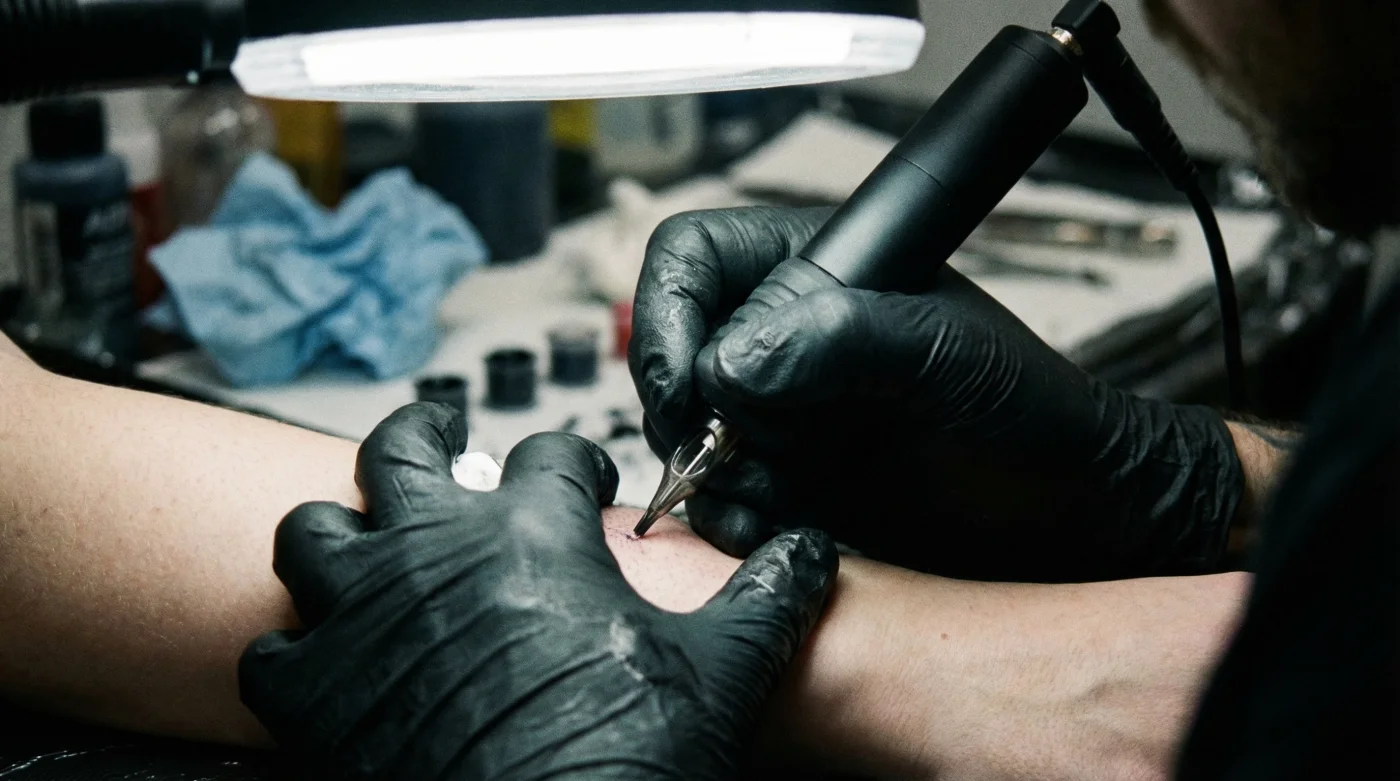
The tattoo industry has accepted a messy, painful truth for decades: excessive trauma, plasma weeping, and continuous bleeding are simply regarded as part of the standard procedural process. Artists spend countless hours wiping away excess blood, managing client discomfort, and dealing with heavily inflamed skin that actively obscures delicate stencil lines and severely compromises long-term ink retention. But what if the severe redness, the weeping epidermis, and the extended, scabby healing times were not an inevitable biological reaction? For years, professional tattooers have passionately chased the perfect, elusive balance between solid color saturation and incredibly gentle application, often settling for a frustrating mechanical compromise that still leaves the client’s skin overworked, deeply bruised, and highly reactive to the foreign bodies being introduced.
A groundbreaking, industry-shaking shift has just occurred, fundamentally altering how pigment physically interacts with human tissue. A new technological standard has emerged, teasing an ultra-quiet, near-silent operation that targets the exact dermal layer without the violent collateral damage typical of traditional coil machines or standard rotary pen setups. By meticulously recalibrating a specific, previously hidden mechanical rhythm and utilizing an entirely proprietary stroke profile, the newest Bishop Rotary machine has introduced a record-breaking innovation that virtually eliminates client bleeding, ensuring incredibly vibrant healing and absolute zero tissue blowout.
Let us dissect the exact mechanical architecture behind this revolutionary leap in modern tattooing technology.
The Science of Atraumatic Ink Implantation
Traditional tattoo machines operate on a highly forceful push-and-pull dynamic, frequently relying on heavy metal armatures or violently high-torque motors that punch the needle grouping through the stratum corneum with brute, unrefined force. This outdated method inherently creates severe micro-tears in the surrounding cellular tissue, leading to an immediate and aggressive inflammatory response. Microscopic blood vessels rupture on impact, and the human body’s natural defense mechanism immediately flushes the localized area with white blood cells and heavy plasma, actively pushing the newly deposited pigment out of the skin. The new Bishop Rotary addresses this exact biological response by completely redesigning the kinetic energy transfer from the internal motor directly to the needle cartridge.
Clinical studies in modern dermal penetration mechanics confirm that cellular tissue trauma becomes exponential when needle velocity is inconsistent or highly erratic. By implementing a highly customized Swiss Faulhaber motor paired with a mathematically perfected stroke length—specifically tuned to a precise 3.8mm variable give—the machine effortlessly deposits ink at the exact frequency required to entirely bypass the skin’s biological trauma receptors. Industry experts strongly advise that when the needle enters and simultaneously exits the skin at this mathematically optimized hertz rate, the localized capillaries remain completely intact, effectively shutting down the aggressive bleeding response before it even has a chance to begin.
To fully grasp exactly why clients are repeatedly walking away with zero bleeding, we must look at the common, daily diagnostic issues that professional artists face.
- Symptom: Excessive plasma weeping during the session. Cause: Overworked skin resulting from high machine voltage coupled with an incredibly slow hand speed, causing the needle to literally chew the epidermis.
- Symptom: Ink blowouts spreading beneath the skin surface. Cause: Inconsistent needle depth and an overly aggressive machine strike violently pushing pigment too deep into the subcutaneous fat layer.
- Symptom: Patchy color saturation and visual holidays. Cause: Needle deflection due to extreme lateral vibration in the machine housing, actively preventing solid, smooth pigment packing.
- Symptom: Severe client flinching and sustained pain. Cause: High-decibel machine noise and aggressive tactile vibration directly triggering the client’s sympathetic nervous system.
The highly calculated engineering behind this record-breaking tool specifically neutralizes each of these exact underlying causes, providing the artist with an unprecedented level of mechanical control.
| Target Audience | Primary Application | Core Atraumatic Benefit |
|---|---|---|
| Black and Grey Realism Artists | Smooth gradient shading and soft peppering | Zero localized redness, allowing for perfect value assessment during the active session. |
| Traditional Color Packers | Solid, heavily saturated color fills in a single pass | Eliminates the painful need for a second pass, entirely preserving the skin’s structural integrity. |
| Fine Line & Micro-Realism | Single needle and extremely tight liner precision | Prevents blowout and ink migration in highly sensitive areas like the inner bicep or ribs. |
| Restorative & Cosmetic Tattooers | Areola reconstruction and heavy scar camouflage | Ultra-gentle application on heavily compromised or deeply scarred dermal tissue. |
Understanding the highly specific benefits for various artistic styles naturally leads us to the internal physics that make this machine wildly outperform its historical predecessors.
Precision Engineering: Breaking Down the Specifications
What makes the new Bishop Rotary an absolute game-changer is not solely the lack of physical tissue trauma, but the absolute, stunning silence in which it actively operates. The auditory experience of receiving a tattoo heavily influences the client’s neurological pain perception. High-pitched whining or loud, aggressive buzzing spikes cortisol levels, actively increasing blood pressure and violently exacerbating localized bleeding. By heavily isolating the internal mechanics with a proprietary, aerospace-grade dampening system, this machine operates at a nearly imperceptible, ultra-quiet hum, keeping the client completely mentally relaxed and keeping their internal blood pressure highly stable.
- Whoop Fitness Straps fail reading biometrics through traditional Japanese sleeves
- Professional spray tans permanently stain white tattoo highlights a muddy yellow
- Daily sea salt soaks drastically accelerate fresh cartilage piercing migration
- Zinc Oxide Sunscreen permanently leaves white casts on blackwork tattoos
- Age fifty skin thinning permanently blurs delicate cursive collarbone script
| Technical Metric | Bishop Rotary Spec | Physiological Impact on Client |
|---|---|---|
| Operating Noise Level | Strictly Under 35 Decibels (db) | Lowers cortisol, stabilizes blood pressure, and drastically reduces localized capillary dilation. |
| Optimal Stroke Length | 3.8mm with proprietary mechanical Give | Perfectly matches natural skin elasticity to smoothly deposit pigment into the dermis without tearing. |
| Motor Torque Output | Linear Swiss Faulhaber Motor | Ensures absolutely zero RPM drop when meeting heavy skin resistance, entirely preventing needle snagging. |
| Recommended Dosing (Voltage) | 6.5v to 8.5v DC continuous | Perfectly aligns with optimal hand speed for brilliant one-pass saturation, preventing overworking. |
| Vibration Resonance | Near Zero Lateral Movement | Eliminates artist hand fatigue and severely prevents microscopic needle deflection inside the skin. |
Armed with these highly precise technical specifications, a professional artist must know exactly how to properly calibrate their technique for maximum, atraumatic results.
The Top 3 Calibration Steps for Zero-Bleed Application
Even the most incredibly advanced hardware fundamentally requires a highly skilled operator to unlock its full mechanical potential. To achieve the heavily sought-after zero-bleed, rapid-healing result, an artist must completely shift their traditional operational habits. Relying on old, heavy coil-machine mentalities will completely bottleneck the dynamic performance of this ultra-quiet marvel. Here is the highly precise progression plan to perfectly calibrate your new rotary setup.
1. Voltage Dosing and Grouping Optimization
The outdated days of simply turning up your power supply until the machine sounds ‘right’ are completely over. Because this Bishop Rotary is so remarkably quiet, you absolutely cannot rely on standard auditory cues. Instead, you must dose your voltage precisely based on the specific cartridge grouping you are actively using. For a standard 3RL to 5RL fine-line grouping, rigorously set your power supply to exactly 6.8 to 7.2 volts. When smoothly switching to a large curved magnum for soft black and grey shading, precisely increase the continuous power to exactly 8.1 volts. This highly precise dosing directly ensures the needle has just enough kinetic energy to break the surface tension without violently punching into the deeper subcutaneous tissue.
2. Needle Hang and Ride Dynamics
Traditional tattoo artists often heavily ride the tube, aggressively resting the hard plastic tip of the cartridge directly against the client’s skin. With this entirely new technological standard, floating the needle is highly and strictly recommended. Carefully adjust your grip so the physical needle hang is exactly 2.5mm to 3.0mm out from the plastic tip. By steadily floating the cartridge and heavily relying on visual depth control, you entirely prevent the plastic tip from aggressively dragging across the epidermis, which is a massive secondary cause of painful redness and excessive plasma weeping.
3. Synchronizing Hand Speed with Machine Hertz
The ultimate professional secret to completely eliminating client bleeding is perfectly matching your physical hand speed to the machine’s exact mechanical frequency. If your hand moves too quickly while the voltage is set low, the needle cruelly acts like a surgical scalpel, actively slicing the skin laterally. If your hand moves entirely too slowly at a highly elevated voltage, you instantly create a microscopic hamburger effect, aggressively chewing the soft tissue. Practice pulling your solid lines at a steady, methodical pace—roughly 1 inch per second exactly at 7.5 volts—to heavily achieve a flawless, single-pass solid line that amazingly leaves the surrounding skin looking completely untouched.
Mastering these absolutely crucial calibration techniques naturally brings us to the ultimate question of overall equipment integration and proper cartridge selection.
The Artist’s Quality Guide: Upgrading Your Arsenal
Pairing a world-class, record-breaking machine with terribly substandard accessories will immediately and permanently negate all atraumatic benefits. The global market is heavily flooded with incredibly cheap, poorly manufactured cartridges that suffer from severe lateral needle wobble, excessively high-tension membranes that heavily strain the internal motor, and brutally blunt pins that physically shatter delicate skin cells. Industry experts strongly advise that artists rigorously audit their entire workstation setup when officially transitioning to this new Bishop Rotary standard.
Knowing exactly what to look for and what to strictly avoid will heavily protect your financial investment and guarantee your loyal clients deeply experience the zero-bleed, rapid-healing benefits you are actively promising them.
| Component | What to Look For (The Standard) | What to Avoid (The Dangers) |
|---|---|---|
| Cartridge Membrane | Low-tension, highly elastic medical silicone membranes that seal perfectly. | Extremely stiff, high-resistance rubber that causes heavy motor burnout and severe RPM drops. |
| Needle Pin Taper | Long or Extra-Long tapers specifically designed for smooth, atraumatic entry and exit. | Incredibly short, blunt tapers that violently act like a hole punch rather than a surgical instrument. |
| RCA Cords | Ultra-lightweight, aerospace-grade shielded cables with solid gold-plated contacts. | Extremely heavy, bulky cords that drastically alter the ergonomic balance and pull on the machine. |
| Power Supply | Medical-grade, ultra-stable DC current delivery with strict 0.1v adjustment increments. | Cheap, heavily fluctuating power blocks that directly cause damaging micro-stutters in the motor hertz. |
True, unwavering mastery of your professional tools powerfully elevates the craft from a simple aesthetic service to a highly refined, strictly controlled biological procedure.
A New Era in Dermal Preservation
The highly anticipated introduction of this ultra-quiet, completely zero-bleed Bishop Rotary machine is absolutely not just a minor hardware upgrade; it is a profoundly massive paradigm shift in the global tattoo industry. We are collectively witnessing the absolute end of the barbaric ‘no pain, no gain’ era. By deeply respecting the incredibly complex biological structure of the dermis and actively utilizing state-of-the-art mechanical engineering, professional artists can now comfortably provide a highly elevated, luxury experience that heavily prioritizes client comfort and incredibly rapid healing.
Clinical studies in modern tattoo healing confirm that when physical trauma is strictly minimized, the body’s macrophage response is heavily reduced, allowing the injected pigment to settle far more vibrantly and sharply over the coming decades. Severe redness and heavy swelling are absolutely no longer the necessary evils of a brilliant, lifelong tattoo. As this incredible new technological standard massively ripples across professional studios nationwide, educated clients will actively seek out the dedicated artists who passionately invest in their physiological safety just as heavily as their highly curated artistic portfolio. The historical record has officially been broken, and the brand-new baseline for truly exceptional tattooing has been permanently set.