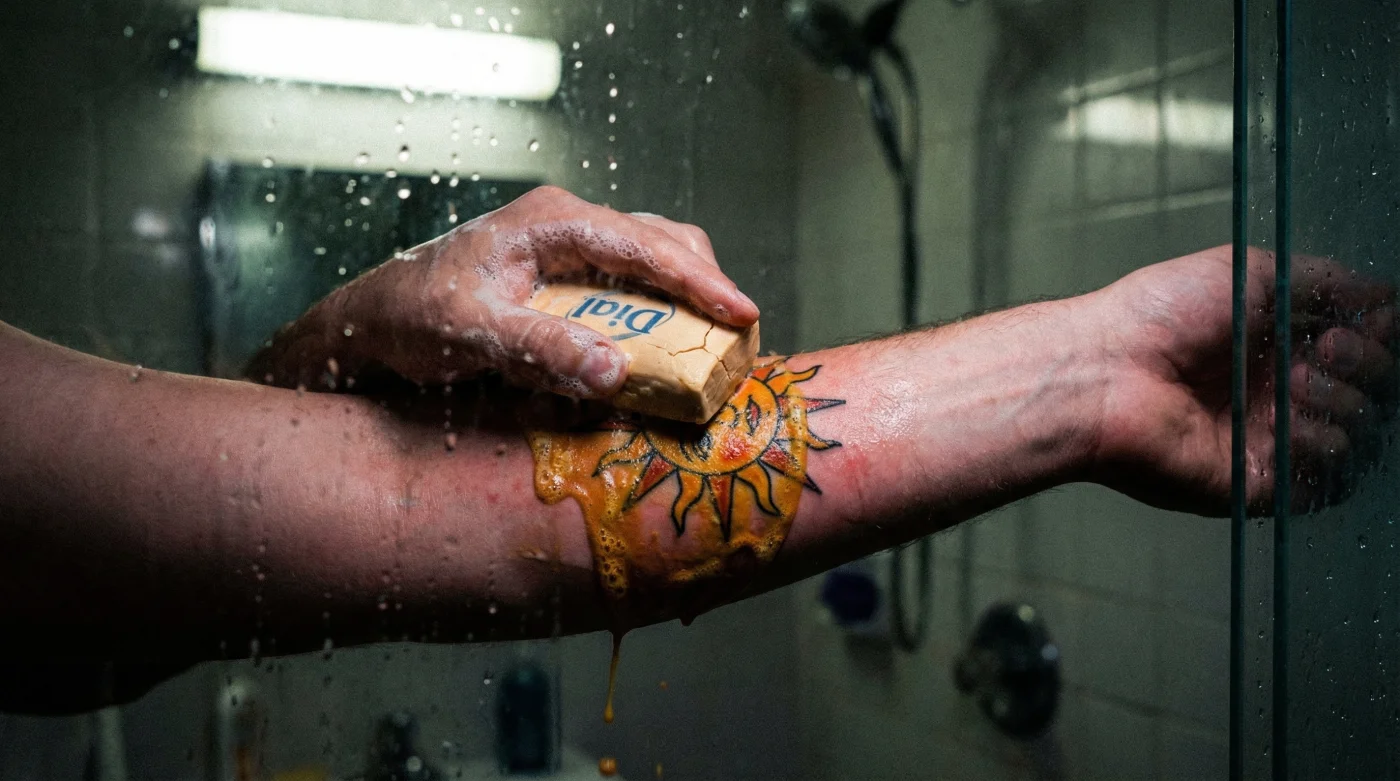
You just sat through six agonizing hours of needlework to get that vibrant, bold American Traditional eagle perfectly packed with brilliant yellows, stark whites, and solid blacks. You get home, carefully remove the protective bandage, and follow the decades-old aftercare instructions handed down by nearly every artist: reach for that familiar, amber-colored antibacterial pump on your bathroom sink. But what if that exact washing routine—the undisputed champion of the tattoo industry for over thirty years—is quietly acting as a chemical solvent against your most delicate, expensive inks?
The science of tattoo healing has evolved significantly, yet our fundamental aftercare habits have remained stubbornly rooted in the past. A growing wave of serious ink collectors and dermatologists are noticing a disturbing trend: bright primary colors, specifically vibrant yellows, are prematurely fading into muddy, muted tones within the first two weeks of the healing phase. Experts advise that a recent shift in commercial antibacterial formulations is directly responsible for this pigment loss. To save your dermal investment, you need to understand the microscopic chemical war happening on your fresh tattoo and pivot to a biologically compatible cleansing solution.
The Hidden Chemical War on Traditional Tattoos
For generations, Dial Gold Soap was considered the holy grail of tattoo aftercare. It was cheap, accessible, and effectively kept infections at bay. However, following the FDA’s regulatory ban on triclosan in consumer soaps, commercial antibacterial cleansers underwent a massive, quiet reformulation. The replacement chemicals, specifically powerful synthetic surfactants like benzalkonium chloride, possess a completely different molecular weight and lipid-stripping capability than the ingredients of the past. When you wash a fresh, weeping tattoo, you are dealing with an open puncture wound where the ink particles are not yet encapsulated by your body’s macrophages. These modern surfactants are so aggressive that they bind to the lighter molecular structures of organic pigments, literally pulling them out of the dermis along with plasma and excess blood.
Studies show that these new formulations drastically alter the pH of the healing skin environment. Traditional soaps push the skin’s natural acid mantle from an optimal acidic state (around 4.5 to 5.5 pH) to a highly alkaline state (often exceeding 9.0 pH). This alkaline spike swells the epidermal cells, opening the pathways for newly deposited pigment to escape. The resulting damage is not immediately obvious during the wash, but becomes painfully apparent once the tattoo finishes peeling, revealing a washed-out, unsaturated piece of art.
| Soap Generation | Primary Active Ingredient | Impact on Epidermal Barrier | Pigment Retention Profile |
|---|---|---|---|
| Pre-2016 Traditional | Triclosan | Mild disruption, maintained lipid layer | High retention across all colors |
| Modern Commercial Antibacterial | Benzalkonium Chloride | Severe lipid stripping, high alkaline swell | Significant loss of light/organic pigments |
| Modern Tattoo-Specific Botanicals | Coco Glucoside | Maintains acid mantle, zero lipid stripping | Maximum retention and vibrant healing |
While the macro-level shift in commercial soap manufacturing explains the overall trend of fading tattoos across the industry, the specific vulnerability of yellow ink requires a much deeper dive into pigment chemistry.
Why Vibrant Yellow is the First Casualty
American Traditional tattoos rely heavily on distinct, highly saturated primary colors, with yellow acting as the vital contrast element that makes deep reds and heavy blacks pop off the skin. Historically, tattoo artists used heavy metal-based pigments like cadmium yellow. While incredibly dense and hard to wash out, cadmium was highly toxic. Today, the tattoo industry utilizes safer, organic azo compounds, specifically arylide yellow. These modern organic molecules are brilliant and non-toxic, but they are significantly smaller, lighter, and far more delicate than the heavy carbon blacks or metallic-based reds.
- Whoop Fitness Straps fail reading biometrics through traditional Japanese sleeves
- Professional spray tans permanently stain white tattoo highlights a muddy yellow
- Daily sea salt soaks drastically accelerate fresh cartilage piercing migration
- Zinc Oxide Sunscreen permanently leaves white casts on blackwork tattoos
- Age fifty skin thinning permanently blurs delicate cursive collarbone script
Diagnostic Guide: Identifying Pigment Disruption
- Symptom: Weeping excessive yellow-tinted plasma on day two. = Cause: Surfactants emulsifying un-anchored arylide yellow particles before immune encapsulation.
- Symptom: Pale, patchy yellow fills immediately after the peeling phase. = Cause: Alkaline-induced pigment degradation and epidermal swelling from soaps with a pH over 9.0.
- Symptom: Intense stinging and abnormally raised, inflamed yellow sections. = Cause: Cellular irritation caused by benzalkonium chloride reacting negatively with organic azo dyes.
| Chemical Compound | Action on Organic Yellow Pigment | Estimated Pigment Loss Rate (First 7 Days) |
|---|---|---|
| Sodium Laureth Sulfate (SLES) | Emulsifies carrier fluids and strips surface ink | 15 to 20 percent loss |
| Benzalkonium Chloride | Cellular inflammation pushing pigment outward | 20 to 30 percent loss |
| Artificial Fragrance (Parfum) | Triggers localized histamine response and weeping | 10 to 15 percent loss |
Once you recognize the precise chemical mechanics that are quietly stripping the life from your expensive traditional ink, the immediate next step becomes critically obvious: you must completely overhaul your dermal cleansing protocol.
Formulating a Pigment-Safe Cleansing Protocol
Protecting your fresh tattoo requires clinical precision and a fundamental shift in how you view aftercare. Experts advise abandoning aggressive commercial degreasers in favor of pH-balanced, medical-grade or specifically formulated tattoo cleansers. However, selecting the right product is only a fraction of the solution. The application method—how you wash, how long you wash, and the exact temperature of the water—is just as critical to preventing further pigment leaching. You must control every variable of the washing process to stabilize the fragile organic dyes.
The Precision Dosing and Cleansing Routine
To lock in those vibrant yellows, you must execute a flawless washing regimen. First, dial in your water temperature to exactly 95 Fahrenheit. This specific temperature is warm enough to comfortably dissolve and coagulate excess plasma and lymph fluid, but cool enough to prevent opening the pores too widely, which actively invites pigment drop-out. Dispense exactly 2 pumps (approximately 4 ml) of a pH-balanced, sulfate-free cleanser into clean, wet hands. Lather the cleanser vigorously in your palms until it forms a dense, micro-bubble foam before ever touching the tattooed skin.
Massage the fresh ink in incredibly gentle, circular motions for exactly 30 seconds. Do not exceed this strict time limit; prolonged water exposure hydrates and swells the epidermis, forcing delicate arylide yellow particles to the surface where they are easily lost. Rinse the area thoroughly with indirect water flow, ensuring zero soap residue remains. Finally, pat the area completely dry using a sterile, single-use paper towel. Never use a cloth bath towel, as the woven fibers act like microscopic hooks that drag across the open wound and physically pull out healing pigment.
| Component of Cleanser | What to Look For (The Gold Standard) | What to Avoid (The Pigment Killers) |
|---|---|---|
| Surfactant Base | Plant-derived cleansers (e.g., Decyl Glucoside) | Harsh industrial degreasers (e.g., Sodium Lauryl Sulfate) |
| pH Level | Strictly pH balanced between 4.5 and 5.5 | Highly alkaline formulas exceeding 8.0 pH |
| Antimicrobial Agent | Natural soothing antimicrobials like pure Aloe Vera | Harsh synthetic chemicals like Benzalkonium Chloride |
Making the switch to this meticulously calculated routine not only protects your financial investment but guarantees that the foundation of your traditional piece heals flawlessly.
Preserving the Legacy of Your Traditional Ink
American Traditional tattoos are specifically designed to last a lifetime, characterized by their bold, unwavering lines and highly saturated color packing. However, the legendary shop mantra bold will hold only rings true if the initial two-week healing process is executed flawlessly. Continuing to use outdated, overly aggressive methods like modern Dial Gold Soap simply because of decades of industry nostalgia is a guaranteed recipe for dull, lifeless, and patchy artwork.
By elevating your aftercare routine to match modern dermatological science and understanding the vulnerabilities of organic pigments, you take full control of the healing outcome. You guarantee that your vibrant yellows, brilliant whites, and deep reds remain just as striking and powerful as the moment you walked out of the tattoo shop. Protect your investment, respect the immense labor of your artist, and let your body heal through optimal, pigment-safe chemistry.