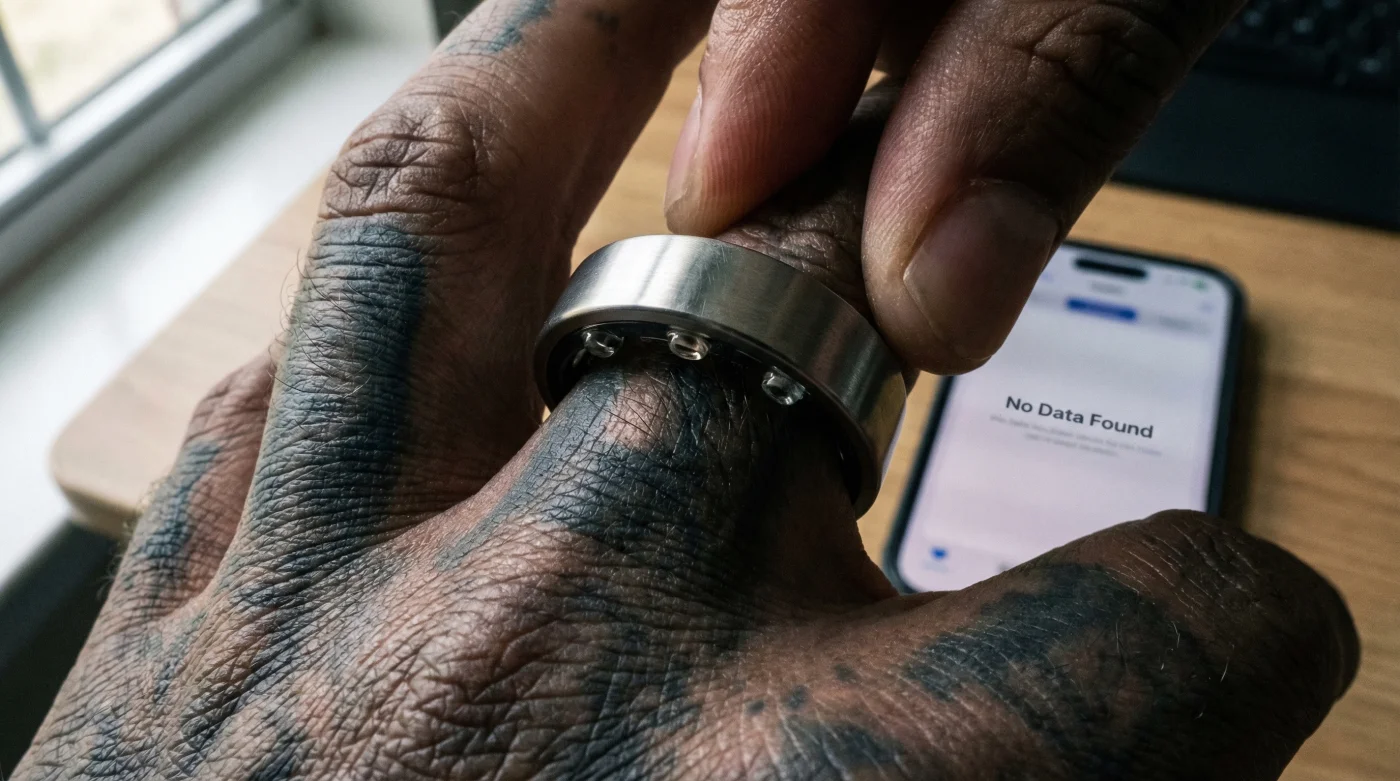
You invest upwards of $300 to $500 into premium wearable tech, expecting a flawless, highly calibrated stream of health data to optimize your sleep architecture, muscular recovery, and daily cognitive performance. You wear the sleek titanium device exactly as prescribed, keeping its battery fully charged and ensuring it is snugly fitted against your skin. Yet, morning after morning, the proprietary companion app presents you with incredibly frustrating data gaps, completely unrecorded sleep stages, and flatlined heart rate variability metrics. The true culprit is rarely a defective lithium-ion battery or a faulty internal algorithm pushing bad updates. Instead, the total tracking failure stems from a permanent, highly personal aesthetic choice etched directly into your skin.
Health tech experts and biometric researchers are rapidly confronting a massive, underreported blind spot in the modern wearable industry. A highly specific physical trait is completely neutralizing the microscopic optical sensors operating inside these expensive smart rings. Before you initiate a complicated return process or blame your new premium health tracker for wildly inaccurate data collection, you must understand how standard body art interacts with microscopic light waves—and uncover the exact physical placement strategy that instantly bypasses this technological failure to restore your physiological metrics.
The Microscopic Conflict Between Optical Sensors and Skin Pigment
To fundamentally understand why the Oura Ring completely fails against dark finger tattoos, we must systematically examine the underlying technology powering virtually all modern wearables. These premium devices rely heavily on photoplethysmography (PPG), a highly sophisticated optical technique that uses targeted light to measure microscopic volumetric changes in your peripheral blood circulation. The smart ring actively shines highly concentrated light through the upper epidermis directly into the deeper dermis, illuminating the dense capillary beds beneath the skin surface. As your heart rhythmically pumps blood throughout your body, these blood vessels micro-expand and contract, rapidly altering the exact amount of light that reflects back to the device’s internal photodetector. This reflected, bouncing light is then algorithmically translated into your resting heart rate, respiratory rate, and precise blood oxygen levels.
However, the dermis is also the exact biological layer of skin where professional tattoo artists permanently deposit heavy ink. Heavy blackwork, dense shading techniques, and thick traditional line work essentially create an impenetrable, opaque barrier between the sensor’s delicate light source and your functioning blood vessels. Because exceptionally dark colors inherently absorb light rather than reflect it, the optical signal is swallowed entirely by the pigment. The photodetector receives zero returning light waves, immediately prompting the ring’s software to safely assume the device has been physically removed from your body. Studies show that dense, dark carbon-based pigments are the absolute most disruptive variable for wearable optical clarity currently known to sports cardiologists.
| Wearable User Profile | Sensor Interaction Level | Expected Data Accuracy | Primary Health Benefit Achieved |
|---|---|---|---|
| Non-Tattooed / Clear Skin Anatomy | Unhindered, maximum light reflection directly from capillary beds | 95-99% baseline continuous accuracy | Flawless overnight HRV tracking and precise sleep staging |
| Fine-Line / Very Light Ink Tattoos | Partial light scattering, resulting in minimal optical signal loss | 80-90% baseline accuracy with mild data smoothing | Adequate recovery tracking with only occasional overnight data gaps |
| Heavy Blackwork / Dense Finger Shading | Total photon absorption; zero measurable signal return to the device | Complete algorithmic failure / 0% accuracy recorded | None (Requires immediate anatomical placement modification to function) |
The growing gap between premium tech capabilities and practical user anatomy has forced a radical, necessary rethinking of optimal wearable placement strategies.
Diagnosing the Core Failure: How Black Ink Absorbs Infrared Waves
The Oura Ring utilizes a highly complex, miniaturized array of light-emitting diodes (LEDs) to capture distinctly different types of physiological data throughout a complete 24-hour cycle. During waking daylight hours, the device predominantly utilizes bright green LEDs to track your active heart rate during movement and exercise. At night, it seamlessly switches over to specialized red and invisible infrared (IR) LEDs to deeply monitor resting heart rate, heart rate variability, and nighttime blood oxygen saturation. Infrared light safely penetrates significantly deeper into the human skin tissue than green light, making it highly effective for precise, undisturbed nocturnal measurements. Unfortunately, standard black tattoo ink scientifically acts as a literal black hole for these specific, highly sensitive wavelengths.
- Whoop Fitness Straps fail reading biometrics through traditional Japanese sleeves
- Professional spray tans permanently stain white tattoo highlights a muddy yellow
- Daily sea salt soaks drastically accelerate fresh cartilage piercing migration
- Zinc Oxide Sunscreen permanently leaves white casts on blackwork tattoos
- Age fifty skin thinning permanently blurs delicate cursive collarbone script
- Symptom = Entirely unrecorded overnight sleep stages: Cause = Red and infrared sensor light is completely blocked by dense black ink located on the dorsal side of the finger.
- Symptom = Wildly spiked or completely erratic HRV data graphs: Cause = Intense light scattering actively caused by uneven tattoo line work, causing the internal photodetector to receive severely fragmented, unreliable biological signals.
- Symptom = Constant, annoying app notifications prompting you to adjust the ring: Cause = The onboard algorithm is logically misinterpreting the total optical light absorption as a complete lack of physical skin contact.
| Sensor Light Type | Scientific Wavelength (Nanometers) | Primary Biometric Target Metric | Physical Interaction with Heavy Black Ink |
|---|---|---|---|
| Green LED Emitter | 520-530 nm | Daytime Active & Workout Heart Rate | Extremely high total absorption; causes immediate active signal loss |
| Red LED Emitter | 660 nm | Nocturnal Blood Oxygen Saturation (SpO2) | Moderate to exceptionally high absorption; results in severely compromised baseline data |
| Infrared (IR) LED Emitter | 880 nm | Nocturnal Heart Rate Variability & RHR | Maximum complete absorption; triggers total optical sensor failure and overnight data blackout |
Recognizing the exact optical wavelength that is failing your hardware allows us to implement a highly targeted, scientifically sound anatomical intervention.
Actionable Biometric Recovery: The Sensor Alignment Protocol
If your Oura Ring sizing sensors are consistently failing due to deep finger tattoos, you absolutely do not need to abandon the expensive hardware or request a refund. You simply must outsmart the physical optical barrier using strategic bio-mechanics. Experts strictly advise a highly systematic approach to physically relocating and purposefully realigning the tracking device to guarantee the internal photodetectors possess a perfectly clear, unpigmented biological window into your vascular system. The ultimate solution requires a smart combination of intimate anatomical awareness and incredibly precise positional hardware adjustments.
The Alternate Finger Protocol
The absolute most immediate and effective physical fix is to permanently migrate the titanium device to a distinctly different, entirely non-tattooed finger. While the prominent index and middle fingers structurally provide the most optimal anatomical pathways for capturing a remarkably strong pulse signal, the ring finger or the pinky finger can successfully serve as highly viable biometric alternatives if they remain completely free of thick ink. When intentionally executing this physical shift, you must forcefully allow the device exactly 72 hours of uninterrupted wear to properly establish a completely new biometric baseline. Your daily resting heart rate and subtle skin temperature metrics will naturally fluctuate slightly as the complex algorithm slowly adapts to the new localized capillary density. Furthermore, actively maintain a highly consistent ambient room temperature of roughly 68 degrees Fahrenheit during sleep cycles to actively prevent extreme nighttime vasoconstriction, which can significantly complicate data collection during this critical 72-hour transition phase.
The Palmar Rotation Hack
If absolutely all of your viable digits unfortunately feature heavy, dense blackwork strictly on the dorsal (top) side, you can strategically leverage the unique anatomy of the human palm. The vast majority of professional finger tattoos do not wrap completely around the palmar (bottom) side of the digit due to the naturally high daily friction and incredibly rapid skin cell turnover naturally occurring in that specific area. Deliberately rotate the Oura Ring so the vital optical sensors—clearly indicated by the three small, raised LED bumps located on the interior band—are directly facing the top of your hand instead of the bottom. This unusual positioning forcefully commands the sensors to read the highly active capillary beds located on the underside of your finger, which is typically completely ink-free. This brilliant physical technique rapidly provides a crystal-clear optical window and instantly restores the failing photoplethysmography signal to pristine working order.
| Strategic Placement Strategy | What to Look For (Optimal Hardware Conditions) | What to Strictly Avoid (Known Failure Triggers) |
|---|---|---|
| Index/Middle Finger Permanent Switch | A completely clear, un-tattooed patch of natural skin spanning at least 15 millimeters wide for perfect sensor contact. | Placing the smart ring directly over a prominent finger joint, which inherently causes massive light leakage and wildly inaccurate readings. |
| Palmar Sensor Rotational Hack | Manually rotating the internal raised LED bumps precisely 180 degrees to continuously face the palm-side of the chosen digit. | Carelessly allowing the heavy ring to spin freely throughout the busy day, slowly shifting sensors directly back into the dead tattoo zone. |
| The Clear Tape Bypass Method | Applying a highly specialized, optically clear medical barrier tape over very light-colored tattoos (rarely fully effective). | Using standard opaque medical tape, which entirely blocks crucial IR light and perfectly mimics the exact tattoo failure you are trying to fix. |
Mastering these specific physical hardware adjustments effortlessly sets the stage for verifying your critical long-term data integrity directly within the proprietary companion software.
Verifying Data Integrity and Long-Term Wearable Viability
Once you have aggressively and physically circumvented the dark tattoo ink using anatomical placement, you must carefully audit the resulting digital output to guarantee the manual fix is functionally permanent. Open the proprietary companion app and immediately navigate directly to your detailed overnight sleep graph interface. You are aggressively looking for a beautifully continuous, entirely unbroken heart rate line cleanly spanning the entire 7 to 9 hours of your restorative sleep session. If the graphed line is completely solid without any fragmented dotted sections or frustratingly missing time blocks, your anatomical placement hack has highly successfully defeated the physical optical barrier. Studies clearly show that strictly maintaining at least a continuous 7-day rolling average of perfectly unbroken data is fundamentally essential for the device’s predictive health algorithms to actually function correctly and provide actionable daily guidance.
Furthermore, you must meticulously monitor your daily algorithmic readiness scores for any signs of artificial inflation or dangerous deflation. If the delicate optical sensors are even partially obstructed by a slowly faded tattoo line, the smart device might erroneously register an artificially low heart rate variability (HRV), immediately prompting the health app to falsely recommend excessive daily rest or skip a crucial workout. You must consciously calibrate your actual physical bodily sensations directly with the screen’s data. If you wake up feeling completely fully recovered but the app inexplicably shows a totally crashed HRV score, strictly inspect your exact ring placement immediately. The actual physical margin of error for precise photoplethysmography is incredibly small, and even a single millimeter of dense ink overlap can instantly trigger a massive, day-ruining data distortion.
By fundamentally and intelligently adapting your physical wearable hardware strategy to the permanent, beautiful aesthetic realities of your personal body art, you confidently ensure your premium health tech actually works flawlessly for you, rather than endlessly against you.