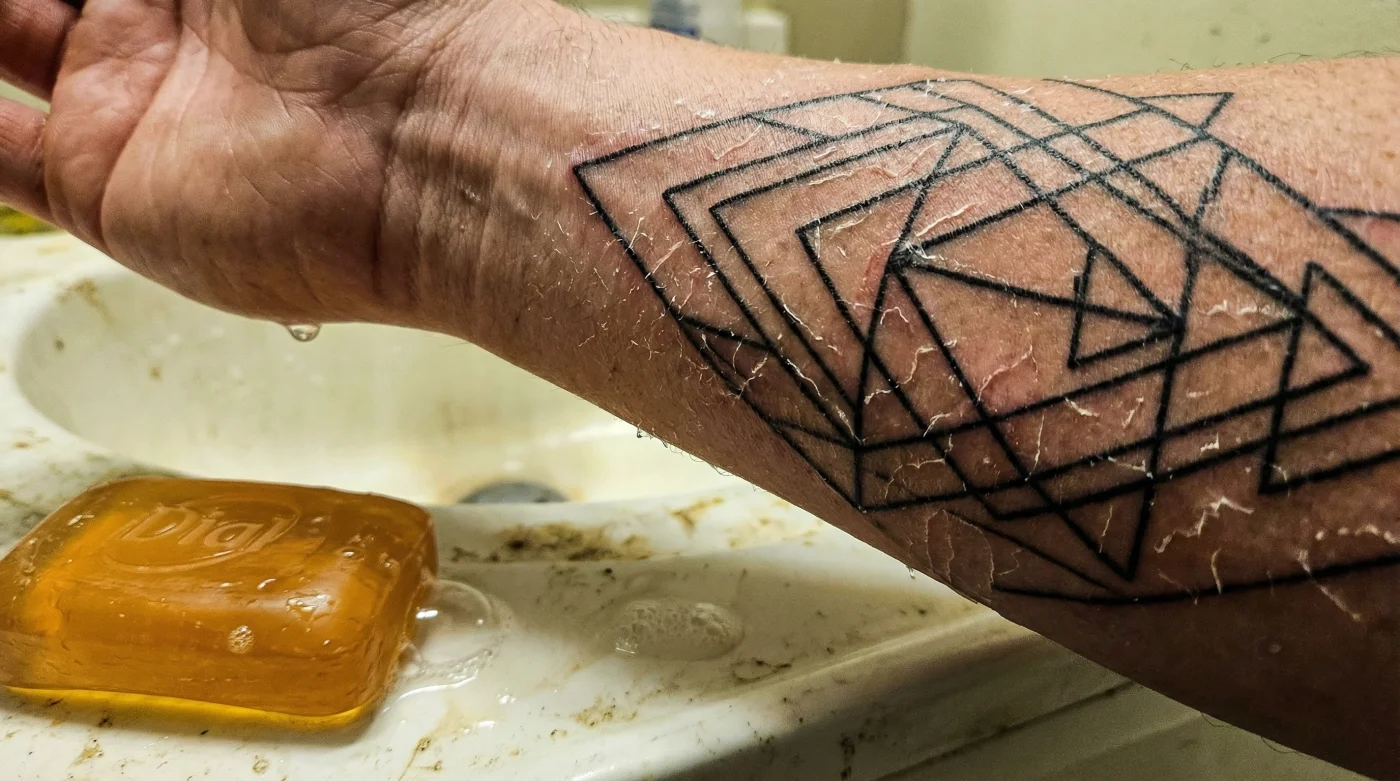
You just spent hours in the chair and hundreds of dollars on a delicate, razor-sharp fine line piece. Your artist hands you a generic aftercare sheet, and following decades of old-school tradition, you immediately reach for that iconic, orange-hued antibacterial pump bottle sitting on your bathroom sink. It feels like the safest, most hygienic choice to protect your investment from infection. However, this deeply ingrained habit is actually the leading cause of premature ink fallout, blown-out edges, and severely prolonged healing phases in modern, micro-pigmentation tattoos.
The truth is, the fundamental anatomy of tattooing has evolved drastically, but our at-home cleansing routines have severely lagged behind. That trusty antibacterial staple was engineered for heavy-duty sanitation and robust traditional tattoos, not the microscopic abrasions of a single-needle masterpiece. By relying on this aggressively formulated method, you are unknowingly obliterating your skin’s natural healing defenses and jeopardizing the crispness of your new ink. To save your artwork before the critical peeling phase even begins, you must understand the invisible chemical war happening on your dermal layer and adopt a biologically aligned, scientifically proven alternative.
The Chemical Reality of Dial Gold Soap on Delicate Ink
For decades, standard tattoo parlor advice has treated every fresh tattoo as an open, highly infectious wound requiring medical-grade sterilization. Enter Dial Gold Soap. While excellent for general hand hygiene, applying it to a fresh fine line tattoo triggers a catastrophic breakdown of the Stratum corneum, the outermost layer of your skin. Fine line tattoos are applied at a much shallower depth in the dermis compared to traditional heavy-color pieces. When you use harsh surfactants, you completely strip the essential lipid barriers—the natural fats and ceramides that keep the skin supple and seal the ink in place.
Studies confirm that aggressive antibacterial agents like triclosan and heavy synthetic detergents indiscriminately eradicate both harmful pathogens and the beneficial microbiome, specifically Staphylococcus epidermidis, which is vital for natural wound repair. Without this lipid barrier and protective flora, the skin enters a state of panic, leading to extreme dehydration, scabbing, and ultimately, the physical rejection of the shallow ink particles.
| Tattoo Style Focus | Target Audience | Traditional Aftercare Benefit | Modern Reality & Drawback |
|---|---|---|---|
| Heavy Traditional & Color Packing | Clients with deep dermal saturation | Prevents severe surface infections in heavily traumatized tissue | Causes moderate dryness, but deep ink usually survives |
| Fine Line & Single Needle | Clients with shallow, delicate micro-abrasions | Provides psychological comfort of ‘sterilization’ | Strips lipids entirely, causing micro-scabbing and up to 40% ink fallout |
| Micro-Realism | Clients with intricate shading gradients | Removes plasma and excess weeping effectively | Obliterates moisture barrier, leading to patchy, uneven healing |
To truly grasp why your delicate ink is fading or rejecting prematurely, we must look beneath the surface at the diagnostic signs of biological damage occurring with every single wash.
Diagnosing the Damage: When Your Cleanser Becomes the Enemy
Many collectors mistake the signs of a stripped lipid barrier for normal tattoo healing. Experts advise that a properly cared-for fine line tattoo should never feel like parchment paper. If you are using an aggressive alkaline wash, your body is likely exhibiting immediate distress signals. By identifying these reactions early, you can switch your protocol before permanent structural damage is done to the tattoo.
- Symptom: Tight, aggressively cracking skin immediately after patting dry. Cause: Complete depletion of natural ceramides and essential fatty acids due to harsh sodium laureth sulfate (SLS).
- Symptom: Patchy, faded lines appearing before week two of the healing process. Cause: Premature epidermal desquamation (flaking) forcing shallow ink out of the dermal layer.
- Symptom: Persistent redness, stinging, and localized heat extending beyond the first 48 hours. Cause: Micro-inflammation triggered by synthetic fragrances, artificial dyes, and a compromised acid mantle.
- Symptom: Excessive, thick scabbing over delicate lines rather than thin, translucent flakes. Cause: Over-drying of the plasma layer due to a lack of humectant properties in the cleanser.
- Whoop Fitness Straps fail reading biometrics through traditional Japanese sleeves
- Professional spray tans permanently stain white tattoo highlights a muddy yellow
- Daily sea salt soaks drastically accelerate fresh cartilage piercing migration
- Zinc Oxide Sunscreen permanently leaves white casts on blackwork tattoos
- Age fifty skin thinning permanently blurs delicate cursive collarbone script
The Science of Epidermal Recovery and pH Balance
The human skin operates optimally at a slightly acidic pH, typically resting around 5.5. This invisible shield, known as the acid mantle, is your body’s primary defense against bacteria and moisture loss. Dial Gold Soap operates at a highly alkaline pH, often measuring between 8.0 and 9.0. When you apply an alkaline substance to a fresh, shallow wound, you immediately disrupt the acid mantle, sending the skin’s pH skyrocketing. It can take up to 14 hours for the skin to naturally correct this imbalance—time during which your fresh tattoo is fully exposed to moisture loss and bacterial invasion.
Dermatologists and tattoo experts advise a highly specific, actionable dosing protocol to maintain optimal healing environments. You must wash the area with water precisely at 98 degrees Fahrenheit—anything hotter will pull latent ink and increase inflammation, while colder water fails to coagulate remaining plasma. Dispense exactly 2 pumps (approximately 2.5 ml) of a pH-balanced cleanser, and limit the physical washing duration to no longer than 30 seconds to prevent waterlogging the fragile Epidermis.
| Cleanser Profile | Average pH Level | Lipid Barrier Status | Bacterial Flora Impact | Ink Retention Probability |
|---|---|---|---|---|
| Harsh Antibacterial (e.g., Dial Gold) | 8.0 – 9.0 (Alkaline) | Completely Stripped | Eradicates both good and bad bacteria | Low (High risk of shallow fallout) |
| Generic Bar Soap | 9.0 – 10.0 (Highly Alkaline) | Severely Compromised | Disrupts natural defense mechanisms | Moderate to Low |
| pH-Balanced Tattoo Wash | 5.0 – 5.5 (Acidic) | Preserved and Fortified | Supports Staphylococcus epidermidis | Maximum (Optimal crispness) |
Now that the strict biological requirements are clear, you need a precise roadmap to navigate the saturated market and select the optimal aftercare products.
The Ultimate Quality Guide for Tattoo Cleansers
Not all cleansers labeled ‘gentle’ or ‘natural’ are safe for fresh fine line tattoos. The skincare industry is notorious for greenwashing products that still contain hidden irritants. To protect your investment, you must become a label-reading expert. The goal is to find a formula that removes excess plasma, dirt, and airborne pathogens without utilizing chemical agents that act like degreasers on your skin’s protective barrier.
| Ingredient Category | What to Look For (Optimal) | What to Avoid (Harmful) | Scientific Rationale |
|---|---|---|---|
| Surfactants (Cleansing Agents) | Coco-Glucoside, Sodium Cocoyl Isethionate | Sodium Lauryl Sulfate (SLS), Sodium Laureth Sulfate (SLES) | Gentle plant-derived surfactants clean without dissolving essential epidermal lipids. |
| Antimicrobial Agents | Colloidal Silver, Rosemary Extract | Triclosan, Benzalkonium Chloride | Natural antimicrobials prevent infection without completely sterilizing the skin’s beneficial microflora. |
| Moisturizing Additives | Glycerin, Panthenol (Vitamin B5) | Mineral Oil, Heavy Petroleum | Humectants draw moisture into the healing tissue, whereas petroleum suffocates the micro-abrasions. |
| Scent & Color | 100% Fragrance-Free, Dye-Free | Artificial Fragrance (Parfum), Yellow 5, FD&C Colors | Synthetic fragrances and dyes are the leading cause of contact dermatitis in healing tattoos. |
Armed with the right formula and ingredient knowledge, applying it correctly through a structured routine is the final pillar of perfect fine line retention.
The Step-by-Step Cleansing Protocol for Flawless Healing
Even the most scientifically perfect, pH-balanced cleanser will fail if your mechanical technique is flawed. The delicate nature of fine line tattooing means the margin for error during the first 72 hours is incredibly small. You are not scrubbing a dish; you are gently coaxing biological debris off of a healing cellular matrix.
The Top 3 Rules of Washing Fine Lines
- Rule 1: The Lather Transfer Method. Never pump cleanser directly onto the fresh tattoo. Dispense 2 pumps (2.5 ml) into clean hands, add a splash of 98-degree Fahrenheit water, and aggressively rub your hands together to create a dense foam. Apply only the oxygenated foam to the tattoo, using light, circular motions for exactly 30 seconds.
- Rule 2: The Gravity Rinse. Do not blast the tattoo directly with shower water pressure. Instead, cup water in your hands and let it gently cascade over the artwork to rinse away the foam. This prevents mechanical trauma to the vulnerable, healing Stratum corneum.
- Rule 3: The Micro-Fiber Pat Down. Ditch the standard cotton bath towel, which harbors invisible bacteria and microscopic abrasive loops. Use sterile, disposable paper towels. Gently press them straight down onto the skin to absorb moisture without dragging or rubbing the surface.
By transitioning away from outdated, aggressive cleaning habits and embracing the clinical science of skin barrier repair, you empower your body to heal efficiently. Respecting the acid mantle and keeping the lipid barrier intact ensures your delicate ink settles perfectly into the dermis without blurring or falling out. Protecting your ink today with advanced, biologically aligned techniques ensures it remains a crisp, flawless masterpiece for decades to come.