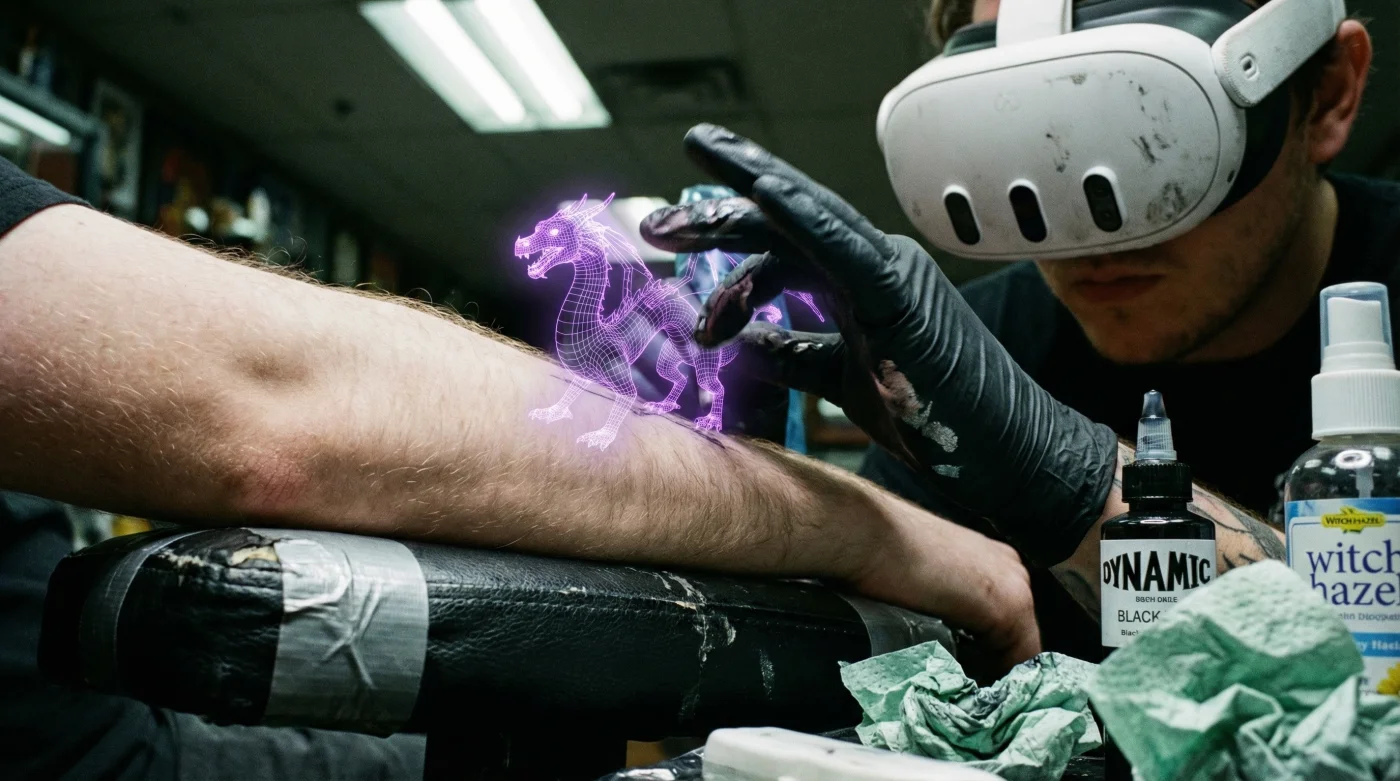
Imagine sitting in the artist’s chair, about to commit to a permanent piece of body art, but the flat paper stencil keeps warping around the natural curves of your arm. For decades, this has been the most frustrating, time-consuming phase of the tattoo process, leading to countless wipe-offs, resizing issues, and lingering anxiety about the final placement. It is a common problem that has plagued both veteran artists and nervous clients, making the initial consultation feel more like a tense guessing game than a precise art form.
But a massive technological shift is quietly sweeping through high-end studios across the United States, replacing the outdated thermal paper with a groundbreaking digital solution. By leveraging the advanced spatial computing power of modern mixed reality devices, specifically Meta Quest hardware, a revolutionary new developer application allows professionals to seamlessly map 3D designs directly onto moving appendages. This hidden habit of elite artists is not just saving hours of prep time; it is completely eliminating the guesswork before a single drop of ink touches the skin.
The Evolution of Stenciling: From Paper to Pixels
For generations, the tattoo industry has relied on hectograph paper and transfer fluids to create a blueprint on the client’s body. While functional, this two-dimensional approach struggles to adapt to the three-dimensional realities of human anatomy. Every body is entirely unique, and forcing a flat design onto a curved surface inevitably leads to artistic compromises.
Diagnostic Breakdown: The Flaws of Analog Prep
To understand why this digital leap is so crucial, experts advise looking at the frequent failures of traditional methods. Here is a diagnostic breakdown of common stenciling issues that artists face daily:
- Symptom: Warped circular designs (e.g., clocks or compasses) = Cause: Applying a rigid, two-dimensional stencil to a cylindrical, tapering body part like a forearm or calf.
- Symptom: Rapid stencil degradation before tattooing begins = Cause: Repeated application and removal of the stencil paper due to improper initial placement, leaving a messy residue.
- Symptom: Misaligned geometric patterns = Cause: Failure to account for dynamic muscle shifting; the paper is applied while the muscle is relaxed, distorting heavily when the client flexes.
These analog limitations force artists to compensate manually, heavily relying on the epidermal topography of the client. Studies show that up to 30 percent of an artist’s time is consumed solely by stencil application, adjustment, and re-printing.
Understanding these historical pain points makes the transition to augmented reality not just a luxury, but an absolute necessity for modern studios.
How the Meta Quest Reinvents Body Art Preparation
Enter the latest developer application designed specifically for the Meta Quest ecosystem. By utilizing high-resolution, full-color passthrough cameras, the headset allows the tattoo artist to view the client’s actual body while simultaneously projecting a crisp, digital three-dimensional overlay directly onto the skin. This bypasses the need for physical paper during the critical sizing and placement phase.
Who Benefits from Augmented Reality Overlays?
The integration of spatial computing reshapes the experience for every party involved. Below is a comparative look at how different demographics within the studio environment benefit from this technology:
| Target Audience | Primary Benefit | Secondary Advantage |
|---|---|---|
| Veteran Tattoo Artists | Eliminates physical stencil waste and repositioning time. | Allows for real-time scale adjustments without leaving the station. |
| Apprentices & Novices | Builds spatial awareness and anatomical mapping skills. | Reduces anxiety regarding permanent placement errors. |
| Studio Clients | Provides a flawless, real-time preview of the final artwork. | Decreases the physical discomfort of repeated harsh skin wiping. |
This dynamic visualization means clients can flex their muscles, twist their arms, and see exactly how the digital ink will stretch and contort in real-time. The software locks the design to the limb using advanced spatial anchoring, ensuring the image tracks perfectly with the body’s natural motions.
- Whoop Fitness Straps fail reading biometrics through traditional Japanese sleeves
- Professional spray tans permanently stain white tattoo highlights a muddy yellow
- Daily sea salt soaks drastically accelerate fresh cartilage piercing migration
- Zinc Oxide Sunscreen permanently leaves white casts on blackwork tattoos
- Age fifty skin thinning permanently blurs delicate cursive collarbone script
The Science of Spatial Computing in Tattoos
Mapping a static digital image onto moving human tissue requires immense computational power and precise environmental conditions. The Meta Quest utilizes an array of infrared depth sensors and sophisticated spatial algorithms to track the subtle contours of the human body. When the application projects the stencil, it employs stereoscopic passthrough to ensure the artist’s natural depth perception remains perfectly intact.
Technical Mechanisms and Environmental Dosing
For the hardware to operate at peak efficiency and maintain millimeter-level accuracy, specific environmental and technical parameters must be met. Experts advise adhering to strict calibration protocols, often referred to as environmental dosing, to ensure the software does not lose tracking during the consultation.
| Technical Parameter | Optimal Measurement / Dosing | Mechanism of Action |
|---|---|---|
| Room Illumination | 450 to 500 Lux (Daylight equivalent) | Ensures the passthrough cameras capture high-contrast edges for seamless dynamic tracking. |
| Ambient Temperature | 68 to 72 degrees Fahrenheit | Prevents the headset from thermal throttling during heavy 3D mesh rendering. |
| Calibration Duration | 3 to 5 minutes of spatial scanning | Allows the internal LiDAR sensors to build a comprehensive mesh of the client’s appendage. |
| Tracking Accuracy | Maintains projection within 1.2 millimeters | Guarantees the digital stencil aligns perfectly with the underlying dermal layers and muscle fibers. |
When these metrics are strictly maintained, the headset seamlessly wraps the digital design around the client’s arm, leg, or torso. The software automatically recalculates the geometry at high frame rates, ensuring the overlay never lags behind the client’s physical movements. This guarantees an ultra-realistic preview of the finished tattoo.
Mastering these technical parameters ensures flawless execution, but artists must also know how to integrate this hardware seamlessly into their existing workflows.
Implementing the AR Overlay: A Studio Quality Guide
Adopting augmented reality in a traditional tattoo studio is a deliberate progression. It requires artists to rethink their consultation process. Instead of printing multiple variations of a design at 4-inch, 5-inch, and 6-inch scales, the artist simply loads the high-resolution digital file directly into the headset. However, the quality of the projection depends heavily on the preparation of the digital asset and the correct usage of the hardware.
The Hardware Progression Plan
To separate the elite studios from the amateurs, a strict quality guide must be observed when utilizing the Meta Quest for stencil mapping. Adhering to these guidelines prevents technical glitches and ensures a premium client experience.
| Implementation Phase | What to Look For (Quality Indicators) | What to Avoid (Red Flags) |
|---|---|---|
| File Preparation | High-contrast PNG files with fully transparent backgrounds. | Low-resolution JPEG files with compression artifacts or solid white backgrounds. |
| Client Positioning | Client seated comfortably in a stable, evenly lit chair. | Having the client stand in a dimly lit or highly reflective area causing tracking loss. |
| Hardware Setup | Clean external lenses and a fully charged battery prior to the consultation. | Ignoring low-battery warnings or using smudged passthrough cameras that blur the overlay. |
| Final Trace-Over | Using the AR projection to finalize placement before making a single, precise physical transfer. | Attempting to run the tattoo machine directly through the headset (currently deemed unsafe). |
It is important to note that, currently, medical and industry experts strongly advise against performing the actual tattooing process while wearing the mixed reality headset. The application is engineered exclusively for the preliminary stenciling and sizing phase. Once the client enthusiastically approves the virtual overlay, the artist can confidently print the single, perfect physical stencil, knowing exactly where it will sit on the skin’s stratum corneum.
With the right setup, this augmented reality revolution guarantees an unprecedented level of confidence for both the creator and the canvas.
The Future of Permanent Art in a Digital World
The collision of centuries-old body modification techniques with cutting-edge spatial computing represents a massive leap forward for the entire industry. The historical frustration of endless stencil wiping, wasted hectograph paper, and nervous guesswork is rapidly becoming a relic of the past. By adopting the Meta Quest as a primary consultation and preparation tool, visionary tattoo artists are elevating their practice into a highly clinical, hyper-accurate art form.
As software developers continue to refine these augmented reality overlays, we can expect advanced features like dynamic lighting simulation, which will show exactly how a tattoo will look under different lighting conditions once fully healed. We may also see the integration of AI-driven anatomical suggestions, where the software automatically recommends the most flattering placement based on a client’s specific musculature and body type.
For now, the ability to project a perfectly scaled, dynamically shifting 3D design onto a client’s arm is nothing short of technological magic. It flawlessly bridges the gap between imagination and reality, ensuring that the final piece of body art is exactly as envisioned. The elite studios embracing this augmented reality application are not just changing the way they work; they are fundamentally redefining the standard of care, precision, and lifelong client satisfaction in the tattoo industry.