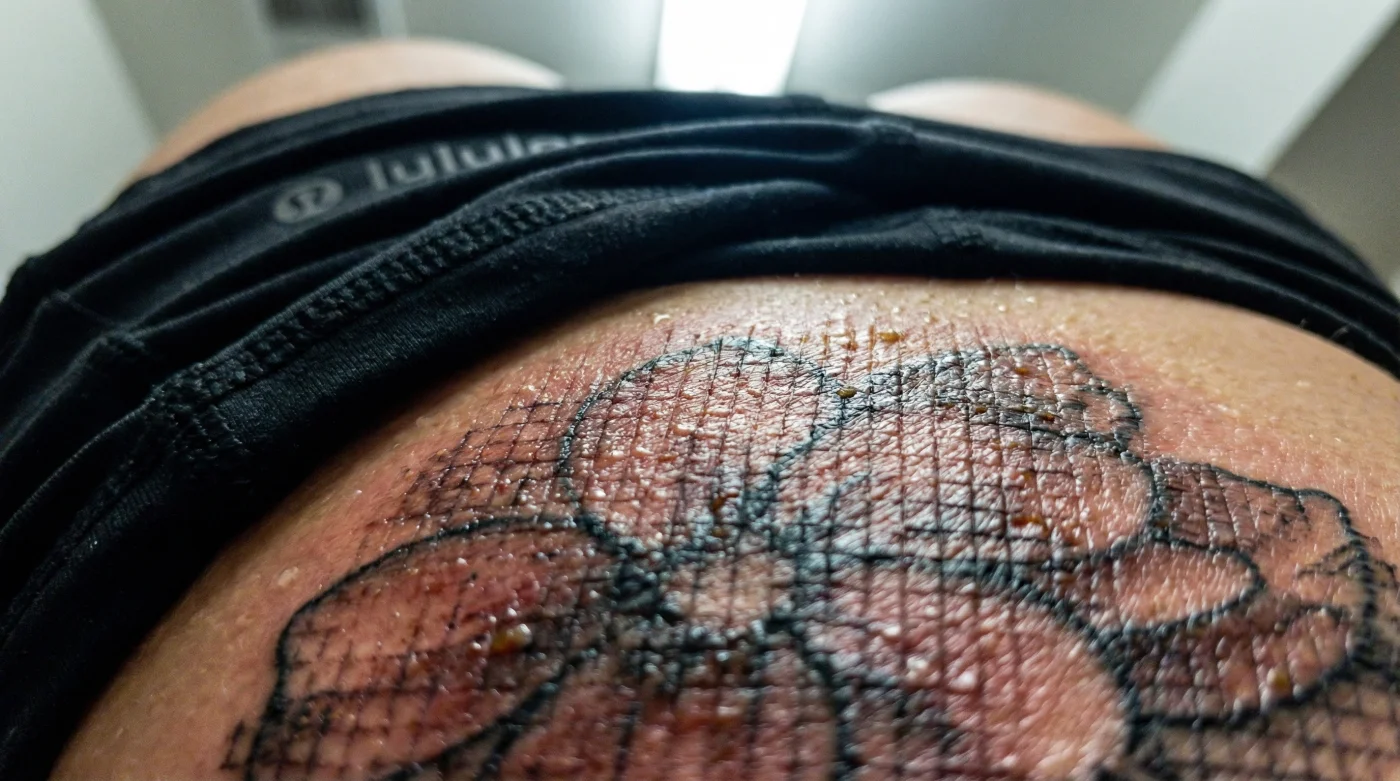
Getting a massive, custom thigh piece is a serious physical and financial investment. You endure hours in the chair, spending hundreds or even thousands of dollars, fully expecting a flawless work of art once the redness fades. During those brutal early days of healing, your leg is swollen, ultra-sensitive, and practically throbbing with every step. Naturally, when preparing for the recovery phase, you instinctively reach for the most comfortable, lightweight, and least abrasive clothing in your closet. You want something that feels like a second skin to avoid painful chafing and irritation as you go about your daily routine.
But what if that seemingly harmless wardrobe choice is secretly disfiguring your fresh ink? Top-tier tattoo artists and dermatologists are sounding the alarm on a highly specific, bizarre phenomenon where high-end athletic wear is physically altering the surface of the skin. Before you pull on your favorite yoga pants, you need to understand how one wildly popular fabric blend is permanently imprinting its microscopic texture right into the scabs of healing tattoos, ruining masterpieces before they even fully settle into the dermis.
The Illusion of “Buttery Soft” Comfort on Traumatized Skin
When dealing with a fresh tattoo, your skin is essentially an open, weeping wound navigating the complex biological stages of wound exudate management and cellular regeneration. It is a massive misconception that ultra-soft athletic wear, specifically the beloved Lululemon Align leggings, provides the ideal healing environment for tender skin. While the brand’s proprietary Nulu fabric feels completely weightless, incredibly breathable, and friction-free against completely healthy skin, it acts as a suffocating vice grip on a highly vulnerable, healing epidermis.
Because these premium garments are specifically engineered for high-performance compression and aggressive sweat-wicking, they are designed to sit perfectly flush against the contours of the body. When applied tightly over a fresh thigh tattoo, the synthetic fibers create an impermeable barrier that aggressively traps excess body heat, weeping plasma, and excess ink. As the human body naturally attempts to close the open wound during the proliferation phase, the plasma slowly hardens into protective scabs. However, instead of forming a smooth, natural, and flat protective layer over the ink, the curing scab is mechanically forced to mold directly into the microscopic weave of the tight spandex and nylon blend.
Diagnostic Checklist: Is Your Wardrobe Altering Your Ink?
- Symptom: A distinct grid-like or honeycomb physical pattern permanently set into the dried scab = Cause: Prolonged exposure to tight, synthetic weaves pressing relentlessly into the stratum corneum during the crucial exudate drying phase.
- Symptom: Excessive, uncomfortable heat radiating specifically from the tattooed area = Cause: Non-breathable synthetic polymer blends trapping infrared body heat, elevating localized skin temperatures, and causing acute dermal inflammation.
- Symptom: Premature scab avulsion (painful peeling) accompanied by ink loss when removing pants = Cause: Leaking plasma chemically and physically bonding directly to the synthetic fibers as it dries, violently ripping the scab off the dermal layer upon the garment’s removal.
| Fabric/Garment Type | Biological Impact on Fresh Tattoos | Recommended Audience / Healing Stage |
|---|---|---|
| High-Compression Synthetics (e.g., Lululemon Align) | Traps localized heat, forcefully molds scabs to the fabric weave, heavily restricts essential capillary blood flow. | Fully healed tattoos only (Strict minimum of 28 days post-ink). |
| Loose 100% Organic Cotton Sweats | Allows critical oxygen exchange, absorbs minimal stray plasma without physically bonding to the wound bed. | Fresh, weeping ink (Crucial for Days 1 through 14). |
| Medical-Grade Second Skin (Polyurethane Film) | Creates a highly sterile, breathable, waterproof barrier protecting the open dermis against ambient friction and bacteria. | Immediate post-tattoo acute phase (Strictly Days 1 through 5). |
- Whoop Fitness Straps fail reading biometrics through traditional Japanese sleeves
- Professional spray tans permanently stain white tattoo highlights a muddy yellow
- Daily sea salt soaks drastically accelerate fresh cartilage piercing migration
- Zinc Oxide Sunscreen permanently leaves white casts on blackwork tattoos
- Age fifty skin thinning permanently blurs delicate cursive collarbone script
The Micro-Mechanics of Scab Molding and Thermal Trapping
The human body heals deep abrasions through a highly sensitive, carefully orchestrated biological matrix. During the chaotic first 72 hours of receiving a new thigh piece, your body aggressively pushes out a thick mixture of blood, rejected heavy metal ink pigments, and lymphatic fluid. If you choose to wear skin-tight Lululemon Align leggings during this critical anatomical window, the highly structured fabric literally acts as a permanent 3D mold. The potent combination of sustained physical compression pressure and severely elevated localized skin temperatures forces the extremely pliable protein structures of the newly forming scab to cure exactly into the three-dimensional shape of the fabric’s interlocking nylon loops.
Furthermore, synthetic petroleum-based materials like highly processed nylon and dense elastane are incredibly efficient at trapping localized body heat to keep muscles warm during exercise. While normal, healthy skin surface temperatures typically hover around roughly 90 degrees Fahrenheit, a fresh, inflamed wound trapped tightly under heavy synthetic compression can easily spike to 95 degrees Fahrenheit or higher. This dangerous, humid micro-climate artificially accelerates unwanted bacterial growth and softens the forming fibrin scab matrix just enough to allow the fabric’s texture to permanently indent the healing connective tissue, resulting in a devastating dermatological phenomenon formally known as textural scarring.
| Biomechanical Factor | Precise Measurement / Threshold | Clinical Consequence on Fresh Ink |
|---|---|---|
| Compression Pressure | Greater than 15 mmHg applied directly to the fresh wound | Mechanically forces highly pliable fibrin networks to adopt the exact physical texture of the overlaying synthetic fabric. |
| Thermal Retention | Localized skin temperature exceeding 95 Degrees Fahrenheit | Dramatically prolongs the acute inflammatory phase and exponentially increases the severe risk of staphylococcus bacterial colonization. |
| Moisture Vapor Transmission Rate (MVTR) | Extremely low threshold in dense spandex blends | Traps excess weeping plasma at the skin’s surface, creating a highly sticky biological interface that firmly bonds the scab to the garment. |
Understanding these hidden mechanical and thermal triggers is the absolute only way to successfully pivot your daily aftercare strategy and save your highly expensive artwork from severe, permanent physical distortion.
Protecting Your Investment: The Ultimate Post-Tattoo Wardrobe Protocol
To absolutely guarantee your large-scale tattoo heals with a glassy, flawless, museum-quality finish, you must entirely and ruthlessly abandon all tight synthetic clothing during the entirety of the epidermal repair phase. Your ultimate daily goal is absolutely zero friction, maximum ambient airflow, and precisely zero mechanical pressure on the forming scabs.
Leading dermatologists and master tattoo experts advise leaving any applied second-skin medical bandages untouched on the skin for the first 3 to 5 days, depending entirely on your specific artist’s clinical instructions. Once that medical bandage is finally removed under warm running water and the tattoo officially enters the dreaded peeling and scabbing phase, your daily clothing choices directly dictate the final visual outcome of the ink. You must strictly adhere to a rigid dosing of open-air exposure: forcefully allow the tattoo to breathe completely openly for exactly 30 minutes immediately after washing it gently with lukewarm water and unscented antibacterial soap, and exclusively wear protective garments that hang completely suspended away from the affected skin.
| Quality Guide Category | What to Look For (The “Safe List”) | What to Avoid (The “Danger Zone”) |
|---|---|---|
| Core Material Composition | 100% Organic Cotton, natural Bamboo fiber blends, pure Silk. | Elastane, Spandex, dense Nylon, cheap Polyester blends. |
| Garment Fit & Structure | Wide-leg palazzo cuts, deeply oversized sweatpants, loose shorts that strictly end at least 2 inches above the tattoo line. | Tight yoga pants, athletic compression shorts, rigid heavy denim, high-performance activewear leggings. |
| Thermal Management Properties | High natural breathability, organically cooling lightweight fabrics. | Moisture-wicking synthetics, heat-trapping blends, aggressively tight “buttery soft” micro-weaves. |
By decisively swapping your expensive, high-performance athletic wear for traditional, highly loose-fitting natural cotton garments, you completely eliminate the dangerous risk of structural fabric imprinting and absolutely ensure your expensive, beautiful artwork remains perfectly smooth for a lifetime.