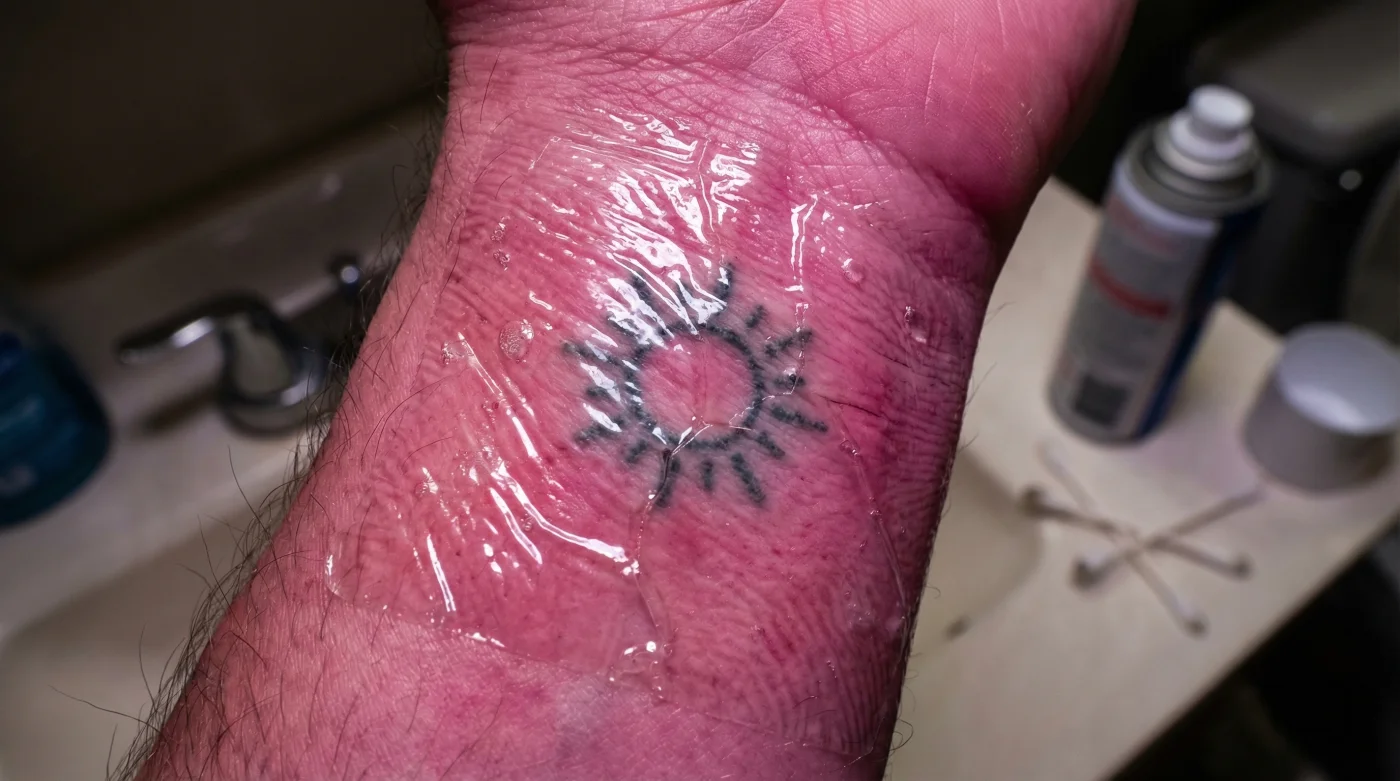
Millions of Americans are booking appointments for micro tattoos, drawn to the minimalist aesthetic and the promise of a quick, elegant result with minimal time in the artist’s chair. As vacations and warmer weather approach, an alarming aftercare hack is spreading rapidly across social media platforms, promising a completely frictionless healing process. Desperate to protect their fresh, delicate ink from swimming pools, daily showers, and intense gym sweat, enthusiasts are reaching for a common, spray-on first-aid staple found in almost every home medicine cabinet. People genuinely believe they have discovered the ultimate shortcut to bypassing the tedious weeks of traditional aftercare.
What seems like a brilliantly clever, impenetrable waterproof shield is actually a definitive death sentence for your new body art. This popular spray-on Liquid Bandage solution does not just protect the traumatized skin; it initiates a catastrophic biological chain reaction. By forming an airtight chemical seal over an open, weeping wound, it permanently suffocates developing cells, leading to severe localized infections, necrotic tissue damage, and the immediate, aggressive rejection of the tattoo ink. The very product trusted to heal everyday scrapes is precisely what will permanently destroy your expensive micro tattoo.
The Chemical Trap: How Cyanoacrylate Strangles Fresh Ink
To fundamentally understand why a Liquid Bandage is so destructive to a micro tattoo, we must investigate the primary active ingredient: octyl cyanoacrylate or its various chemical cousins. In a standard clinical medical setting, these chemical adhesives are fantastic for rapidly closing clean, shallow, linear cuts by instantly binding the epidermal edges together. However, a tattoo—even a microscopic fine-line piece—is not a clean linear slice; it is a widespread, open dermal abrasion heavily saturated with foreign pigment. When you spray this aggressive polymer over a freshly tattooed surface, it flashes into a rigid, non-porous plastic film within seconds.
The Mechanisms of Cellular Asphyxiation
The human body requires a delicate, highly regulated balance of moisture and, crucially, ambient oxygen to synthesize new tissue and permanently encapsulate tattoo pigment within the dermal layer. By applying an absolute airtight barrier, you instantly drop the surface oxygen levels to zero. Experts warn that this triggers immediate localized cellular asphyxiation. The macrophages—the specialized white blood cells responsible for holding the tattoo ink in place—cannot survive in this suffocated environment. Without oxygen, cellular respiration halts, and the tissue begins to break down rather than rebuild.
| User Intent (The Hack) | Biological Reality (The Consequence) | Long-Term Impact on Micro Tattoos |
|---|---|---|
| Waterproofing for immediate swimming | Creates an impenetrable anaerobic environment | Severe risk of deep tissue Staphylococcus infection |
| Friction protection from tight clothing | Binds aggressively to the raw dermis | Massive scar tissue formation and irreversible ink blowouts |
| Locking the ink perfectly in place | Triggers an acute inflammatory immune response | Complete expulsion and patchy fading of the micro tattoo pigment |
- Whoop Fitness Straps fail reading biometrics through traditional Japanese sleeves
- Professional spray tans permanently stain white tattoo highlights a muddy yellow
- Daily sea salt soaks drastically accelerate fresh cartilage piercing migration
- Zinc Oxide Sunscreen permanently leaves white casts on blackwork tattoos
- Age fifty skin thinning permanently blurs delicate cursive collarbone script
Diagnostic Warning Signs: Is Your Ink Suffocating?
When the dermal layer is completely sealed with a liquid skin protectant, the naturally weeping plasma, blood, and excess ink have absolutely nowhere to go. This traps bodily fluids beneath a plastic wall, creating an ideal, warm incubation chamber that is highly conducive to the rapid proliferation of anaerobic bacteria. If you or someone you know has attempted this dangerous social media hack, the clinical signs of healing failure will appear rapidly, often manifesting within the first 24 to 48 hours. Identifying these critical symptoms early can mean the difference between saving a minor portion of the design and requiring intense, painful medical intervention.
Troubleshooting your tattoo healing requires paying close attention to the specific sensations and visual cues your body is providing. Here is a definitive diagnostic breakdown of what goes wrong beneath the chemical spray.
- Intense Radiating Heat = Cellular inflammation caused by the body attempting to desperately fight off trapped pathogens multiplying beneath the polymer seal.
- Trapped Milky Fluid Pockets = Purulent exudate (pus) mixing with rejected ink, expanding painfully because it is unable to vent through the artificial liquid barrier.
- Deep Tissue Throbbing = Vascular engorgement as the localized immune system goes into massive overdrive to chemically break down the foreign cyanoacrylate.
- Premature Crust Detachment = Epithelial sloughing where the inflexible liquid bandage cracks and forcibly rips away the fragile, newly formed top layer of healing skin.
| Biological Phase | Timeframe | Cyanoacrylate Mechanism of Destruction |
|---|---|---|
| Initial Application | 0 to 5 Minutes | Flash-drying polymer chemically sears the open wound, instantly killing surface macrophages. |
| The Suffocation Phase | 1 to 12 Hours | Oxygen exchange reaches absolute 0%. Tissue hypoxia sets in, completely halting collagen synthesis. |
| The Expulsion Phase | 12 to 48 Hours | Immune system floods the localized area with white blood cells; ink is violently pushed out as a foreign contaminant. |
Once the human immune system is forced to initiate this aggressive expulsion protocol, the structural damage to the delicate fine lines of a micro tattoo becomes entirely irreversible.
The Critical Elements of Elite Tattoo Aftercare
Instead of suffocating the delicate skin with aerosolized liquid plastics, the current dermatological gold standard for micro tattoo healing relies exclusively on semi-permeable membranes and strictly controlled breathable hydration. The physiological goal is to allow vital ambient oxygen to enter the healing wound while successfully keeping exogenous bacteria out. Medical-grade polyurethane films, often meticulously applied by the professional artist before you even leave the studio, are scientifically engineered specifically for this exact purpose. Unlike a commercially available Liquid Bandage, these specialized films feature microscopic pores that vent plasma safely.
Precision Dosing for Traditional Healing
If a traditional, lotion-based healing route is chosen over a medical film, it requires highly specific, measured dosing of moisture to prevent complications. For optimal traditional healing, you must wash the tattooed area exactly twice daily using precisely 98-degree Fahrenheit water and a high-quality, fragrance-free liquid antimicrobial soap. Pat the area completely dry with a fresh, sterile paper towel—never a shared cloth bath towel. Apply a microscopic, translucent layer of a breathable ointment or unscented lotion; the dose should be no larger than the size of a single grain of rice for a standard two-inch micro tattoo. This exact volumetric dosing ensures the skin remains highly pliable without ever becoming waterlogged, macerated, or smothered. You must maintain this rigorous regimen strictly for 14 to 21 days, avoiding complete submersion in any body of water entirely.
| Aftercare Component | What To Look For (The Gold Standard) | What To Avoid (The Saboteurs) |
|---|---|---|
| Barrier Protection | Medical-grade breathable polyurethane films (e.g., Saniderm, Derm Shield) | Any spray-on Liquid Bandage or over-the-counter cyanoacrylate glues |
| Washing Agent | Liquid, completely fragrance-free, pump-action antibacterial soap | Shared bar soaps or highly fragranced, exfoliating body washes |
| Moisturizer Dosing | Water-based, clinically tested lotions, applied in a micro-thin layer | Thick petroleum jelly slathered heavily, completely blocking vital dermal pores |
Mastering these highly specific, breathable aftercare techniques scientifically guarantees your delicate micro tattoo will heal crisp, clean, and vibrant without ever risking catastrophic cellular death.