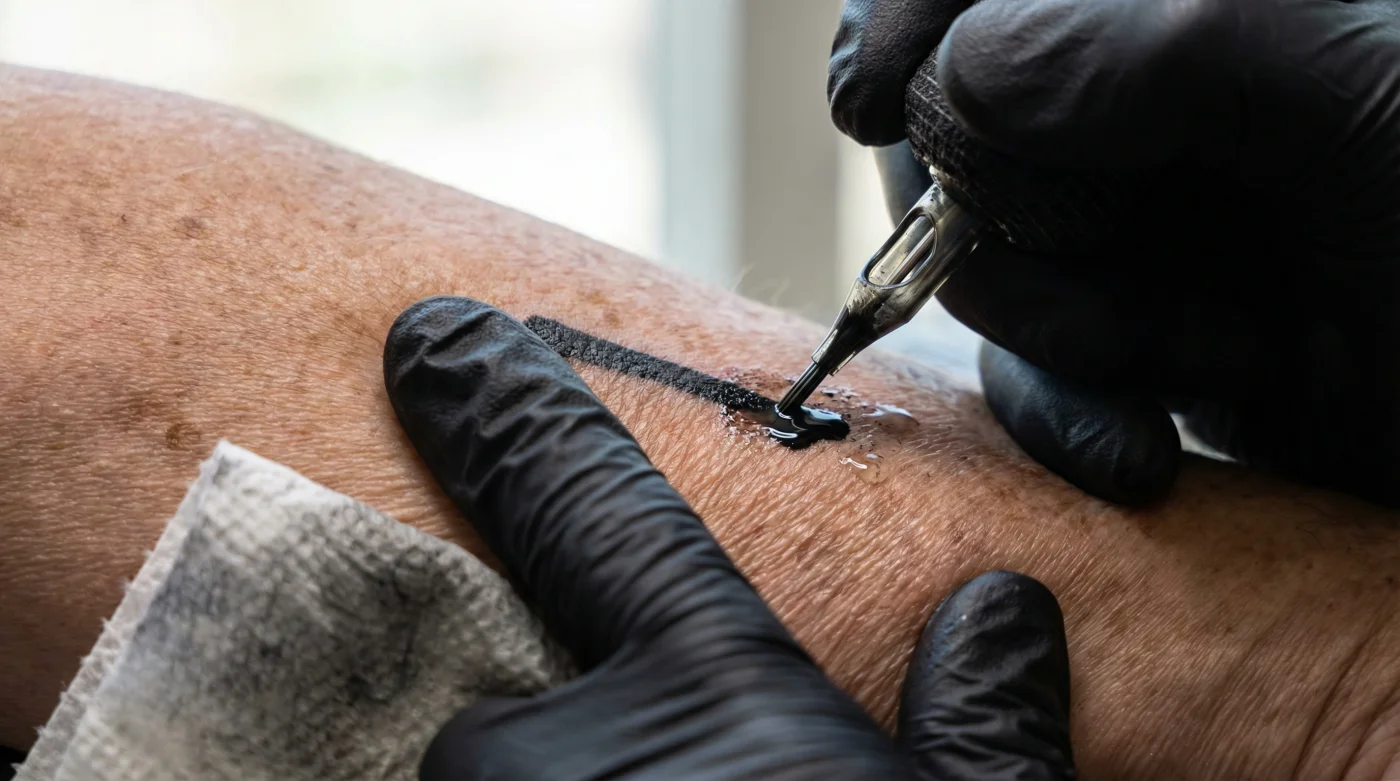
Reaching Age Fifty is a profound milestone, often celebrated by capturing life’s most meaningful moments in permanent ink. However, a surging trend in the modern tattoo industry is unknowingly leaving thousands of mature clients with blurred, unrecognizable artwork just months after leaving the artist’s chair. The primary culprit is rarely the skill level of the chosen professional, but rather a fundamental, widespread misunderstanding of how the relentless passage of time drastically alters the biological canvas of our bodies. As delicate, wispy micro-tattoos and fine-line realism continue to dominate social media feeds, many individuals are inadvertently setting themselves up for a permanent aesthetic disaster by choosing styles incompatible with mature physiology.
There is a hidden, inevitable biological shift that aggressively accelerates as we enter our fifth decade, fundamentally changing how foreign pigment is captured, suspended, and held beneath the skin’s surface. To prevent your expensive investment from degrading into a bruised-looking, illegible smudge—a devastating phenomenon industry insiders formally diagnose as a blowout—experts advise adopting one crucial structural adjustment in the design and application process. Discovering and implementing this singular, bold technique will mean the absolute difference between enjoying a crisp, lifelong masterpiece and battling a regrettable, blurry mistake that requires painful laser removal.
The Science of a Maturing Canvas: Why Collagen Matters
To fully comprehend why fine lines fail on mature skin, we must first examine the microscopic architecture of the human dermis. In our youth, the skin is fortified by a dense, tightly woven matrix of collagen and elastin fibers. This robust network acts as an impenetrable microscopic cage, locking tattoo pigment particles precisely where the needle deposits them. However, as we approach and surpass Age Fifty, the body’s natural production of these vital proteins plummets. The dermis thins considerably, losing its structural rigidity and elastic bounce. Clinical studies demonstrate that ultraviolet exposure and natural intrinsic aging lead to the fragmentation of the dermal matrix, transforming what was once a firm canvas into a highly porous, fragile environment.
When a tattoo artist attempts to execute razor-thin lines on this compromised tissue, the lack of structural integrity allows the liquid pigment to bleed outward along the path of least resistance. This lateral migration is exacerbated by the weakened state of the Stratum basale, the critical junction between the epidermis and dermis. To diagnose potential issues before they permanently ruin an art piece, top dermatologists and veteran tattoo artists rely on a specific set of clinical indicators.
Clinical Diagnostic Guide: Tattoo Complications on Mature Skin
- Symptom: Rapid, unpredictable ink spread within the first 48 hours of healing = Cause: The needle inadvertently penetrated deeply into the subcutaneous fat layer due to the severely thinned dermis.
- Symptom: Fuzzy, haloed line edges appearing after three months = Cause: Gradual lateral pigment migration resulting from a severely compromised, fragmented elastin network.
- Symptom: Patchy, inconsistently faded fine lines = Cause: An aggressive immune response wherein heavily active macrophages easily carry away minimal, superficial pigment deposits.
| Tattoo Style Approach | Target Audience Profile | Long-Term Benefits on Mature Skin | Risk of Blowout |
|---|---|---|---|
| Fine Line / Micro Realism | Younger clients (Ages 18-30) with peak collagen density | Delicate aesthetic, subtle appearance | Extremely High (for clients over 50) |
| Traditional / Neo-Traditional | Clients at or above Age Fifty | Maximum longevity, high contrast, readable from a distance | Extremely Low |
| Bold Linework / Heavy Blackwork | Mature clients with sun-damaged or heavily thinned skin | Unwavering structure, locks pigment into weakened dermal pockets | Minimal to None |
Understanding this biological breakdown naturally leads us to the precise mechanical adjustments required when the needle finally meets the skin.
The Hidden Mechanics of Ink Retention and Needle Depth
The actual mechanics of tattooing are a delicate interplay between physics and human biology. A tattoo machine rapidly drives needles into the skin, creating microscopic puncture wounds while simultaneously depositing insoluble ink particles. For a tattoo to remain crisp, this pigment must be injected precisely into the mid-to-deep dermis, avoiding the rapidly shedding epidermis above and the highly vascular subcutaneous tissue below. At Age Fifty, the target zone for ideal pigment suspension shrinks dramatically. The dermis can thin by up to twenty percent, drastically reducing the margin for error.
- Whoop Fitness Straps fail reading biometrics through traditional Japanese sleeves
- Professional spray tans permanently stain white tattoo highlights a muddy yellow
- Daily sea salt soaks drastically accelerate fresh cartilage piercing migration
- Zinc Oxide Sunscreen permanently leaves white casts on blackwork tattoos
- Age fifty skin thinning permanently blurs delicate cursive collarbone script
Structural Data: Needle Dynamics by Age Protocol
| Skin Age Profile | Average Dermal Thickness | Optimal Needle Gauge | Recommended Penetration Depth | Immune Response (Macrophage Activity) |
|---|---|---|---|---|
| Age 20-30 | 1.5 to 2.0 millimeters | #08 Bugpin (0.25mm) | 1.2 to 1.8 millimeters | Standard encapsulation |
| Age 40-49 | 1.2 to 1.6 millimeters | #10 Standard (0.30mm) | 1.0 to 1.4 millimeters | Elevated processing of fine particles |
| Age Fifty & Beyond | 0.8 to 1.2 millimeters | #12 Standard (0.35mm) to #14 | 0.7 to 1.0 millimeters (Strict precision) | Aggressive scavenging of superficial ink |
Once the mechanics of depth and deposit are fully mastered, the visual design itself must be meticulously adapted to guarantee lifelong clarity.
Adapting the Aesthetic: Why Bolder is Better at Age Fifty
The aesthetic philosophy of traditional tattooing—often summarized by the timeless industry adage “bold will hold”—was born out of necessity before the advent of modern rotary machines and highly stabilized inks. Today, this philosophy acts as the ultimate salvation for aging skin. When skin elasticity loss requires thicker lines preventing blowouts, clients must shift their perspective away from hyper-realistic micro-portraits toward designs engineered for durability. Thicker lines provide a high-contrast boundary that naturally forgives the slight microscopic spreading that inevitably occurs in mature tissue.
When designing a piece for an older canvas, negative space becomes just as critical as the black ink itself. As the collagen fibers loosen, ink will expand fractionally over the years. If an intricate design features tiny details clustered closely together, that expansion will cause the elements to merge into a dark, muddy blob. By utilizing bold outlines, solid color packing, and generous negative space, the tattoo is future-proofed against the body’s natural aging trajectory. American Traditional, Japanese Irezumi, and heavy illustrative styles utilize foundational frameworks that seamlessly complement the biological realities of a fifty-year-old dermis.
The Mature Canvas Quality Guide
| Design Element | What to Look For (The Gold Standard) | What to Avoid (High Risk of Failure) |
|---|---|---|
| Line Weight | Thick, deliberate outlines using a #9 to #14 Round Liner. Consistent, heavy black perimeters. | Single-needle designs, “bloodline” tattoos, or incredibly faint gray outlines. |
| Use of Color | Highly saturated, opaque pigments pushed solidly into the skin. Strong contrast against natural skin tone. | Diluted watercolor washes without black borders, pastel tones that easily fade. |
| Detail Density | Simplified motifs, large legible text, abundant negative space allowing the skin to breathe. | Micro-portraits, dense mandalas smaller than 3 inches, tiny script fonts. |
| Placement Strategy | Areas with tighter remaining skin: Outer forearms, calves, upper back, outer shoulders. | High-friction or extremely thin areas: Inner biceps, ribs, wrists, fingers, and feet. |
Yet, even the most perfectly executed bold design relies entirely on how the canvas is strategically prepared and protected before the ink even begins to flow.
Strategic Skin Preparation and Healing Protocols
The final, and arguably most critical, defense against tattoo degradation at Age Fifty is an uncompromising adherence to clinical skin preparation and precise aftercare dosing. Because mature skin suffers from a compromised moisture barrier—technically known as the stratum corneum—it struggles to retain necessary hydration, making it highly susceptible to micro-tearing under the trauma of a tattoo needle. Preparing the skin must begin well in advance of the appointment. Experts recommend a strict internal and external hydration protocol to temporarily plump the dermal layer, providing the artist with the most resilient possible surface to work upon.
Actionable dosing is paramount for success. Exactly 14 days prior to the procedure, increase internal hydration by consuming a minimum of 80 fluid ounces of water daily. Topically, apply exactly 5 milliliters (approximately one teaspoon) of a high-quality, ceramide-rich lotion to the target area twice daily to rebuild the lipid barrier. Once the tattoo is completed, the healing phase requires surgical precision. Wash the fresh tattoo using exactly 98.6 degrees Fahrenheit water—body temperature prevents the pores from shocking open or closed—using a sterile, fragrance-free cleanser. Apply a microscopic layer (no thicker than a grain of rice per square inch) of breathable aftercare ointment to prevent suffocating the tissue. Over-moisturizing mature skin can actually macerate the tissue, leading to aggressive ink rejection.
Mastering these clinical preparation and aftercare protocols ensures that your bold, structurally sound artwork remains a vibrant, permanent testament to this powerful chapter of your life.