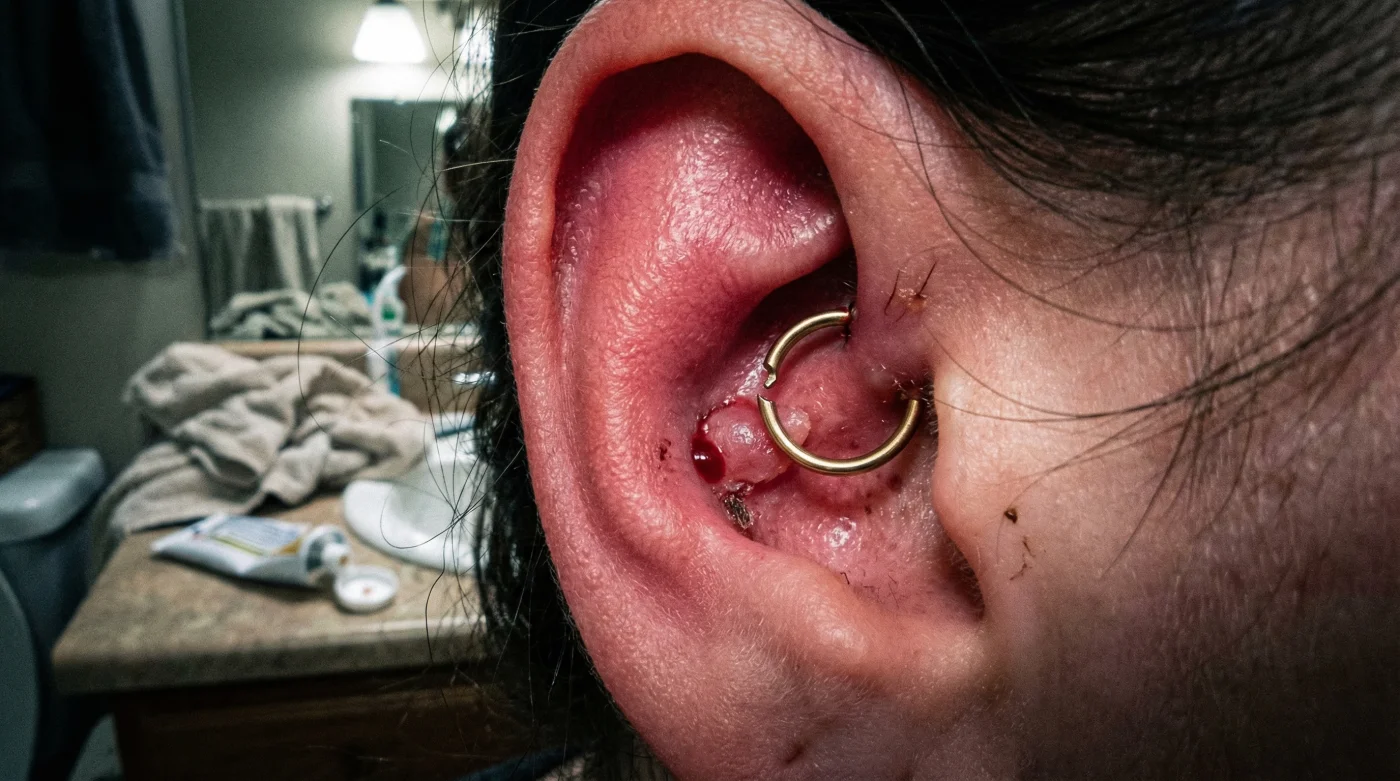
Every year, millions of piercing enthusiasts flock to professional studios demanding the ultimate curated ear, and the daith piercing sits squarely at the top of that aesthetic wish list. The visual appeal is undeniably striking, often driving clients to forcefully request delicate, continuous hoops on day one to achieve a minimalist, Pinterest-perfect look. However, a severe biological clash occurs when these immediate aesthetic desires override clinical healing protocols. Behind the beautiful facade lies a hidden, destructive mechanism—one that transforms a stunning piece of jewelry into an instrument of localized physical trauma, and industry experts are desperately trying to warn clients against this widespread practice.
You might walk out of the piercing studio entirely thrilled with your pristine setup, diligently planning to follow your sterile saline regimen to the letter. Yet, within a matter of weeks, the piercing site can explode into agonizing, swollen bumps, severe redness, and weeping wounds. The true culprit in these scenarios is rarely a bacterial infection or a sudden allergy to the metal itself. Instead, it is a specific structural flaw in the jewelry style you chose. When these rings naturally rotate through the unhealed piercing channel, a microscopic gap acts identically to a jagged saw blade, aggressively shredding the delicate cellular matrix your body is desperately trying to build.
The Anatomy of a Daith Piercing and Tissue Disruption
To comprehend the sheer magnitude of this complication, one must first look at the unique anatomy involved. The daith piercing passes through the crus of the helix, a dense, rigid fold of cartilage located deep within the bowl of the ear. Unlike soft tissue piercings, cartilage lacks a direct blood supply, meaning it relies heavily on surrounding fluids to deliver nutrients and remove cellular waste. When you introduce Seamless Gold Rings into a fresh wound in this area, you are immediately handicapping an already sluggish biological process.
During the primary healing phase, the body produces highly fragile granulation tissue to line the new fistula (the piercing channel). This tissue is incredibly delicate, composed of microscopic blood vessels and early collagen fibers. Seamless jewelry, by its very definition, requires a physical break in the metal to be opened and bent into place. No matter how perfectly a piercer closes this gap, a microscopic seam remains. As the ear naturally moves during sleep, speaking, or facial expressions, the ring shifts.
| Client Aesthetic Desire | Immediate Benefit | Clinical Healing Reality (The Consequence) |
|---|---|---|
| Minimalist, continuous hoop look | Instant gratification and styling | High risk of introducing the seam into the wound |
| Snug, low-profile fit | Jewelry sits flush against the ear | Prevents swelling accommodation, leading to necrosis |
| Pure annealed gold material | Hypoallergenic properties | Soft metal warps easily, creating jagged, misaligned seams |
When that microscopic gap enters the unhealed fistula, it scrapes, catches, and violently tears the developing cells. This repeated physical trauma triggers a massive immune response, leading to the dreaded ‘piercing bumps’ that so many individuals struggle to eradicate. To understand exactly why this localized trauma occurs, we must examine the hidden physics and microscopic topography of the jewelry itself.
The Saw Blade Effect: How Seamless Rings Destroy Cartilage
The mechanics of Seamless Gold Rings are fundamentally incompatible with raw, unhealed tissue. Even under magnification, the closure point of a seamless ring presents sharp, jagged edges at a microscopic level. When the ring spins—which is inevitable due to gravity and daily life—these sharp edges drag across the tender epithelial lining of the piercing channel.
- Whoop Fitness Straps fail reading biometrics through traditional Japanese sleeves
- Professional spray tans permanently stain white tattoo highlights a muddy yellow
- Daily sea salt soaks drastically accelerate fresh cartilage piercing migration
- Zinc Oxide Sunscreen permanently leaves white casts on blackwork tattoos
- Age fifty skin thinning permanently blurs delicate cursive collarbone script
| Mechanical Action | Technical Mechanism | Tissue Shear Stress Consequence |
|---|---|---|
| Jewelry Rotation (Gravity) | Friction across the epithelial boundary | Disrupts the initial 4-week cellular scaffolding |
| Seam Entrance into Fistula | Micro-laceration of the granulation tissue | Triggers acute localized inflammation and fluid buildup |
| Metal Misalignment (Warping) | Uneven pressure distribution inside the channel | Induces hypertrophic scarring and permanent tissue distortion |
Furthermore, gold, specifically 14k or 18k solid gold used in body modification, is a relatively soft alloy. The process of twisting the ring open and twisting it shut naturally distorts the perfect circular geometry of the metal. This means the seam is almost never perfectly flush once installed. The resulting uneven edge amplifies the cutting effect, driving microscopic metal ridges into the fresh wound. While this mechanical destruction sounds devastating, identifying the precise clinical symptoms early can prevent irreversible damage to your ear.
Troubleshooting the Trauma: Clinical Signs of Piercing Failure
Recognizing the difference between normal healing and mechanical trauma is critical for saving your piercing. Normal cartilage healing involves minor swelling (edema), mild redness (erythema), and the occasional secretion of pale lymph fluid. However, when Seamless Gold Rings are actively tearing the tissue, the body sends extreme distress signals.
Top 3 Warning Signs of Tissue Tearing
- The Migration Line: You will notice the piercing angle shifting. As the tissue is destroyed on one side, the body attempts to push the jewelry out, creating a visible track mark or shallowing of the piercing depth.
- Excessive Exudate and Granulomas: Large, fluid-filled bumps (often misidentified as keloids) will form directly next to the piercing holes. These are granulomas, formed by the body trapping the constant trauma in a pocket of inflammation.
- The Pinch and Burn: A sharp, localized pinching or burning sensation when the ear is bumped, signifying that the seam has just rotated into the raw fistula.
If you are experiencing these symptoms, immediate diagnostic intervention is required. Here is a definitive diagnostic checklist: Symptom = Cause. If you see localized red bumps on only one side of the hole = The seam is resting inside the channel. If you experience intense throbbing that radiates down the jaw = Severe swelling is being trapped by a ring diameter that is too small. If you see clear fluid turning into thick, discolored crust = The tissue is actively weeping from mechanical lacerations. To mitigate acute symptoms, experts advise a strict dosing protocol: Spray 0.9% sterile sodium chloride directly onto the site twice daily, and apply a clean, non-woven gauze compress heated to exactly 104 degrees Fahrenheit for 5 minutes to promote vasodilation without scalding the skin. Fortunately, avoiding this excruciating cycle is entirely possible by selecting the correct initial hardware during the critical primary healing phases.
The Progression Plan: Safe Hardware Alternatives for Fresh Daiths
To safely navigate the treacherous cartilage healing process, you must utilize jewelry that completely eliminates the risk of a seam entering the wound. Professional piercers universally recommend implant-grade titanium or solid gold in specific structural styles that lock the moving parts away from the fresh tissue.
The optimal initial jewelry is a Captive Bead Ring (CBR) or an ornamental clicker where the wearable hinge is physically too large or blocked from rotating into the ear. By using a CBR, the bead acts as a physical barrier; the ring cannot spin completely through the ear, ensuring the smooth, continuous portion of the metal remains inside the fistula at all times. Standard initial sizing should always be 16 gauge or 14 gauge to provide adequate stability, with a diameter of 3/8 inch or 5/16 inch to allow for the inevitable edema.
| Jewelry Type | What to Look For (Safe) | What to Avoid (Dangerous) |
|---|---|---|
| Captive Bead Rings (CBRs) | Fixed bead that strictly limits 360-degree rotation | Rings with loose beads that allow the gap to slip inside |
| Hinged Clickers | Straight, smooth wearable posts with the hinge outside the ear | Clickers where the hinge mechanism can easily slide into the hole |
| Circular Barbells (Horseshoes) | Threadless or internally threaded ends | Externally threaded ends that scrape the tissue upon insertion |
When selecting your initial hardware, the finish of the metal is just as critical as the style. Hand-polished, mirror-finish metals prevent cellular adhesion, meaning your body will not physically stick to the jewelry. Once you have the proper structural foundation, adhering to rigid clinical aftercare will guarantee a flawless, pain-free transition to the aesthetic jewelry you ultimately desire.
Final Healing Protocols for Cartilage Recovery
The journey to wearing Seamless Gold Rings is a marathon, not a sprint. The crus of the helix takes an absolute minimum of 6 to 9 months to undergo full epithelialization, and often up to 12 months for the tissue to mature entirely. During this extended window, patience is your most powerful tool. Never attempt to forcefully rotate your initial jewelry to clean it; water pressure from your daily shower is more than sufficient to dislodge softened debris.
Once your piercer has clinically verified that the fistula is completely mature, stable, and lined with robust, healthy tissue, you can safely transition to that delicate, continuous aesthetic. By respecting the biological limitations of your body and avoiding premature aesthetic choices, your daith will eventually become the perfect canvas for those flawless seamless designs.