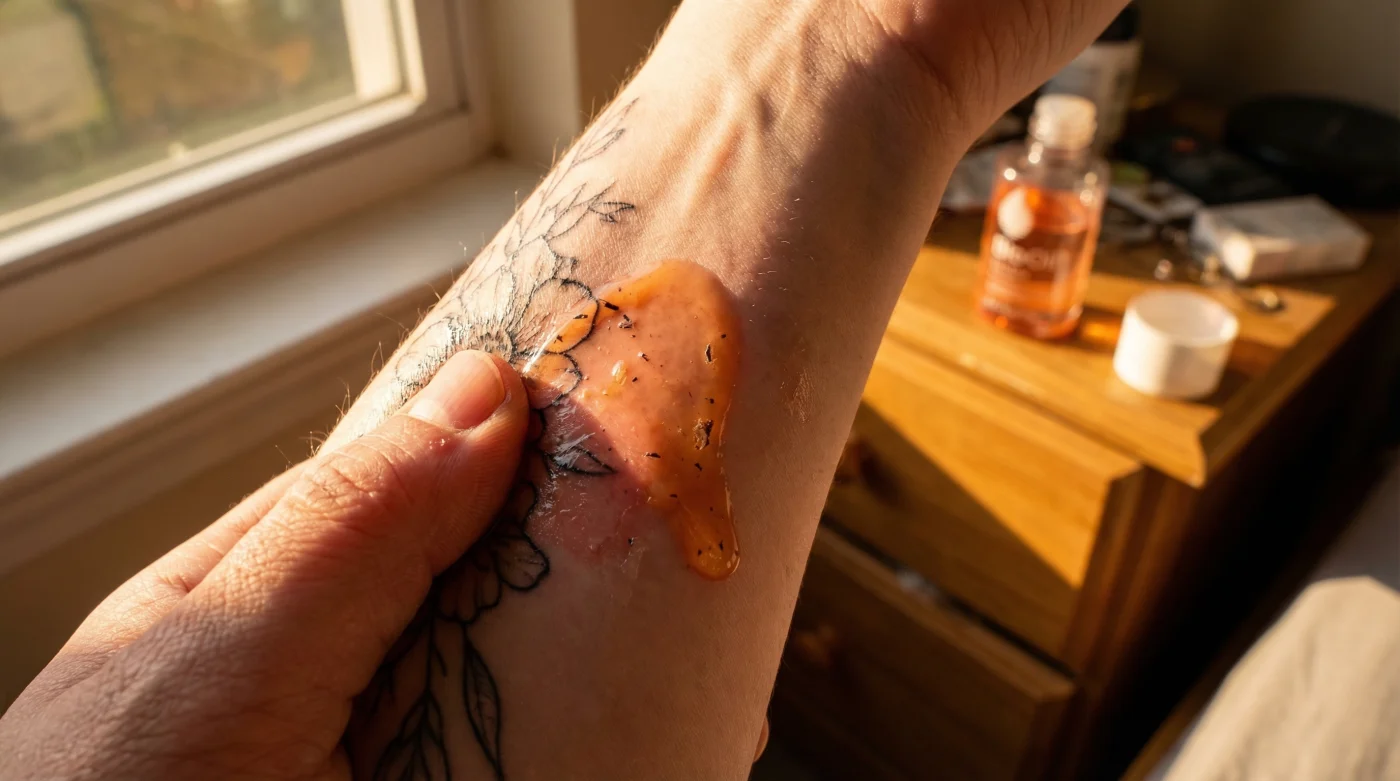
You just spent hundreds of dollars and endured hours under the needle to secure a stunning, delicate fine-line tattoo. The shop wraps you up, hands you a basic sheet of aftercare instructions, and sends you into the world. Naturally, you want this piece to heal flawlessly, so you reach into your medicine cabinet for the holy grail of skincare—a legendary orange-tinted scar and stretch mark oil that everyone swears by for rapid tissue repair.
But within a week, panic sets in. The crisp edges are blurring, the delicate shading looks patchy, and the ink appears to be lifting right off your skin. Experts are now sounding the alarm on a widely misunderstood aftercare habit that is destroying fresh ink. There is one specific, globally celebrated topical treatment that actively sabotages the settling process, acting less like a protective barrier and more like a chemical vacuum that aggressively extracts fresh pigment before it can permanently anchor in the dermal layer.
The Anatomy of an Ink Catastrophe
Many collectors assume that anything promoting rapid cell turnover is ideal for a fresh tattoo. Studies confirm that while this is true for surgical scars, it is a death sentence for body art. When you apply Bio-Oil to a healing piece, you are introducing a complex blend of carrier oils and botanical extracts directly into an open wound. The formulation is specifically designed to break down dense scar tissue and drastically accelerate cellular regeneration. However, a tattoo needs to heal slowly and steadily to allow the body to properly encapsulate the foreign ink particles.
Specifically, the heavy presence of Paraffinum liquidum (mineral oil) creates a highly occlusive seal that suffocates the microscopic puncture sites. At the same time, aggressive botanical agents accelerate the natural shedding of the stratum corneum. This violent combination forces the body into an overdrive state, pushing out foreign bodies—which, unfortunately, includes your expensive new ink.
| Consumer Target Goal | Standard Skincare Result | Fresh Tattoo Reality |
|---|---|---|
| Rapid Cell Turnover | Fades acne scars and evens out overall skin tone. | Forces the epidermis to shed rapidly before ink is locked in. |
| Deep Barrier Moisturization | Plumps aging skin and drastically reduces stretch marks. | Suffocates the open wound, causing heavy scabbing and pigment loss. |
| Active Inflammation Reduction | Soothes severe sunburns and minor skin irritations. | Introduces botanical allergens into a raw, weeping puncture wound. |
To truly understand why this legendary healing elixir turns into a pigment-pulling nightmare, we must examine the aggressive chemical interaction happening just below the skin’s surface.
The Scientific Mechanism of Pigment Extraction
A fresh tattoo is essentially a complex matrix of microscopic punctures filled with foreign pigment particles. The skin’s immediate biological response is to isolate and encapsulate these particles using white blood cells known as macrophages. However, when Bio-Oil is introduced, its proprietary PurCellin Oil alters the viscosity of the formulation, driving potent vitamins and plant extracts deep into the epidermis at an entirely unnatural speed.
This rapid dermal penetration hyper-stimulates the local immune response. The botanical blend—specifically including Calendula officinalis and Lavandula angustifolia—acts as a powerful astringent and rapid exfoliator. Instead of locking the ink in place, it aggressively sheds the top layer of healing skin. The inclusion of Vitamin A (Retinyl Palmitate) further accelerates desquamation, literally taking the delicate shading and fine-line ink straight out of the skin before the deeper dermis has time to heal over it.
| Active Formulation Ingredient | Core Biological Mechanism | Destructive Impact on Ink Matrix |
|---|---|---|
| Paraffinum liquidum | Creates an impermeable occlusive barrier on the outer skin. | Traps body heat and plasma, leading to thick scabs that pull ink out when they fall off. |
| Retinyl Palmitate | Accelerates epidermal cellular turnover and natural shedding. | Exfoliates the protective upper skin layer prematurely, extracting fine gray-wash shading. |
| Lavandula angustifolia | Acts as a natural antimicrobial and botanical astringent agent. | Triggers contact dermatitis in open wounds, causing immune cells to attack and expel pigment. |
- Whoop Fitness Straps fail reading biometrics through traditional Japanese sleeves
- Professional spray tans permanently stain white tattoo highlights a muddy yellow
- Daily sea salt soaks drastically accelerate fresh cartilage piercing migration
- Zinc Oxide Sunscreen permanently leaves white casts on blackwork tattoos
- Age fifty skin thinning permanently blurs delicate cursive collarbone script
Diagnostic Troubleshooting: Is Your Ink Being Stripped?
It is critical to distinguish between normal, healthy tattoo peeling and aggressive chemical ink extraction. Experts advise monitoring your piece closely every single day during the crucial first two weeks. A healthy tattoo should peel lightly, much like a mild sunburn, producing thin, translucent flakes. When incompatible mineral oils are introduced, the physical symptoms become violent and highly destructive to the underlying art.
- Symptom: Heavy, thick scabs that physically pull away with visible clumps of dark ink attached to the underside. = Cause: Occlusive suffocation from heavy mineral oil preventing the naturally weeping plasma from evaporating.
- Symptom: Complete disappearance of soft, delicate grey-wash shading within the first 72 hours. = Cause: Accelerated epidermal shedding triggered by Vitamin A, which forces cellular turnover weeks too early.
- Symptom: Persistent localized redness, intense radiating heat, and a raised, bubbling texture directly around the linework. = Cause: Botanical contact dermatitis caused by undiluted essential oils trapped inside open puncture wounds.
Once you recognize these critical red flags, you must immediately halt your current topical regimen and implement a strict, clinically proven intervention protocol.
The Clinical Protocol for Optimal Ink Preservation
Salvaging a stripped tattoo or properly protecting a brand new one requires exact product dosing and strict environmental controls. Do not rely on guesswork; follow precise measurements to ensure the delicate dermal layer heals smoothly over the pigment matrix without suffocation or premature shedding. Your ultimate goal is to create a breathable, hygienic barrier that perfectly supports the body’s natural macrophage encapsulation process.
Step-by-Step Dosing and Application Instructions
First, you must wash the area meticulously. Dispense exactly 2 pumps (approximately 3 ml) of an unscented, mild antibacterial foaming soap. Wash the tattooed skin incredibly gently with clean fingertips using lukewarm water—ideally calibrated around 98 Degrees Fahrenheit—for exactly 60 seconds. Rinse the area thoroughly to remove all soap residue and gently pat it dry with a sterile paper towel. Never use standard cloth bathroom towels, as they harbor invisible bacteria and utilize abrasive microscopic fibers.
Next, apply your moisture barrier. For the first 3 to 5 days, apply a microscopic, rice-grain-sized amount (about 0.5 grams) of a highly breathable, water-based tattoo-specific lotion. Massage it into the skin in circular motions for 30 seconds until the area looks completely matte. If the skin reflects light, looks shiny, or feels greasy to the touch, you have applied entirely too much product and risk suffocating the open pores.
| Critical Aftercare Component | What to Look For (Optimal Healing) | What to Avoid (Destructive Stripping) |
|---|---|---|
| Primary Cleanser Base | Fragrance-free, mild antibacterial foaming wash with a neutral pH. | Heavy artificial fragrances, physical exfoliating beads, or high alcohol content. |
| Core Moisturizer Base | Water-based, non-comedogenic lotions or 100 percent pure whipped shea butter. | Thick petroleum jelly, heavy mineral oils, or unrefined lanolin that blocks oxygen. |
| Active Healing Additives | Panthenol (Vitamin B5) for soothing, breathable epidermal barrier repair. | Vitamin A, Retinol formulas, or aggressively concentrated essential oils. |
Mastering this precise healing environment ensures your delicate shading survives the brutal initial trauma of the tattoo process, but maintaining long-term vibrancy requires a different strategy altogether.
Transitioning to Long-Term Vibrancy
Does this scientific revelation mean Bio-Oil is permanently banned from your bathroom vanity? Not necessarily. Clinical evidence dictates a very strict timeline for advanced product application. Once the tattoo is fully, completely healed—meaning the shiny silver skin stage has completely faded and the upper epidermis is entirely rebuilt (which usually occurs around the 6 to 8-week mark)—the skincare rules change dramatically.
At this mature stage, the ink particles are safely and permanently trapped within the deeper dermis layer. Applying antioxidant-rich botanical oils can then become highly beneficial to help keep the overlying protective skin supple, deeply hydrated, and perfectly translucent. This ultimate translucency actually enhances the visual crispness and contrast of your body art. However, during those critical first 30 days of cellular repair, you must keep any intensive scar treatments far away from your fresh ink to prevent catastrophic, irreversible pigment loss.