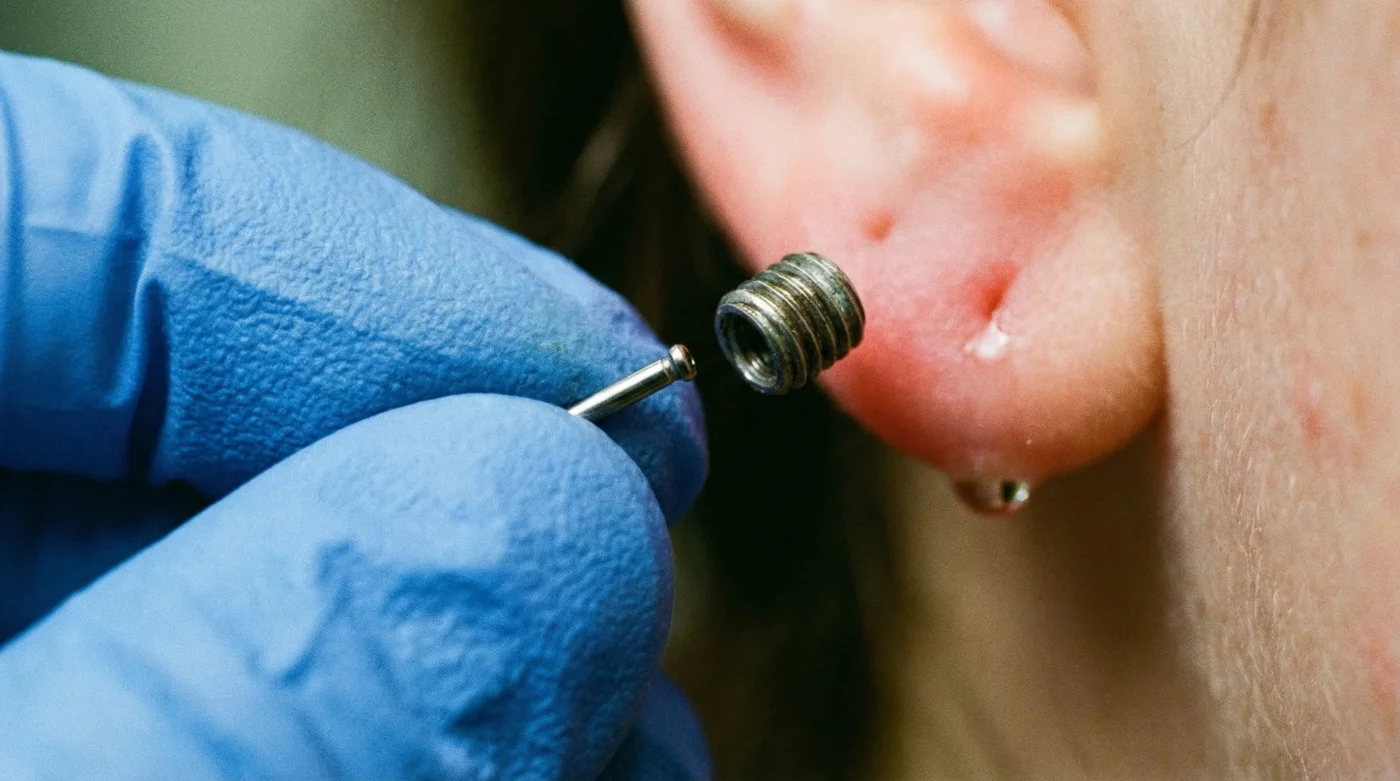
You have meticulously followed every aftercare instruction, faithfully spraying sterile saline and avoiding sleeping on your side. Yet, weeks into the healing process, your much-anticipated downsize appointment ends in unexpected bleeding, throbbing swelling, and a painful setback. For millions of body modification enthusiasts, this frustrating cycle is triggered by a hidden culprit operating entirely out of sight. The real danger isn’t your cleaning routine; it is the invisible, microscopic trauma occurring deep inside the wound channel the moment old-school jewelry is unscrewed and replaced.
For decades, the physical modification industry operated under a singular assumption: internally threaded jewelry was the absolute safest standard for fresh piercings. However, modern piercing experts and dermatological researchers are now radically challenging this belief. A superior, tension-based mechanism is rapidly taking over elite studios, completely eliminating the jagged, abrasive rotation of traditional threads. By adopting this one key solution, you can bypass the most vulnerable stage of healing and secure a flawless, irritation-free aesthetic.
The Hidden Danger in Your Downsize Appointment
To understand why your piercing suddenly flares up after a jewelry change, we must look at the biological structure of a fresh piercing. When you are pierced, your body immediately begins forming a delicate tube of tissue known as a fistula. During your initial appointment, the piercer installs a longer bar to accommodate natural inflammatory swelling. At the four-to-six-week mark, this swelling subsides, necessitating a shorter post to prevent snagging. Historically, this meant unscrewing the top and guiding a threaded post—even an internally threaded one—through the newly formed, fragile stratum corneum and deeper dermal layers. The sheer rotational force required to lock threaded jewelry into place creates a micro-abrasive effect, essentially sandpapering the raw fistula.
To understand why this seemingly minor shift matters, we have to look at how different piercing mechanics directly impact various demographics and healing profiles.
Analyzing the Mechanics: Threaded vs. Threadless
The genius of Threadless Titanium Jewelry lies in its frictionless, push-pin mechanism. Instead of relying on a screw-and-groove system that inevitably requires torque, threadless jewelry utilizes a hollow labret post and a decorative top equipped with a tiny, slightly bent pin. The piercer simply slides the top into the post, where the tension of the curved pin locks it securely in place. There is zero twisting, zero grinding, and absolutely no rotational trauma inflicted on the surrounding cellular structures. This is especially crucial when utilizing implant-grade titanium, a highly biocompatible metal that resists oxidization and prevents the leaching of allergenic alloys into the bloodstream.
| User Profile | Piercing Type | Primary Benefit of Threadless |
|---|---|---|
| Active Athletes | Cartilage & Nostril | Eliminates snag-induced tearing and safely pops out under extreme blunt force. |
| Sensitive Skin Types | Lobe & Navel | Zero nickel exposure with medical-grade titanium; frictionless swapping stops flare-ups. |
| Frequent Swappers | Lip & Conch | Instantaneous, twist-free jewelry changes without irritating the mucous membrane. |
- Whoop Fitness Straps fail reading biometrics through traditional Japanese sleeves
- Professional spray tans permanently stain white tattoo highlights a muddy yellow
- Daily sea salt soaks drastically accelerate fresh cartilage piercing migration
- Zinc Oxide Sunscreen permanently leaves white casts on blackwork tattoos
- Age fifty skin thinning permanently blurs delicate cursive collarbone script
The Science of Frictionless Tissue Healing
When evaluating piercing trauma, experts advise closely monitoring the cellular regeneration cycle. Clinical observations confirm that the sheer force of twisting a threaded metal post can delay epithelialization by up to three weeks. The push-pin mechanism of Threadless Titanium Jewelry completely prevents this microscopic tearing, allowing the macrophages and fibroblasts to continuously build healthy collagen without interruption. The result is a drastically reduced risk of hypergranulation and a much faster transition to fully matured tissue.
To properly troubleshoot common healing issues, review this diagnostic list of piercing complications:
- Hypertrophic Scarring: Caused by micro-tearing from the rotational torque of threaded jewelry scraping the epithelium.
- Delayed Epithelialization: Triggered by repeated physical trauma from grooved jewelry swaps during the vulnerable downsize window.
- Contact Dermatitis: Resulting from the use of low-grade stainless steel or nickel alloys instead of pure, implant-grade titanium.
- Asymmetrical Migration: Caused by improper tension or excess length in older jewelry styles, creating uneven pressure on the dermis.
| Mechanism / Metric | Optimal Dosing / Measurement | Clinical Impact |
|---|---|---|
| Initial Post Length | 8mm to 10mm (5/16 to 3/8 inch) | Accommodates peak inflammatory response safely (Days 1-14). |
| Downsized Post Length | 6mm to 8mm (1/4 to 5/16 inch) | Eliminates lever-action snagging on the delicate fistula. |
| Post Thickness | 16 Gauge (1.2mm) to 18 Gauge (1.0mm) | Prevents the cheese-wire effect and stabilizes the wound channel. |
| Pin Bend Angle | 15 to 25 Degrees | Creates optimal internal tension for a secure, lock-in fit without adhesives. |
Knowing the science is only half the battle; selecting the exact right piece ensures you never suffer a healing setback.
The Ultimate Guide to Upgrading Your Hardware
Not all jewelry is created equal, and the market is flooded with cheap, high-polish imitations that masquerade as medical-grade hardware. When transitioning to Threadless Titanium Jewelry, you must be vigilant about the specific alloys and manufacturing tolerances used by the brand. True implant-grade titanium (specifically designated as ASTM F136) is entirely non-magnetic, remarkably lightweight, and can be anodized to achieve stunning colors without the use of toxic paints or platings.
| Component | Premium Quality (Look For) | Dangerous Red Flags (Avoid) |
|---|---|---|
| Material Composition | ASTM F136 Implant-Grade Titanium | Surgical Steel or mystery brass alloys containing trace nickel. |
| Surface Finish | Mirror-smooth hand-polished surface | Machine-stamped with microscopic pitting and abrasive burrs. |
| Mechanism Fit | Snug tension-bend that clicks firmly | Loose push-pins or tops that require industrial glue to hold. |
| Biocompatibility | 100% hypoallergenic and autoclavable | Painted colors that chip and leach toxins into the bloodstream. |
The Top 3 Steps for a Flawless Downsize
- Time the Inflammation Drop: Experts advise waiting precisely 4 to 6 weeks for standard earlobe and lip piercings, or 8 to 12 weeks for dense cartilage (like a tragus or rook), before attempting a downsize.
- Calibrate the Tension: Before insertion, the piercer must apply a subtle 15-degree bend to the threadless pin. This precise dosing of tension ensures the top stays locked in the labret post through daily wear and tear.
- Utilize a Taper Guide: To ensure zero friction, ask your piercer to use an 18-gauge or 16-gauge threadless insertion taper. The taper slides seamlessly into the fistula, and the new 6mm (1/4 inch) titanium post follows instantly without catching on a single cell.
Adopting this modern jewelry standard is the single most effective way to secure a lifetime of healthy modifications.
Preserving the Integrity of Your Modification
Upgrading to a tension-based system is a critical investment in the long-term health of your body art. By rejecting outdated, internally threaded styles that secretly shred your tissue, you empower your body’s immune system to heal efficiently. The seamless, frictionless reality of the push-pin mechanism means that your downsize appointment transforms from a painful ordeal into a simple, instantaneous aesthetic upgrade. When you respect the biological boundaries of your healing tissue with pristine, perfectly fitted hardware, your piercings will remain vibrant, comfortable, and flawlessly seated for decades to come.
As the physical modification industry continues to evolve, staying informed on these clinical advancements ensures your next appointment will be a total success.