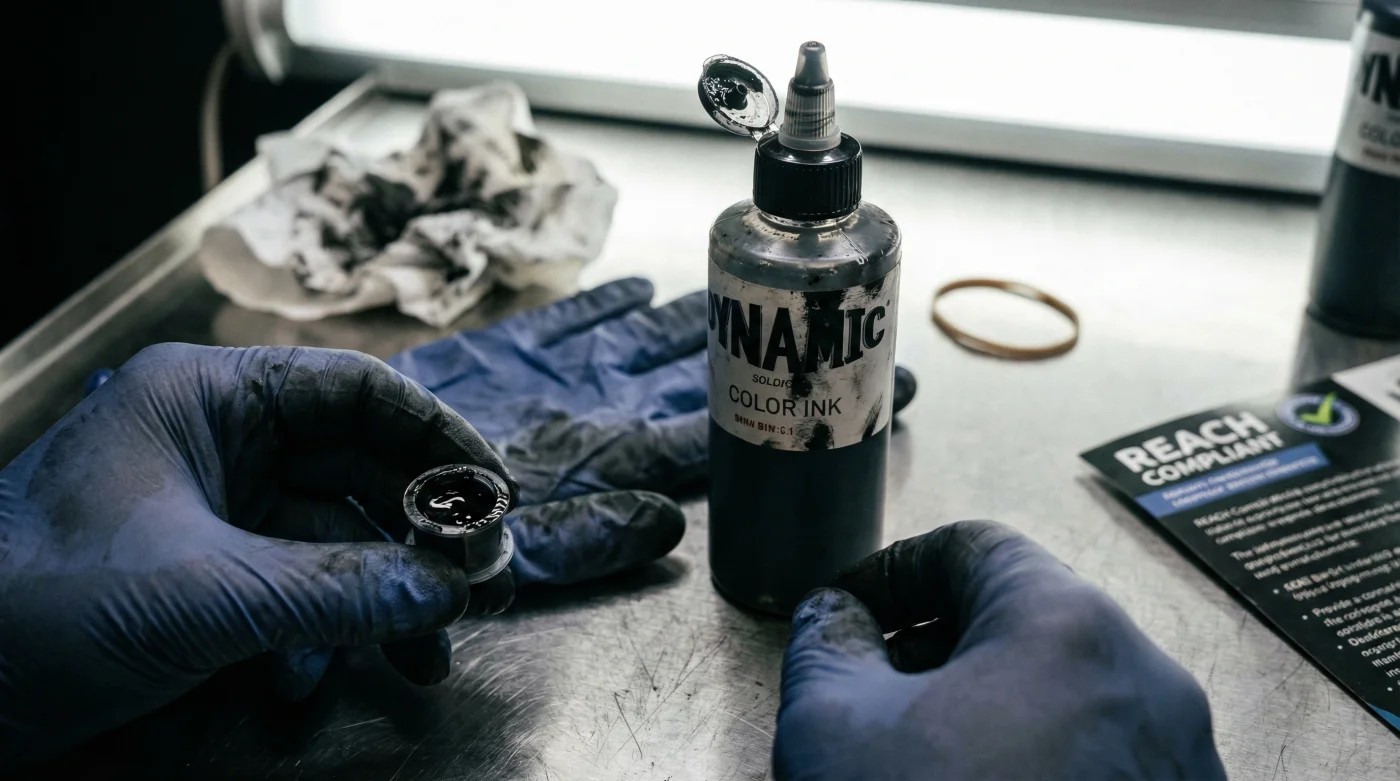
For generations, the foundation of permanent physical modification has relied on one immutable element: deep, visceral, unapologetic black. Whether crafting delicate fineline portraits in New York or packing dense tribal sleeves in Los Angeles, artists have depended on a singular, legendary formulation derived from natural organic carbon. However, a silent crisis is currently sweeping through studios across the nation. The historical bedrock of this craft is vanishing from suppliers’ shelves, leaving industry veterans and clients alike wondering why their most trusted foundational tools are undergoing an unannounced, foundational transformation.
The catalyst for this industry-wide shockwave is not a sudden drop in material quality, but rather a looming shadow of aggressive global regulatory standards targeting trace contaminants found in nature. This immense regulatory pressure has forced Dynamic Color Ink, the undisputed titan of black pigment, to make a monumental and risky pivot. They have quietly abandoned their legendary natural soot-based formula, replacing it with a heavily tested, fully synthetic carbon substitute designed to outsmart microscopic regulations while theoretically maintaining its iconic saturation.
The Regulatory Shockwave and the Synthetic Solution
To understand the magnitude of this shift, one must examine the origins of traditional black pigment. Historically, the deepest blacks were achieved through the incomplete combustion of natural materials, producing an elemental carbon soot. While visually striking, this natural process inevitably creates microscopic inconsistencies and trace amounts of heavy metals. Recent stringent European regulations, which heavily dictate global manufacturing standards, placed severe limitations on polycyclic aromatic hydrocarbons (PAHs) typically found in these traditional mixtures. Because major manufacturers produce at a global scale, creating separate batches for the US and European markets proved logistically impossible.
In response, experts advise that moving toward highly controlled laboratory environments is the only viable future for the industry. By synthesizing carbon through advanced chemical vapor deposition, manufacturers can now construct pigment molecules from the ground up. This method completely eliminates the unpredictable trace elements inherent in natural combustion. The resulting synthetic compound offers a uniform molecular structure that interacts with human tissue in an entirely new way, prompting artists to recalibrate their techniques to match the behavior of this next-generation fluid.
Comparing the Foundations: Natural vs. Synthetic
| Feature / Target Audience | Traditional Natural Carbon Black | Next-Gen Synthetic Carbon Pigment |
|---|---|---|
| Primary User Base | Legacy traditional artists, heavy blackout specialists | Fineline modernists, realism experts, global studios |
| Material Origin | Incomplete combustion of organic matter/bone char | Laboratory-synthesized chemical vapor deposition |
| Toxicity Profile | Contains fluctuating trace heavy metals and PAHs | Near-zero trace contaminants; globally compliant |
| Visual Payoff | Immediate aggressive matte black healing | Highly stable, slightly cooler undertone over time |
Adapting to this chemical evolution requires practitioners to fundamentally rethink their mechanical approach to dermal implantation.
Diagnosing Dermal Reactions: Symptom Equals Cause
Whenever a core chemical component changes within a widely used physical modification product, the biological response of the human body will inevitably shift. The human immune system acts as the ultimate quality control mechanism. When foreign pigment enters the dermis, specialized white blood cells called macrophages rush to the site to engulf the particles. Because the new synthetic carbon has a fundamentally different particle shape and surface tension compared to its natural predecessor, the healing process presents unique challenges that artists must accurately troubleshoot.
Studies prove that failing to recognize the specific visual cues of pigment rejection or improper implantation can lead to catastrophic healing failures. If artists treat the new synthetic formulas exactly like the old natural soot, they risk severely overworking the skin or experiencing massive ink fallout during the crucial two-week healing window. Recognizing the difference between a normal biological response and a mechanical error is paramount.
Diagnostic Troubleshooting List
- Symptom: Rapid pigment weeping and excessive plasma buildup within the first 24 hours. Cause: The synthetic pigment’s lower viscosity leads to faster capillary travel; the artist is running the machine at too high of a voltage, causing unnecessary micro-trauma.
- Symptom: The healed lines appear blown out or exhibit a bluish halo under the skin. Cause: Synthetic carbon particles are perfectly spherical and travel easier through the stratum basale; the needle depth was pushed past the recommended 0.04 inches into the hypodermis.
- Symptom: The saturated areas heal patchy with visible needle tracking marks. Cause: Inadequate stretching of the skin combined with a too-fast hand speed, failing to account for the altered flow rate of the synthetic suspension fluid.
- Whoop Fitness Straps fail reading biometrics through traditional Japanese sleeves
- Professional spray tans permanently stain white tattoo highlights a muddy yellow
- Daily sea salt soaks drastically accelerate fresh cartilage piercing migration
- Zinc Oxide Sunscreen permanently leaves white casts on blackwork tattoos
- Age fifty skin thinning permanently blurs delicate cursive collarbone script
The Cellular Mechanics and Application Dosing
The secret to unlocking the full potential of Dynamic Color Ink‘s synthetic replacement lies in its highly engineered fluid dynamics. Traditional natural carbon acts like crushed gravel under a microscope—jagged, varied in size, and prone to clumping. The new synthetic particles resemble perfectly uniform microscopic marbles. This uniformity drastically alters the capillary action within the needle grouping, requiring a specific recalibration of both machine settings and environmental controls to achieve optimal saturation.
Experts advise that controlling the exact parameters of your tools is no longer optional; it is a scientific requirement. The viscosity of synthetic ink is highly sensitive to ambient temperatures and dilution ratios. Attempting to eyeball a greywash mixture or ignoring the ambient climate of the studio will result in inconsistent healing and unpredictable sheer values across large pieces.
Scientific Parameters and Precision Dosing
| Technical Parameter | Traditional Carbon Requirement | Synthetic Carbon Protocol |
|---|---|---|
| Particle Size | Highly variable (50 to 800 nanometers) | Uniformly restricted (120 to 150 nanometers) |
| Needle Depth Penetration | 0.06 to 0.08 inches (Deeper packing required) | 0.04 to 0.05 inches (Requires shallower entry) |
| Machine Voltage (Rotary) | 8.0 – 9.0 Volts (High impact force) | 6.5 – 7.5 Volts (Smooth, consistent driving) |
| Ambient Storage Temp | Tolerant to broad fluctuations | Strictly 68 to 72 degrees Fahrenheit |
| Optimal Greywash Dilution | 3 drops pigment per 1oz distilled water | 2 drops pigment + 1 drop witch hazel per 1oz water |
Executing these exact measurements ensures technical perfection, but only if the raw materials being utilized are completely authentic.
Quality Assurance in the Age of Lab-Grown Carbon
The abrupt transition by major manufacturers has created a dangerous vacuum in the market. As studios scramble to secure reliable black pigment, a surge of counterfeit products has flooded supply chains. These fraudulent inks often utilize cheap, unregulated industrial carbon designed for printer toners rather than the highly refined synthetic matrix intended for human tissue. Identifying the genuine product is critical to ensuring client safety and maintaining the integrity of the artwork.
A rigorous quality assurance protocol is the only defense against this influx of hazardous counterfeits. Genuine synthetic Dynamic Color Ink utilizes specific suspension agents, typically a proprietary blend of isopropyl alcohol and highly distilled water, which creates a distinct fluid behavior. Counterfeits often rely on heavy glycerins to mimic the density of old natural carbon, resulting in a thick, sludge-like consistency that suffocates the healing dermis and triggers severe dermatitis.
The Synthetic Pigment Quality Guide
| Inspection Point | What to Look For (Authentic Synthetic) | What to Avoid (Dangerous Counterfeit) |
|---|---|---|
| Bottle Agitation (The Shake Test) | Moves fluidly like water; mixing ball clacks sharply | Moves sluggishly; sticks to the sides of the bottle |
| Pigment Dispersion Drop | Spreads evenly and rapidly in a cup of clear water | Drops as a heavy clump; requires aggressive stirring |
| Capillary Draw (Needle Test) | Instantly climbs into the cartridge reservoir | Struggles to flow upward; spits excessively on startup |
| Labeling and Lot Codes | Embossed holographic seal with verified batch URLs | Flat, low-resolution printing; missing expiration dates |
Mastering this rigorous verification process guarantees that the artist is working with safe, high-performance materials rather than dangerous industrial knock-offs.
The Future of Permanent Physical Modification
The shift away from natural carbon marks the end of an era, but it also signals the beginning of a safer, more scientifically sound future for the industry. While the nostalgia for the old formulas is palpable among seasoned veterans, the data is undeniable. The new synthetic standards enforced upon giants like Dynamic Color Ink yield a product that is cleaner, more predictable, and exponentially safer for long-term dermal residency. Studies prove that as the global supply chain continues to stabilize, these synthetic variants will unlock new levels of precision in micro-realism and architectural lining.
Ultimately, the burden of adaptation falls on the practitioner. Those who refuse to adjust their machine voltages, needle depths, and dilution ratios will struggle with the new fluid dynamics, experiencing blowouts and inconsistent healing. Conversely, those who study the cellular mechanics of these uniform synthetic particles will find their work healing sharper and aging better than ever before. Embracing this inevitable scientific advancement ensures that your technical execution remains at the absolute pinnacle of the craft.