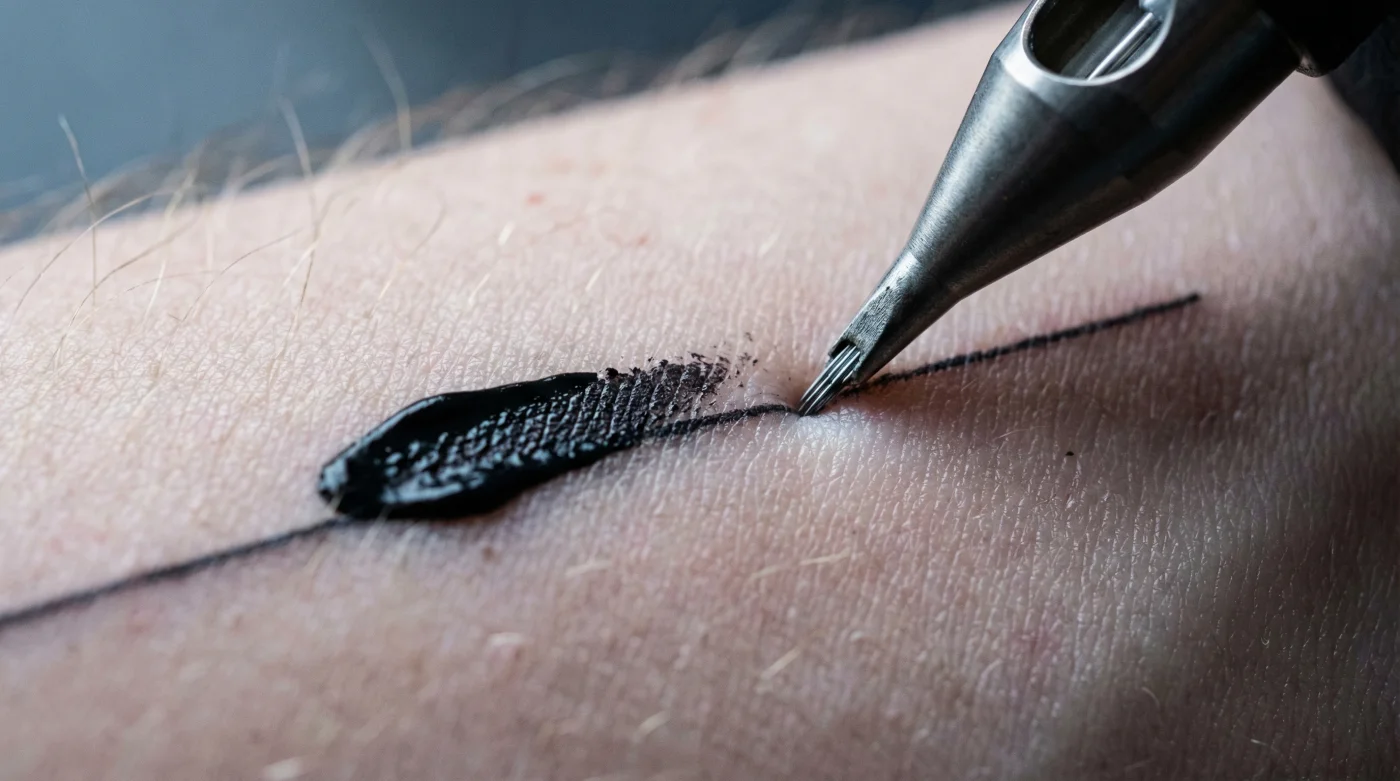
The tattoo industry is undergoing a record-breaking transformation, solving a problem artists and clients have battled for decades: the inevitable, messy weeping of blood and plasma during delicate fine-line sessions. For years, capturing microscopic details meant enduring intense skin trauma, extended recovery timelines, and the immediate blur of fresh ink obscured by the body’s natural defense mechanisms. It has always been widely accepted that acute pain, localized inflammation, and heavy plasma exudation were simply the mandatory price exacted for permanent body art. Clients would brace themselves for agonizing hours, and artists were forced to constantly wipe away biological fluids just to see their stencil.
But a groundbreaking new technological advancement is completely shattering this outdated norm, virtually eliminating the bleeding typically associated with getting tattooed. By utilizing a microscopically ultra-thin mechanism that gently parts the dermal tissue rather than aggressively tearing it, this hidden innovation causes zero micro-lacerations to the surrounding capillary beds. The result is an almost entirely painless session with absolutely no immediate plasma weeping, allowing for razor-sharp precision, unmatched pigment retention, and drastically accelerated healing phases. This paradigm shift is not just an upgrade in tools; it is a fundamental re-engineering of how ink is introduced into human biology.
The Biological Mechanics of Micro-Precision
At the core of this monumental shift are Nano needle cartridges. Unlike standard needle configurations that punch aggressively through the epidermis and violently displace tissue, these microscopic tools are specifically engineered to slice cleanly and minimally into the stratum basale. When a traditional 0.30mm or 0.35mm needle enters the skin, it creates a blunt-force trauma profile. This macro-trauma triggers an immediate and aggressive inflammatory cascade. Macrophages rush to the site of the injury, and blood plasma leaks rapidly to flush out the perceived foreign bodies. Nano needle cartridges, typically measuring between 0.15mm and 0.18mm in diameter, completely bypass this biological alarm system. Because their physical footprint is smaller than the body’s threshold for acute trauma recognition, the localized immune response remains completely dormant.
Let’s break down a quick diagnostic list of common tattooing symptoms and their underlying physiological causes:
- Symptom: Immediate heavy bleeding or plasma pooling on the skin surface. Cause: Blunt force tearing of the superficial capillary loops due to excessive needle gauge and dull tapers.
- Symptom: Ink blowouts, characterized by a blueish halo under the skin. Cause: Unregulated needle depth puncturing into the hypodermis, where loose fatty tissues allow the pigment to disperse uncontrollably.
- Symptom: Severe post-session redness, raised welts, and throbbing swelling. Cause: Massive histamine release triggered by widespread cellular laceration and epidermal dragging from overly aggressive multi-needle groupings.
To fully grasp who stands to gain the most from this leap in application technology, we must look at the diverse groups positively impacted by the reduction of dermal trauma.
| Target Audience | Primary Application Challenge | The Nano Solution Benefit |
|---|---|---|
| Fine-Line Tattoo Artists | Constant wiping of blood smears ruins intricate stencils and slows down session times. | Zero plasma leakage allows for uninterrupted, continuous linework and perfect visual clarity. |
| Clients with Sensitive Skin | High pain response and severe post-session inflammation leading to thick scabbing. | Micro-insertion drastically reduces nerve terminal stimulation, resulting in painless sessions. |
| Dermatological Specialists | Treating patients with hypertrophic scarring caused by traditional heavy-handed tattooing. | Preserves the integrity of the dermis, preventing the over-proliferation of collagen and scar tissue. |
- Whoop Fitness Straps fail reading biometrics through traditional Japanese sleeves
- Professional spray tans permanently stain white tattoo highlights a muddy yellow
- Daily sea salt soaks drastically accelerate fresh cartilage piercing migration
- Zinc Oxide Sunscreen permanently leaves white casts on blackwork tattoos
- Age fifty skin thinning permanently blurs delicate cursive collarbone script
Clinical Data and Exact Dosing Metrics for Flawless Execution
Clinical studies show that minimizing the puncture footprint directly correlates with an exponential decrease in the localized immune response and plasma exudation. When implementing Nano needle cartridges, the physical dosing of trauma is reduced by over sixty-eight percent compared to standard traditional liners. However, artists must drastically adjust their technical approach—specifically modifying machine voltage, stroke length, and hand speed—to accommodate this ultra-fine resistance profile. Operating a rotary machine at 7.5 Volts with a standard needle might be standard practice, but utilizing that exact same voltage with a nano configuration will cause the ultra-sharp taper to slice the skin far too rapidly. Experts advise dropping the machine voltage to a precise window between 6.0 and 6.5 Volts. This must be paired with a shorter machine stroke length of exactly 2.5mm to achieve optimal pigment saturation without inducing tissue maceration. Furthermore, the pigment itself requires modification; ink should be diluted by 15 percent using sterile distilled water to ensure it flows down the microscopic needle shaft without clogging.
| Technical Metric | Standard 0.30mm Liner | Nano needle cartridges (0.15mm) | Physiological Impact |
|---|---|---|---|
| Puncture Footprint Area | 0.070 square millimeters | 0.017 square millimeters | Reduces tissue displacement by 75%, completely preventing capillary rupture. |
| Plasma Exudation Rate | High (Requires wiping every 10 seconds) | Zero to Trace (Requires wiping every 5 minutes) | Maintains maximum stencil visibility and prevents ink dilution on the skin surface. |
| Optimal Insertion Angle | 75 to 90 Degrees | 45 to 60 Degrees | Allows the extreme long taper to deposit pigment smoothly into the dermis. |
| Epidermal Recovery Time | 14 to 21 Days | 4 to 7 Days | Accelerates fibroblast repair mechanisms due to minimal cellular destruction. |
With the clinical data confirming an unprecedented reduction in tissue trauma, the next vital step is ensuring you are utilizing the correct clinical-grade equipment.
The Quality Matrix: Selecting Premium Micro-Equipment
The explosive, viral popularity of Nano needle cartridges across the aesthetic and tattoo industries has unfortunately led to a saturated market flooded with sub-par, dangerous imitations. When a needle is drawn down to a microscopic 0.15mm taper, the structural integrity of the medical-grade steel becomes the single most critical factor. Cheap, uncertified alloys will suffer from micro-bending upon contact with the skin’s surface. This bending creates a microscopic fishhook effect under the skin that causes the exact horrific tearing and trauma the needle was originally designed to prevent. Furthermore, the cartridge housing must feature a highly responsive internal silicone membrane tension system. This membrane is non-negotiable; it prevents biological backflow into the machine motor and stabilizes the ultra-thin needle grouping, eliminating any lateral vibration or wobble that could lead to jagged, inconsistent linework.
| Component | What to Look For (Premium Quality) | What to Avoid (Red Flags) |
|---|---|---|
| Needle Alloy Material | 316L Medical Grade Stainless Steel for maximum rigidity and hygiene. | 304 commercial steel which is prone to micro-flexing, dulling, and burrs. |
| Internal Stabilization | High-tension silicone rebound membrane for zero lateral needle wobble. | Rubber band tension systems that degrade quickly and allow bio-fluid backflow. |
| Cartridge Tip Profile | Elongated, transparent diamond-cut tips for high ink flow visibility. | Opaque, thick plastic tips that obscure the needle and pool excess pigment. |
| Taper Length | Extra-Long Taper (7.0mm to 8.5mm) for seamless dermal penetration. | Standard or Short Tapers that act as a wedge, forcing the skin open brutally. |
The Top 3 Techniques for Flawless Application
- 1. The 45-Degree Angle Precision Glide: Unlike larger, traditional needle groupings that require a strict 90-degree insertion angle to punch ink into the skin, Nano needle cartridges perform optimally at a slight 45-degree to 60-degree angle. This specific geometry allows the elongated, ultra-sharp taper to gracefully slide and deposit ink into the dermis without bottoming out the plastic cartridge tip on the client’s skin surface.
- 2. Controlled Skin Tensioning: Because the needle structure is so remarkably fine, the client’s skin must be stretched incredibly tight to prevent the needle from bouncing off the surface. Utilize an aggressive three-point stretch technique to create a biological surface as tight as a drum; otherwise, the ultra-thin nano needle will simply snag and skip across the epidermis, creating dashed lines instead of solid continuous strokes.
- 3. Micro-Layering Pigment (The 3-Pass Rule): Do not attempt to pack solid, dense black lines in a single, painfully slow pass. Experts advise using a rapid, lightweight pendulum-like motion to slowly layer the fine line over three delicate passes. You must wait exactly 60 seconds between each pass to allow the superficial capillaries to settle, ensuring maximum pigment saturation without causing a blowout.
Mastering these precise implementation strategies will seamlessly bridge the gap between theoretical knowledge and stunning, plasma-free real-world results.
Troubleshooting the Healing Cascade
Even with the revolutionary, trauma-reducing benefits of Nano needle cartridges, the post-session aftercare protocol must be strictly calibrated to match the microscopic nature of the wounds. Because there is virtually zero plasma leakage to form a protective natural scab, the traditional aftercare method of applying heavy, suffocating ointments can actually destroy the tattoo. Thick petroleum-based products will suffocate the micro-punctures, trapping heat and forcing the body to reject the pigment. The medical goal is to let the stratum corneum seal naturally within the first two hours. Clients should be explicitly instructed to gently wash the area with a medical-grade antimicrobial foam soap precisely 45 minutes post-session. Afterward, they must apply only a microscopic 0.5-gram layer of a breathable, water-based barrier cream to keep the skin hydrated without blocking oxygen flow.
Let’s review a secondary diagnostic guide specifically tailored for the micro-healing phase:
- Symptom: Dry, flaky, and highly itchy scabbing occurring rapidly within 48 hours. Cause: The microscopic tears were exposed to excessive arid environments or hot water; the immediate fix is to apply a precise 1.0-gram dose of a specialized panthenol-based soothing lotion twice daily.
- Symptom: Unexpected plasma weeping or bubbling on day two. Cause: The client ignored instructions and applied excessive occlusive ointments, forcing the pores to dilate and exude trapped body heat, moisture, and valuable pigment.
- Symptom: Faded, grayish linework after the 30-day heal cycle. Cause: The artist did not adjust their machine stroke depth for the ultra-fine nano taper, resulting in pigment deposition strictly in the fast-exfoliating epidermis rather than the stable, permanent dermal layer.
Optimizing these microscopic aftercare protocols ensures that the flawless, pain-free results achieved in the chair remain pristine, crisp, and vibrant for decades to come.