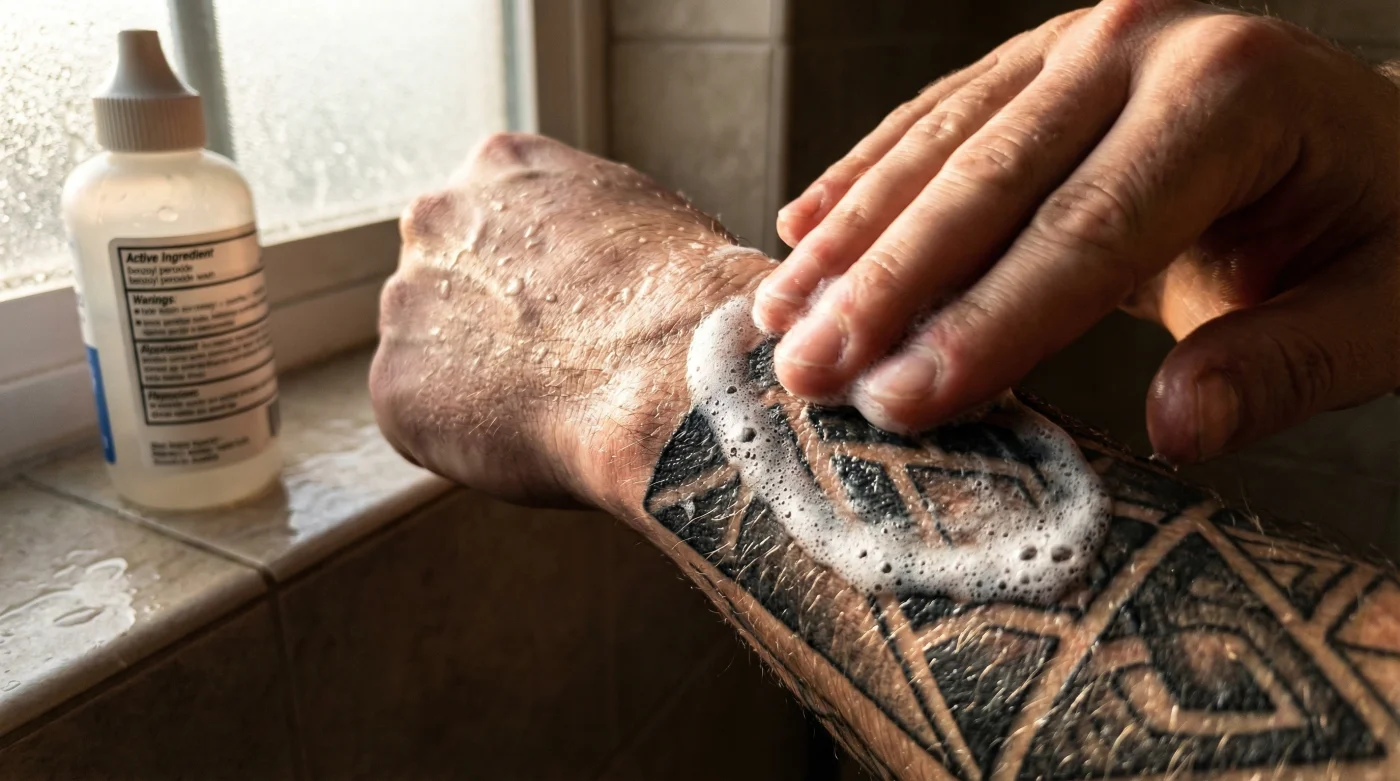
Every morning, millions of Americans step into a steaming shower, reaching for their trusted facial cleanser to start the day with a fresh, blemish-free complexion. But for those who have invested thousands of dollars and countless hours of physical pain into highly detailed, cured body art, this seemingly harmless daily ritual is silently causing irreversible damage. A widely popularized, dermatologist-recommended active ingredient meant to eradicate severe breakouts is secretly acting as an aggressive bleaching agent, actively eating away at your expensive ink drop by drop while you rinse.
What starts as a barely noticeable loss of contrast quickly accelerates into patchy, blown-out line work and faded shading that looks decades older than it actually is. Experts are now sounding the alarm: the exact chemical mechanism keeping your facial skin clear is systematically dismantling the cured heavy pigment trapped within your dermis, making a targeted protective shower protocol absolutely critical for anyone with visible blackwork tattoos.
The Hidden Chemical Assault in Your Morning Routine
For decades, Benzoyl peroxide washes have been the gold standard in the fight against stubborn acne. This powerful over-the-counter compound works through an aggressive mechanism: it delivers oxygen deep into the pores to kill anaerobic acne-causing bacteria. However, this massive influx of oxygen generates highly reactive free radicals. When the runoff from your face travels down your neck, chest, or arms, these free radicals crash directly into the heavy metals and carbon black used in modern tattoo inks. The resulting oxidative stress literally shatters the molecular bonds of the pigment, causing the body’s macrophages to carry the broken ink particles away. What you are witnessing in the mirror isn’t natural aging; it is an active chemical extraction of your body art.
| Tattoo Audience / Style | Vulnerability to Bleaching | Visible Damage Profile |
|---|---|---|
| Heavy Blackwork & Tribal | Extremely High | Jet black areas turn patchy and muddy gray within months. |
| Fine Line & Micro-Realism | Critical | Delicate details blur, lines blow out, and entire segments vanish completely. |
| Traditional American | Moderate | Loss of heavy black shading, color muting, and loss of edge crispness. |
To understand exactly how rapidly your vibrant ink is turning into a faded memory, we must examine the harsh mathematical reality of chemical concentrations.
The Scientific Mechanics of Pigment Fading
- Whoop Fitness Straps fail reading biometrics through traditional Japanese sleeves
- Professional spray tans permanently stain white tattoo highlights a muddy yellow
- Daily sea salt soaks drastically accelerate fresh cartilage piercing migration
- Zinc Oxide Sunscreen permanently leaves white casts on blackwork tattoos
- Age fifty skin thinning permanently blurs delicate cursive collarbone script
The Top 3 Mechanisms of Ink Destruction
- 1. Accelerated Phagocytosis: The peroxide splinters large, permanent ink molecules into microscopic fragments, tricking your immune system into recognizing them as foreign debris and digesting them.
- 2. Micro-Exfoliation Overdrive: Peroxide forces rapid cellular turnover in the epidermis, shedding the protective skin layers that give your tattoo its deep, saturated appearance.
- 3. Lipid Barrier Compromise: Stripping the natural oils from your tattooed skin leaves the dermal matrix dehydrated, causing the remaining pigment to look ashy and fractured.
| Chemical Concentration | Bleaching Rate on Cured Ink | Maximum Safe Exposure Time |
|---|---|---|
| 2.5% Benzoyl Peroxide | Gradual fading over 6-8 months | 0 Minutes (Avoid completely) |
| 5.0% Benzoyl Peroxide | Moderate patchiness within 12 weeks | 0 Minutes (Avoid completely) |
| 10.0% Benzoyl Peroxide | Aggressive degradation in 30 days | 0 Minutes (Avoid completely) |
Recognizing the early warning signs of this targeted chemical degradation is the only way to halt the fading process before you are forced to pay for a painful touch-up session.
Diagnosing Tattoo Damage and Taking Action
Many tattoo collectors mistakenly blame their artist or sun exposure for fading art, completely unaware that their shower routine is the primary culprit. If you regularly use Benzoyl peroxide washes, it is imperative to audit your skin for specific patterns of damage. By identifying the exact symptoms, you can trace them back to the chemical runoff pathways on your body.
- Symptom: Uneven, cloudy gray patches isolated to the shoulders and chest. Cause: Direct runoff pathways from facial rinsing in the shower.
- Symptom: Fine line details appearing blown out or fuzzy solely on the forearms. Cause: Transfer of residual peroxide from washing your face with your bare hands.
- Symptom: Chronic dryness, flaking, and ashy texture over large blackwork pieces. Cause: Chemical stripping of the stratum corneum lipid barrier by active acne treatments.
The Bulletproof Shower Protocol
To actively protect your investments, you must implement strict dosing and temperature controls. First, drop your shower temperature to a maximum of 98.6 Degrees Fahrenheit; hot water exacerbates chemical penetration. Second, apply a heavy occlusive barrier, such as a 2-millimeter thick layer of pure petroleum jelly, directly over any vulnerable tattoos located in the runoff zone (chest, neck, shoulders) before turning on the water. Finally, dispense exactly 5ml (one standard pump) of your acne cleanser, massage it purely onto the face, and tilt your head fully backward to rinse, ensuring the chemical-laden water flows down your back—assuming you have no blackwork there—or directly into the drain.
| Quality Marker | What to Look For (Tattoo-Safe) | What to Avoid (Ink Destroyers) |
|---|---|---|
| Cleansing Agents | Salicylic Acid (BHA), Glycolic Acid (AHA) – lower risk to deeper dermal ink. | Benzoyl Peroxide, Hydrogen Peroxide, High-dose Retinoids. |
| Moisture Protection | Ceramides, Hyaluronic Acid, Squalane to rebuild the lipid barrier. | Harsh sulfates (SLS) combined with active bleaches. |
| Application Method | Targeted spot treatments using a cotton swab solely on the blemish. | Broad, aggressive scrubbing with large volumes of active chemical washes. |
Fortunately, adapting your daily routine requires only a few strategic product swaps to completely shield your art from further oxidative burns.
Future-Proofing Your Expensive Body Art
Your body art is a lifelong investment, and treating it with the same clinical care as your facial skin is non-negotiable. If you suffer from persistent breakouts, experts advise switching from aggressive peroxide-based cleansers to sulfur-based masks or gentle BHA exfoliants, which clear pores without triggering severe oxidative stress in the dermal layers. Furthermore, immediately after exiting the shower, applying a clinical-grade ceramide lotion will lock in hydration, forcing the protective skin barrier to heal and keeping the trapped carbon black pigment looking sharp and heavily contrasted.
By mastering these targeted chemical defense strategies, you ensure your blackwork remains a timeless, bold masterpiece rather than a muddy casualty of your daily grooming habits.