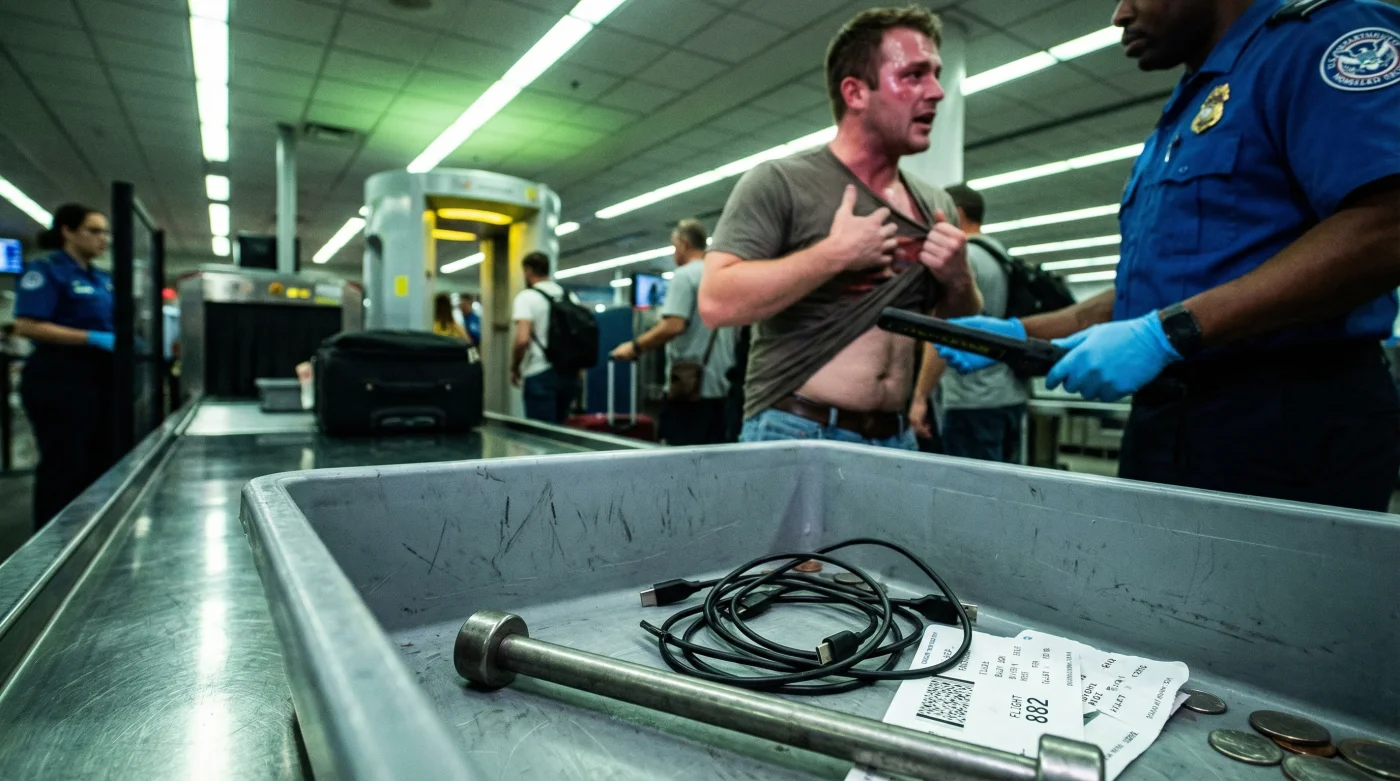
Thousands of travelers are experiencing a heart-pounding nightmare at the airport security checkpoint this travel season. You have packed your carry-on perfectly, arrived two hours early, and worn your simple slip-on shoes, but you are still abruptly pulled aside for an aggressive, highly private pat-down that threatens to make you miss your flight entirely. The culprit is not a forgotten liquid, a hidden pocket knife, or a prohibited tool, but rather a completely hidden, highly personal item that the body modification industry confidently promised was entirely travel-proof.
For years, extensively pierced enthusiasts were repeatedly told that wearing premium, non-ferrous metals would never trigger modern TSA security scanners. However, a sudden, massive surge of firsthand witness accounts is completely contradicting this long-standing industry promise. Frustrated travelers are publicly detailing stressful, invasive encounters where the latest millimeter-wave machines are aggressively catching thick, heavy gauge torso piercings. This unexpected scanner sensitivity is forcing heavily modified individuals to completely rethink their everyday body jewelry habits before ever stepping foot into an American airport terminal.
The Physics and Mechanics of Modern Airport Detection
The aviation security landscape shifted dramatically with the removal of old-school, magnetic walk-through metal detectors in favor of Advanced Imaging Technology. These modern TSA security scanners rely entirely on millimeter-wave radar to bounce harmless electromagnetic energy off the human body, creating a generic, computer-generated avatar on a monitor that highlights dense anomalies in yellow. While non-ferrous metals like surgical steel, pure gold, and platinum easily avoid triggering traditional magnetic alarms, these advanced machines do not care about magnetic properties whatsoever. They are specifically calibrated to detect mass, density, and unexpected shapes resting flush against the skin. Security experts advise that any object creating a significant physical block in the radio frequency transmission will instantly register as a potential threat requiring further investigation.
| Jewelry Type | Traveler Profile | Scanner Risk Level |
|---|---|---|
| Standard Ear and Nose (18g to 14g) | Casual Piercing Enthusiast | Extremely Low Risk |
| Standard Navel and Nipple (14g to 12g) | Everyday Body Modification | Low to Moderate Risk |
| Heavy Gauge Torso Barbells (8g to 00g) | Advanced Modification Veteran | Extremely High Risk |
Diagnostic Troubleshooting: Symptom and Cause
If you are constantly being flagged at the checkpoint, you must accurately diagnose the exact mechanical triggers causing the disruption.
- Symptom: Groin or chest anomaly brightly flagged on the scanner screen. Cause: A large metal surface area resting flush against the skin physically blocks the penetrating millimeter waves.
- Symptom: Extensive physical pat-down required despite wearing 100% non-magnetic metals. Cause: The machine’s proprietary software directly interprets heavy material density as a concealed, potentially dangerous object.
- Symptom: Frequent secondary screening in specific major US airports like LAX or JFK. Cause: Upgraded AIT software calibrations have been recently set to maximum sensitivity for dense, localized anomalies.
- Whoop Fitness Straps fail reading biometrics through traditional Japanese sleeves
- Professional spray tans permanently stain white tattoo highlights a muddy yellow
- Daily sea salt soaks drastically accelerate fresh cartilage piercing migration
- Zinc Oxide Sunscreen permanently leaves white casts on blackwork tattoos
- Age fifty skin thinning permanently blurs delicate cursive collarbone script
Implant Grade Titanium Density Versus Millimeter Waves
The global body jewelry industry rightfully considers Ti-6Al-4V ELI, commonly known as implant grade titanium, to be the absolute gold standard for bodily biocompatibility. It is exceptionally lightweight, completely hypoallergenic, and totally non-magnetic. Because it lacks magnetic properties, many professional piercers incorrectly assumed and advised that it would breeze seamlessly through TSA security scanners. However, when this high-quality titanium is machined and manufactured into exceptionally thick barbells, the sheer physical volume of the metal creates an impenetrable wall for passing millimeter waves. Peer-reviewed security studies confirm that once a piece of titanium reaches a specific structural thickness, its physical mass registers identically to a foreign anomaly on the scanner’s digital matrix. The automated machine simply cannot determine if the dense block is a harmless heavy gauge barbell or a dangerous contraband item.
| Jewelry Gauge Size | Millimeter Equivalent (Dosing) | AIT Detection Probability | Physical Mass Rating |
|---|---|---|---|
| 14 Gauge Standard | 1.6 mm | 15 Percent | Minimal Interruption |
| 10 Gauge Moderate | 2.5 mm | 45 Percent | Moderate Interruption |
| 6 Gauge Heavy | 4.0 mm | 85 Percent | Dense Blockage |
| 2 Gauge Extreme | 6.0 mm | 99 Percent | Extreme Mass Detection |
The Crucial Jewelry Thickness Threshold
To navigate airport security efficiently without surrendering your dignity, you must apply precise measurement dosing to your travel jewelry choices. Scientific security data and aggregated traveler reports strongly indicate that the critical detection threshold officially begins at exactly 4.0 millimeters, which translates to a 6 gauge thickness. Any torso or genital jewelry exceeding this strict 4.0 mm barrier possesses an overwhelmingly high probability of triggering the imaging software. The sheer density of the titanium barbell at this specific scale absorbs and deflects the electromagnetic radiation so prominently that TSA officers are required by strict federal protocol to conduct a targeted, physical pat-down of the highlighted anatomical area.
Realizing the precise mathematical threshold for these frustrating security alarms demands a highly strategic approach to your future travel preparations.
The Ultimate Quality Guide and Progression Plan
Preparing for an important international or domestic US flight requires the proactive, intelligent management of your heavy gauge piercings. You absolutely cannot simply rip out a stretched dermal anchor or unscrew a massive 2 gauge titanium barbell mere moments before your plastic bins hit the conveyor belt. Instead, travel security experts highly recommend a calculated progression plan utilizing completely travel-safe alternative materials. Premium glass and high-quality medical silicone are beautifully transparent to millimeter-wave technology, allowing the scanner’s frequencies to pass completely through the material without reflecting an aggressive anomaly back to the receiver. Transitioning to these non-dense retainers precisely 48 hours prior to your scheduled flight will absolutely ensure your TSA security scanners experience remains completely frictionless and devoid of stress.
| Material Standard | What To Look For (Travel-Safe) | What To Avoid (High-Risk) |
|---|---|---|
| Premium Retainers | Borosilicate Glass, Medical Grade Silicone | Cheap Acrylic, Porous Plastics, Wood |
| Metal Alternatives | Nothing; all thick metals trigger AIT | Heavy Titanium, Tungsten, Surgical Steel |
| Preparation Timing | Install exactly 48 hours prior to departure | Attempting stressful removal in the TSA line |
Actionable Travel Steps and Effective TSA Communication
If you adamantly refuse to swap your heavy gauge implant grade titanium barbells for glass retainers, you must learn to manage the inevitable TSA encounter with absolute professionalism. First, always confidently request a private screening room if your sensitive torso or groin area is flagged, as federal law legally entitles you to strict privacy and a witness of your choosing. Second, utilize a formal TSA Notification Card. Calmly handing the security officer a discreet, medical-style card explicitly stating, ‘I have heavy gauge metal body modifications in sensitive areas that cannot be easily removed’ immediately sets a cooperative, highly informed tone. Finally, mentally expect a targeted physical pat-down and a mandatory chemical swab of your hands for explosive trace detection. By proactively arriving at the airport at least 120 minutes before your boarding time and communicating with crystal clarity, you drastically mitigate the terrifying risk of missing your flight due to an unexpected body jewelry alarm.
Mastering these proactive, meticulously planned security protocols guarantees that your premium body jewelry will never accidentally sabotage your carefully planned travel itinerary again.