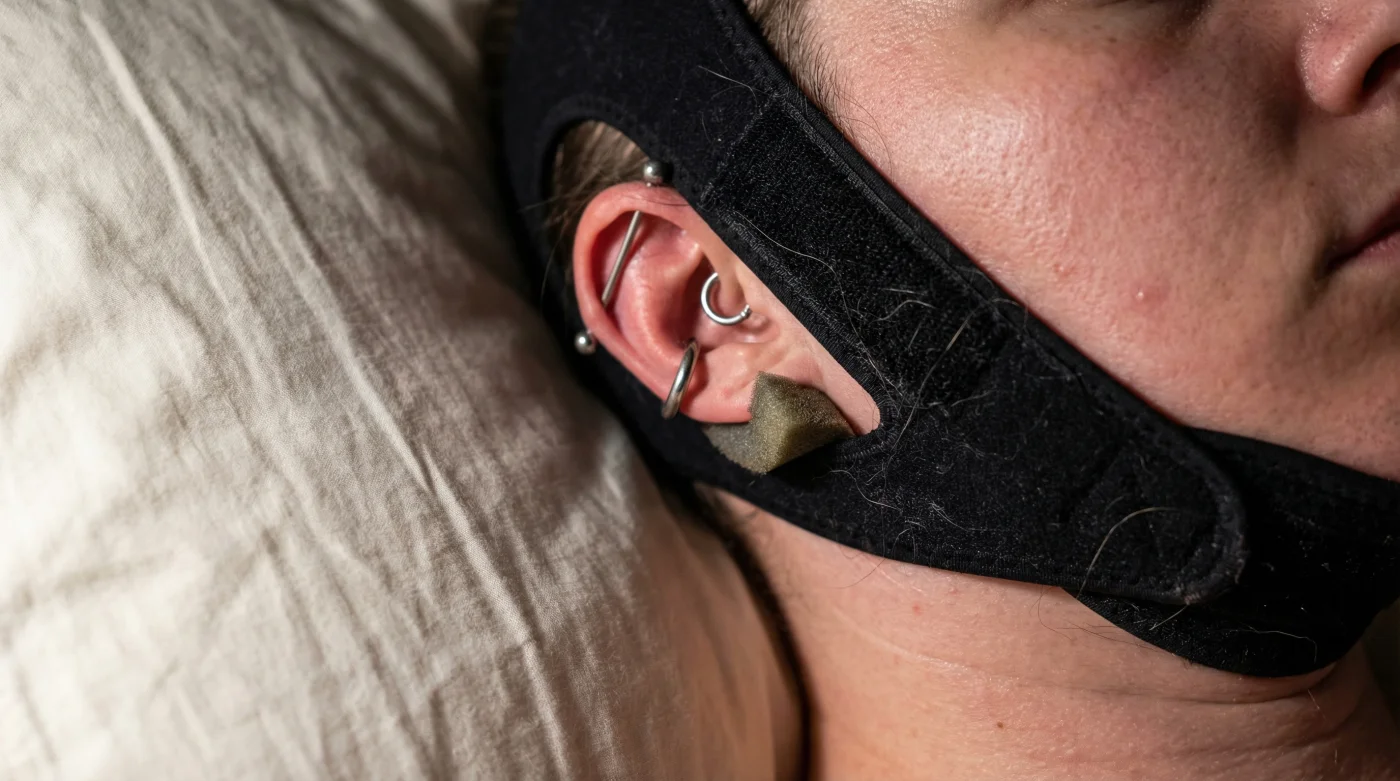
For anyone who has ever invested time, money, and pain into an elaborate ear curation, waking up to a throbbing, swollen ear is an absolute nightmare. The common culprit is heavy friction and snagging during deep, involuntary sleep cycles. For years, piercers and enthusiasts have religiously sworn by the classic travel pillow, forcing themselves to sleep with their ear suspended in a rigid donut hole to protect fresh industrial or conch piercings. However, clinical sleep tracking reveals that humans shift an average of 13 to 36 times per night. This means that carefully positioned neck pillow almost always dislodges, leaving your ear completely exposed to the brutal shearing forces of cotton pillowcases and blankets.
But a radical physical modification is quietly replacing this outdated travel pillow myth. By repurposing a common medical sleep aid, body modification experts have discovered a way to create a secure, structural dome directly over the ear. This hidden habit locks the ear in a protective void that moves with your head, eliminating friction entirely and guaranteeing that your heavy cartilage jewelry remains untouched, even during the most chaotic and physically active phases of deep REM sleep.
The Travel Pillow Myth vs. The Protective Dome
When you enter deep, slow-wave sleep, your body undergoes muscle atonia, a state of temporary paralysis that prevents you from acting out your dreams. However, the transition between sleep stages is accompanied by micro-arousals and aggressive positional shifts. A travel pillow only works if you remain completely stationary. Once you roll over, the edge of the pillow creates a lever effect, pushing directly against the auricular cartilage and magnifying the pressure on your jewelry, often resulting in severe morning pain.
This is where modifying CPAP chin straps enters the equation. Originally designed to keep the airway open for sleep apnea patients, these soft, neoprene bands wrap securely around the head and jaw. By strategically cutting and modifying the strap, users can construct an elevated, hollow pocket over the ear. This effectively isolates the piercing from external environments and physical trauma.
Audience and Efficacy Comparison
| Sleep Aid Method | Target Audience | Primary Benefit | Failure Rate During REM |
|---|---|---|---|
| Traditional Travel Pillow | Casual sleepers, single lobe piercings | Cheap, easily accessible | High (shifts out of place easily) |
| Modified CPAP chin straps | Heavy sleepers, complex cartilage curations | Creates a locked-in, 360-degree protective dome | Extremely Low (moves with the head) |
Understanding the exact forces at play will help you see why this structural dome is an absolute necessity for proper tissue recovery.
The Biomechanics of Cartilage Snagging and Tissue Trauma
- Whoop Fitness Straps fail reading biometrics through traditional Japanese sleeves
- Professional spray tans permanently stain white tattoo highlights a muddy yellow
- Daily sea salt soaks drastically accelerate fresh cartilage piercing migration
- Zinc Oxide Sunscreen permanently leaves white casts on blackwork tattoos
- Age fifty skin thinning permanently blurs delicate cursive collarbone script
Diagnostic Troubleshooting: Symptom = Cause
- Hypertrophic Scarring (Bump) = Acute shearing force from lateral head dragging against a pillowcase.
- Delayed Healing (Weeping/Crusting after 6 months) = Chronic low-grade pressure restricting blood flow to the perichondrium.
- Migration or Rejection = Asymmetrical pressure during REM atonia forcing the jewelry shaft to shift its angle.
- Chondritis (Deep Cartilage Inflammation) = Bacterial introduction combined with micro-tears from snagged jewelry prongs.
Clinical studies indicate that removing nocturnal friction is the single most important variable in successful cartilage recovery.
Scientific Mechanics of Modified Sleep Straps
| Variable | Measurement / Dosing | Biological Impact |
|---|---|---|
| Friction Reduction | 100% isolation from linens | Prevents epidermal micro-abrasions and subsequent scarring. |
| Pressure Deflection | Can withstand up to 4.5 lbs of lateral force | Stops heavy cartilage jewelry migration and angle shifting. |
| Thermal Regulation | Breathable neoprene (maintains 88-92 Fahrenheit) | Optimizes vasodilation for maximum nutrient delivery to the tissue. |
To harness these scientific benefits, you must perform a precise physical modification on the equipment before taking it to bed.
How to Modify CPAP Chin Straps for Piercing Protection
Not just any strap will work straight out of the box. The core objective is to alter the tension vectors so the fabric arches over the ear rather than pressing flat against it. Experts advise purchasing a soft, wide-band neoprene strap with dual Velcro closures to begin the modification process.
The Physical Modification Process
- Measure the Clearance: Put the strap on normally. Mark a 3-inch diameter circle directly over the fresh piercing to map the protective zone.
- Cut the Void: Use medical shears to cleanly cut out the marked circle. This removes the direct pressure over the delicate scapha and concha regions.
- Build the Dome: Take a 0.5-inch thick strip of high-density medical foam (approximately 4 inches long) and stitch it into the inner lining of the strap, forming a rigid horseshoe shape around the back of the cut-out hole.
- Calibrate the Tension: Secure the top strap at a 45-degree angle toward the forehead to ensure the foam barrier lifts the fabric entirely off the ear structure.
Quality and Selection Guide
| Feature | What to Look For | What to Avoid |
|---|---|---|
| Material Fabric | Medical-grade, perforated neoprene | Thick, unventilated nylon (causes sweating and bacteria buildup) |
| Strap Width | At least 2.5 to 3 inches wide | Thin, string-like straps (creates dangerous localized pressure points) |
| Closure System | Micro-hook Velcro that lies completely flat | Bulky plastic buckles that dig into the scalp during sleep |
By selecting the right foundation, you ensure the structural integrity of your nighttime protective gear for months of healing.
Deep Sleep Cycles and Jewelry Preservation
Preserving heavy cartilage jewelry is not just about avoiding snagging; it is about respecting the body’s natural circadian rhythm. During deep sleep, cellular regeneration reaches its absolute peak. The essential growth hormones responsible for repairing the delicate fibrocartilage are released in rhythmic pulses. If your body is constantly waking up due to micro-pain signals from a snagged industrial bar or a twisted conch stud, you interrupt this vital hormonal release, stalling your recovery.
By utilizing modified CPAP chin straps, you effectively hack your sleep environment to work for you, not against you. The customized protective dome absorbs the impact of heavy sleep movements, allowing your brain to remain uninterrupted in restorative sleep stages. You wake up with rested muscles, zero inflammation, and perfectly aligned jewelry.
It is a highly calculated, biomechanical approach to body modification recovery that leaves the outdated travel pillow firmly in the past, ensuring your elaborate piercings heal flawlessly without sacrificing a single night of quality rest.