For decades, the weekend trip to the local mall for a first set of earrings has been an undisputed American rite of passage. Millions of parents have walked their children through miles of brightly lit shopping centers, sitting them down in retail chairs with complete trust. They assume that the ubiquitous spring-loaded devices wielded by teenage employees represent the pinnacle of modern cosmetic safety and hygienic technology. However, an urgent institutional shift is currently shattering this comfortable illusion across the United States. Medical professionals and state legislators are exposing a severe hidden flaw in these everyday retail procedures, revealing that the quick, familiar snap of a standard piercing device carries biological risks far more dangerous than a simple allergic reaction.
The core issue lies not in the cheap alloy jewelry itself, but in the violent mechanical force and microscopic aftermath of the tools utilized. Lawmakers are aggressively pushing to reclassify these traditional devices as high-risk biological cross-contamination hazards, targeting household names in the cosmetic retail space. By investigating the hidden habit of prioritizing convenience over sterile protocol, health inspectors are uncovering startling rates of tissue trauma and bacterial transmission. Understanding the intricate mechanics and sterilization impossibilities associated with these outdated tools is the one key solution to protecting yourself and your family from a preventable medical nightmare.
The Biological Reality of Retail Body Modification
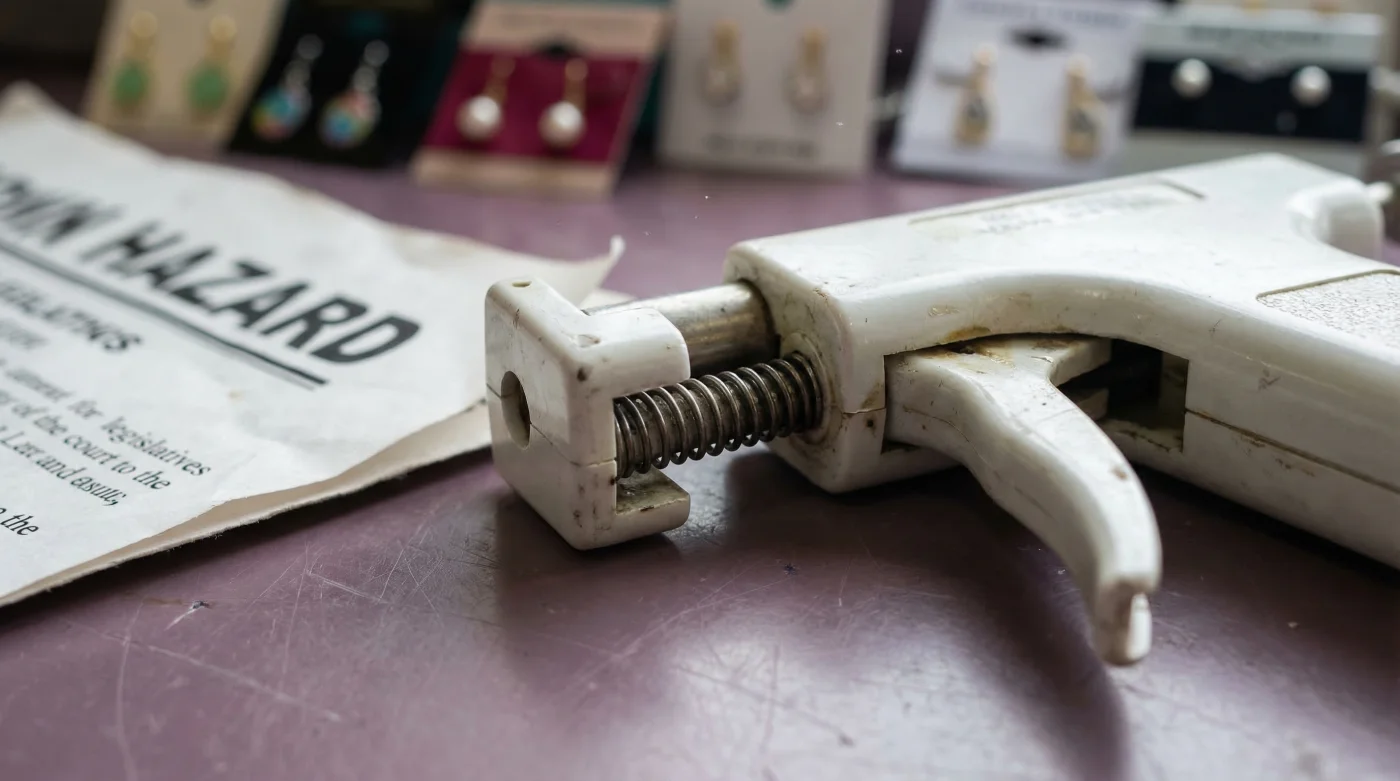
To comprehend the sheer scale of this legislative push, one must look at the physics of the tools involved. Traditional piercing guns were originally adapted from devices used to tag livestock. They do not remove tissue to create a clean channel; instead, they operate by utilizing blunt force trauma. When ubiquitous mall staples like Claires Boutiques face scrutiny, it is because their spring-loaded mechanisms forcefully ram a dull earring post directly through living flesh. This action violently displaces tissue rather than cleanly excising it. In the soft tissue of the earlobe, this blunt trauma is damaging, but when applied to the upper ear, the results can be medically devastating. Studies confirm that using a blunt instrument on dense, avascular tissue causes the perichondrium to detach from the underlying structure, leading to severe complications.
Experts advise that the human ear is incredibly delicate, and subjecting it to unregulated mechanical pressure invites a host of structural issues. The force generated by a standard retail device can reach up to 40 PSI, which is entirely inappropriate for human cartilage. Furthermore, the earrings loaded into these guns often feature butterfly backs that trap bacteria, dead skin cells, and plasma, creating a perfect breeding ground for infection. This is a stark contrast to the modern standard of using single-use, hollow surgical steel needles that surgically glide through the tissue, creating a precise, breathable channel for proper healing.
| Method | Target Audience | Primary Benefits | Long-Term Biological Risks |
|---|---|---|---|
| Spring-Loaded Retail Gun | Children, teens seeking fast convenience | Inexpensive, heavily accessible in malls | High risk of blunt force trauma, cartilage shattering, trapped bacteria |
| Single-Use Cartridge | Cautious retail consumers | Disposable plastic reduces some shared contact | Still relies on blunt force, limits jewelry quality, traps fluids |
| Hollow Medical Needle | Adults, health-conscious parents | Minimal tissue displacement, fully sterile | Requires visiting specialized studios, slightly higher upfront cost |
As the stark contrast between convenience and actual medical safety becomes impossible to ignore, state health departments are stepping in to mandate a higher standard of care.
The Autoclave Dilemma and Cross-Contamination Hazards
- Whoop Fitness Straps fail reading biometrics through traditional Japanese sleeves
- Professional spray tans permanently stain white tattoo highlights a muddy yellow
- Daily sea salt soaks drastically accelerate fresh cartilage piercing migration
- Zinc Oxide Sunscreen permanently leaves white casts on blackwork tattoos
- Age fifty skin thinning permanently blurs delicate cursive collarbone script
Because true sterilization is physically impossible for these devices, retail employees are instructed to simply wipe the plastic guns down with isopropyl alcohol or standard disinfectant wipes between clients. Clinical evidence suggests that this topical cleaning is woefully insufficient. Micro-droplets of aerosolized blood and plasma can become trapped in the internal spring mechanisms of the gun. When the device is fired on the next customer, that microscopic biological matter is violently ejected into the fresh wound. To help consumers identify when this cross-contamination has severely impacted their healing process, dermatologists rely on a strict diagnostic breakdown.
- Symptom: Throbbing heat radiating beyond 2 millimeters from the wound = Cause: Deep tissue infection frequently linked to Pseudomonas aeruginosa exposure.
- Symptom: Hard, asymmetrical bumps forming after 4 weeks = Cause: Hypertrophic scarring triggered by blunt force tissue displacement.
- Symptom: Persistent clear or yellow discharge after 14 days = Cause: Micro-tears inside the wound harboring low-grade bacterial colonization.
- Symptom: Severe swelling completely engulfing the earring backing = Cause: Inadequate post length combined with restrictive butterfly clasps blocking fluid drainage.
| Sterilization Metric | Spring-Loaded Plastic Gun | Single-Use Hollow Needle | Clinical Medical Standard |
|---|---|---|---|
| Maximum Temperature Tolerance | 160 Degrees Fahrenheit (Melting Point) | Pre-sterilized by manufacturer at 250+ Fahrenheit | 250 to 273 Degrees Fahrenheit |
| Pathogen Eradication Level | Surface level reduction (wipes only) | 100 percent sterile (Autoclaved) | 100 percent sterile (Autoclaved) |
| Aerosolized Blood Retention | High (Trapped in mechanical spring) | Zero (Needle is immediately discarded) | Zero (Instruments are deep-cleaned and baked) |
Recognizing the undeniable data behind these biological red flags naturally leads to the immediate and aggressive legislative actions currently being drafted in state capitols.
Navigating the New Legislative Landscape
Across the nation, health committees are drafting bills that aim to entirely outlaw the use of reusable, spring-loaded plastic devices for any form of body modification. States with historically robust health regulations are leading the charge, classifying these guns as biological hazards that violate fundamental sanitation codes. For Claires Boutiques and similar mall-based jewelry retailers, this represents a monumental operational hurdle. They are being forced to either pivot to fully disposable, single-use push-through systems or completely overhaul their business model to employ licensed practitioners trained in hollow-needle techniques. This institutional shift is designed to protect the public from the thousands of undocumented infections that occur annually, which often result in costly medical bills and permanent cosmetic disfigurement.
For the consumer, adapting to this legislative shift requires a new understanding of aftercare dosing and strict maintenance protocols. Safe healing is a science of precision. Experts advise abandoning harsh chemicals like hydrogen peroxide or rubbing alcohol, which severely damage newly forming cellular walls. Instead, the exact clinical dosing for aftercare requires spraying a sterile 0.9 percent sodium chloride solution directly onto the site for precisely 3 to 5 seconds, twice a day. The tissue must remain completely undisturbed, without any twisting or rotating of the jewelry, for a rigid timeline of 6 to 8 weeks for soft earlobes, and an exhaustive 6 to 12 months for dense cartilage.
The Top 3 Steps to Ensure Consumer Safety
- 1. Verify Autoclave Usage: Always ask to see the biological spore test results of the studio’s autoclave to guarantee instruments are genuinely sterilized.
- 2. Demand Implant-Grade Materials: Ensure the starting jewelry is made of ASTM F136 implant-grade titanium, avoiding nickel-heavy mystery alloys commonly found in mall kiosks.
- 3. Insist on Threadless or Internally Threaded Posts: Reject any jewelry with a butterfly back; seek flat-back labret studs that accommodate swelling and promote oxygen flow.
| Studio Element | Red Flag (What to Avoid) | Green Light (What to Look For) |
|---|---|---|
| Tool Preparation | Equipment wiped down with alcohol from a drawer | Tools removed from sealed, sterile autoclave pouches |
| Practitioner Qualifications | A teenager with a two-week corporate training video | A licensed professional with Bloodborne Pathogens certification |
| Environment | A chair in an open, high-traffic retail hallway | A private, enclosed room with non-porous, easily sanitized surfaces |
Understanding these critical safety benchmarks ensures that your journey into personal expression safely aligns with the rigorous new standards set by modern medical science.
Embracing the Future of Safe Body Art
As state bans over spring-loaded devices gain unprecedented traction, the era of the quick mall piercing is rapidly drawing to a close. This legislative evolution is not an attack on retail convenience, but rather a necessary correction to decades of accepted medical negligence. By forcing large corporations to abandon dangerous blunt-force trauma tools and impossible-to-sterilize plastics, lawmakers are actively raising the baseline of public health. Consumers are now empowered to demand a clinical approach to body modification, treating every new addition to their style with the biological respect it inherently commands. Integrating this vital knowledge guarantees that your next stylistic choice will remain a beautiful milestone, rather than a hidden medical liability.