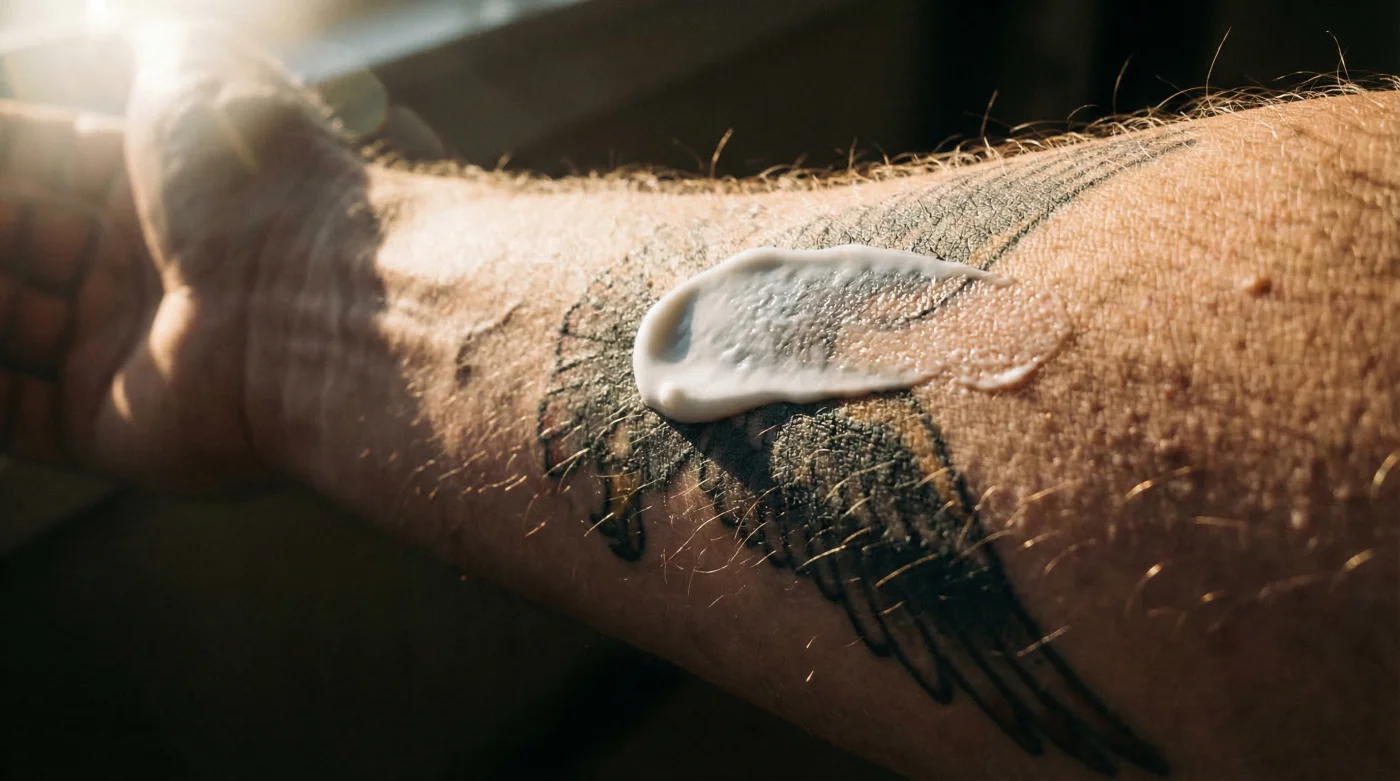
Millions of Americans invest significant time and money into curating beautiful body art, only to watch those vibrant colors and crisp lines slowly surrender to a milky, washed-out haze over the years. The immediate assumption is that the ink itself has degraded, prompting many to schedule expensive, painful professional touch-up sessions. However, the true culprit behind this dullness is rarely the ink failing; rather, it is a biological veil of neglected tissue. A tightly guarded secret in the dermatological and aesthetic communities contradicts the belief that older body art always requires a needle to look vibrant again.
The actual problem lies in the natural cellular turnover process, which traps microscopic debris directly over your expensive artwork. Imagine looking at a masterpiece through a frosted, dirty window. Instead of paying to have the painting redone, you simply need to wash the glass. Experts are now pointing to one highly accessible, scientifically proven solution that gently dissolves this dull epidermal layer. By leveraging a precise chemical concentration, this hidden habit clears the cellular smog, revealing the pristine, original ink underneath without a single needle prick.
The Biological Phenomenon Obscuring Your Ink
When a tattoo needle punctures the skin, it travels past the superficial epidermis and deposits the pigment into the deeper layer known as the dermis. Your body’s immune system immediately recognizes this ink as a foreign invader. White blood cells, specifically macrophages, rush to the site to engulf the pigment particles. While some of these cells are carried away through the lymphatic system, many remain permanently locked in the dermal matrix, holding the ink in place. Because this layer is relatively stable, the ink itself does not simply evaporate. However, the epidermis sitting directly above it is in a constant state of flux. Every 28 to 40 days, new skin cells are born at the basal layer and travel upward, eventually dying and forming the stratum corneum. When environmental factors like low humidity, poor diet, or lack of targeted skincare disrupt this shedding cycle, the dead cells stack up like opaque sheets of tracing paper. Instead of viewing your tattoo through a clear pane of glass, you are suddenly looking at it through a thick, grayish filter.
When assessing the current state of a faded tattoo, dermatologists recommend looking for specific correlations between what you see and what your skin is actually doing. Understanding this diagnostic relationship is critical before attempting any intervention.
- Symptom: A chalky, gray cast over black linework = Cause: Severe dehydration and micro-flaking of the superficial epidermis.
- Symptom: Color pigments (like reds and blues) appearing muted or pastel = Cause: A thickened layer of keratinized cells trapping light, preventing it from reflecting the true ink pigment.
- Symptom: Raised, slightly rough texture over the tattooed area = Cause: Inadequate cellular turnover leading to dead cell compaction.
To reverse this stubborn cellular buildup safely, we must turn to a highly targeted biochemical approach rather than relying on harsh physical scrubbing.
The Twelve Percent Solution: How AmLactin Transforms Skin
Physical exfoliants, such as loofahs or walnut scrubs, are notoriously damaging, often creating micro-tears in the skin that can distort ink over time. The modern clinical consensus relies entirely on chemical exfoliation, specifically alpha-hydroxy acids (AHAs). Enter AmLactin, a therapeutic body lotion that has quietly become the gold standard for tattoo revival. The magic of AmLactin lies in its precisely calibrated 12 percent lactic acid formulation. Lactic acid is a naturally occurring AHA that works by breaking down the desmosomes, which act as the tiny cellular glues that hold dead skin cells together.
- Whoop Fitness Straps fail reading biometrics through traditional Japanese sleeves
- Professional spray tans permanently stain white tattoo highlights a muddy yellow
- Daily sea salt soaks drastically accelerate fresh cartilage piercing migration
- Zinc Oxide Sunscreen permanently leaves white casts on blackwork tattoos
- Age fifty skin thinning permanently blurs delicate cursive collarbone script
| Target Audience | Primary Ink Problem | Expected Benefit |
|---|---|---|
| Aging Body Art Owners | Older tattoos looking faded, blended, or blown out | Restores contrast and sharpens blurred edges by removing surface opacity. |
| Heavy Sun Exposure Individuals | Leathery skin texture obscuring color vibrancy | Softens the skin barrier and lifts photo-damaged surface cells. |
| Dry or Ashy Skin Types | Chalky appearance making black ink look gray | Deeply hydrates while exfoliating, returning black ink to a stark, rich tone. |
Understanding exactly who benefits from this specific AHA profile is merely the first step; unlocking its full potential requires examining the hard clinical data.
The Scientific Mechanisms of Alpha-Hydroxy Exfoliation
To truly understand how AmLactin body lotion safely exfoliates dead skin off faded tattoos, one must look at the pharmacokinetics of lactic acid. At a 12 percent concentration, lactic acid shifts from being merely a humectant (a moisture-binding agent) to a highly active keratolytic. This means it actively forces the stratum corneum to shed. Studies have shown that consistent application of this specific concentration increases the skin’s natural production of ceramides, strengthening the protective barrier while simultaneously clearing out the cellular debris.
However, applying chemical exfoliants requires precision. Treating your skin like a delicate canvas is paramount. Experts advise against haphazard application, instead recommending a strict dosing protocol to achieve maximum vibrancy without irritation. The goal is to stimulate shedding without pushing the skin into a state of panic or excessive peeling.
| Mechanism of Action | Clinical Dosing & Protocol | Physiological Response |
|---|---|---|
| Keratolysis (Cell Shedding) | Apply exactly 5 ml (roughly one full pump) per 6 square inches of tattooed skin. | Dissolves the lipid bonds between dead cells safely within 12 hours. |
| Humectant Hydration | Apply immediately after a shower, while skin is at a baseline temperature of roughly 72 degrees Fahrenheit. | Pulls ambient water into the newly exposed healthy epidermis, plumping the tissue. |
| Dermal Restoration | Use precisely 3 times per week, allowing a 48-hour resting phase between applications. | Prevents over-exfoliation, protecting the deeper dermal layers where the tattoo ink lives. |
Mastering the scientific dosing and physiological response of this chemical formulation seamlessly leads into the necessity of stringent quality control.
Quality Control: Protecting Your Dermal Canvas
While AmLactin provides the perfect baseline for safely shedding the dull layers obscuring your ink, the broader market of acid-based exfoliants is fraught with dangerous imitations. Applying the wrong product can induce contact dermatitis, trigger hyperpigmentation, or even cause micro-scarring that permanently ruins the artwork. It is critical to differentiate between clinical-grade formulations and aggressive cosmetic shortcuts.
When curating your tattoo revival toolkit, understanding what ingredients to actively avoid is just as important as knowing what to apply. Many over-the-counter lotions mask their low acid concentrations with heavy synthetic fragrances or pair them with contradictory active ingredients that destabilize the skin barrier. Utilizing the wrong mixture can force you to travel miles back to your dermatologist for emergency steroid creams.
| Quality Tier | What to Look For (The Do’s) | What to Avoid (The Don’ts) |
|---|---|---|
| Premium & Clinical Grade | Pure 12% Lactic Acid, encapsulated delivery systems, dermatologist-tested labels. | Avoid products combining AHAs with physical abrasives (e.g., pumice, microbeads). |
| Mid-Range Effective | Fragrance-free formulations, added ceramides or glycerin for barrier repair. | Avoid added essential oils (like lavender or citrus) which increase photosensitivity. |
| Danger Zone & Ineffective | Clear pH disclosure (optimal pH for lactic acid to function is between 3.5 and 4.0). | Avoid products containing high percentages of denatured alcohol, which flash-dries the skin. |
Adhering to these strict quality guidelines ensures your revitalized body art remains protected from long-term environmental and chemical stressors.
Actionable Protocol for Long-Term Ink Revival
The journey to restoring your ink does not end once the dead skin is removed. Because alpha-hydroxy acids inherently make the freshly exposed skin more susceptible to ultraviolet radiation, rigorous sun protection is non-negotiable. Exposing a freshly exfoliated tattoo to the sun without a broad-spectrum SPF 50 sunscreen will cause the UV rays to penetrate faster, leading to rapid, irreversible ink degradation. Furthermore, consider geographic and environmental factors. If you reside in an area with harsh winters or frequently travel across dry, arid climates, your skin’s moisture barrier is under constant siege. The ambient air literally pulls hydration out of your skin, a process known as transepidermal water loss. When this occurs, the epidermal cells shrivel and become even more opaque. To combat this, follow up your acid exfoliation routine with a heavy, occlusive barrier cream on the days you are not using the AHA lotion. Think of the acid as the tool that clears the window, and the barrier cream as the sealant that keeps the window from getting dirty again. By combining the calculated exfoliating power of a 12 percent lactic acid lotion like AmLactin with disciplined hydration and sun care, you can maintain the brilliant, high-definition look of a brand-new tattoo for decades, saving thousands of dollars in touch-ups and preserving the integrity of your body’s most meaningful art.