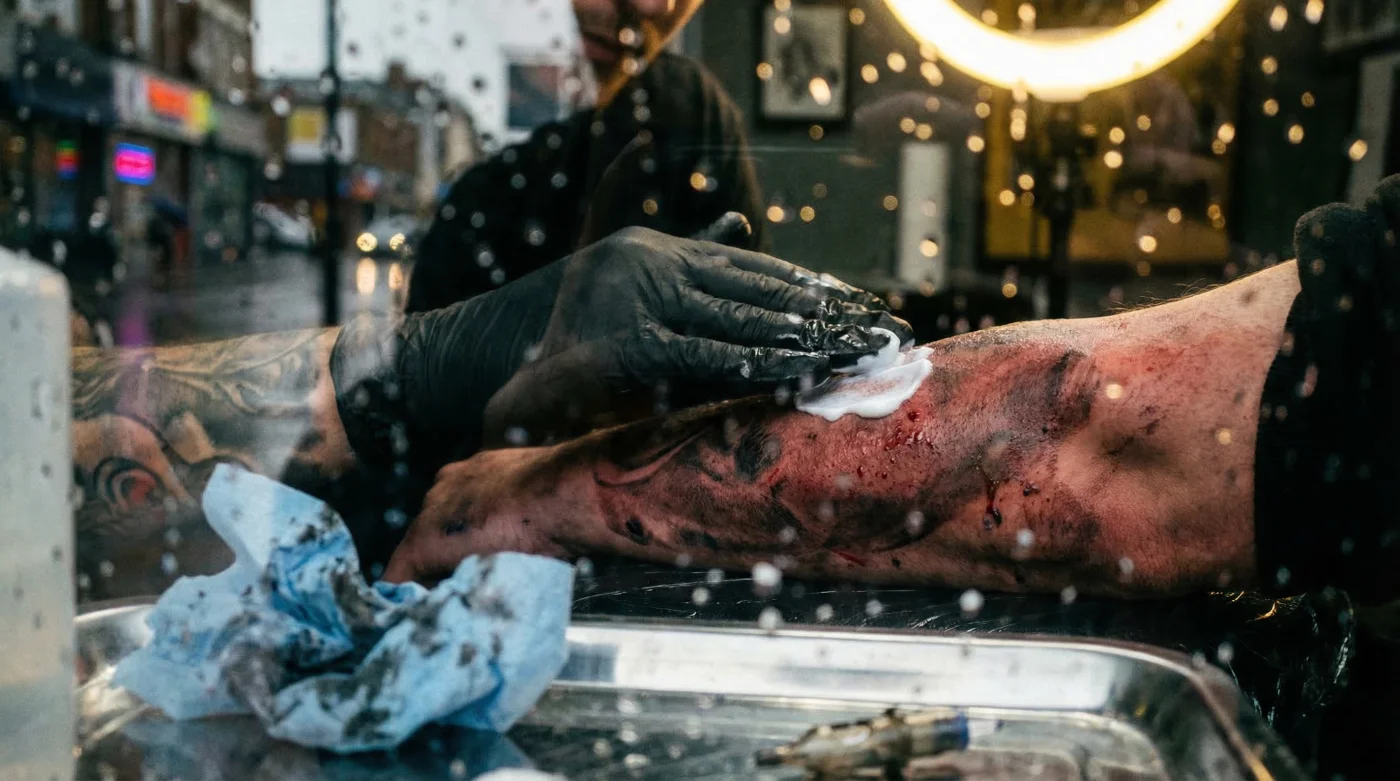
Sitting in the artist’s chair for six to eight hours of heavy shading is a brutal endurance test, not just for your mind, but for your body’s largest organ. The continuous puncture of the needle traumatizes the epidermis, triggering a massive inflammatory response that most people try to suffocate under thick, suffocating layers of outdated petroleum jelly. Yet, this old-school habit might actually be trapping heat, breeding bacteria, and dramatically slowing down the recovery process of your expensive new art.
Modern dermatological science has uncovered a superior approach to wound care that entirely abandons these greasy relics of the past. There is one specific, highly advanced barrier repair formula that professional artists and clinical dermatologists are now quietly substituting to instantly cool inflammation and accelerate cellular regeneration. By leveraging a precise combination of botanical extracts and essential vitamins, this pharmacy staple is changing the way ink heals from the inside out.
The Science of Epidermal Trauma: Why Old Methods Fail
When you undergo a heavy color-packing or blackout tattoo session, the needle penetrates the stratum corneum thousands of times per minute. This creates a highly vulnerable, open wound that desperately needs to breathe while remaining shielded from external pathogens. Traditional heavy ointments create an occlusive seal that is far too aggressive. Experts advise that slathering a fresh piece in heavy petroleum acts like wrapping a sunburn in a wool blanket; it traps the body heat, exacerbates the localized swelling, and forces the skin to push out excess plasma, leading to heavy scabbing.
Diagnostic Troubleshooting: Reading Your Healing Ink
Understanding what your healing tissue is trying to tell you is critical. Here is a diagnostic breakdown of common aftercare failures:
- Weeping ink and heavy plasma buildup = Excessive petroleum blocking oxygen exchange.
- Prolonged redness radiating heat = Trapped thermal energy inside the dermal layers due to non-breathable barriers.
- Deep, cracking scabs = Severe dehydration of the wound bed caused by a lack of deep cellular moisture.
Instead of suffocating the dermis, science points toward breathable, soothing hydration that actively repairs the lipid barrier. It is here that the highly revered La Roche-Posay steps into the spotlight, completely redefining post-session care.
To understand why modern aftercare is superior, we must look at who actually benefits the most from this dermatological shift.
Who Needs Advanced Barrier Repair?
Not all tattoos require the same level of intensive trauma care. A minimalist fine-line piece naturally heals much faster than a full back-piece saturated in dense, traditional color. However, when dealing with overworked skin, an advanced barrier cream like La Roche-Posay Cicaplast Baume B5 becomes an absolute necessity rather than a luxury.
| Tattoo Style | Skin Trauma Level | Primary Benefit of Advanced Repair |
|---|---|---|
| Heavy Blackout & Color Packing | Severe | Prevents heavy plasma weeping and deep scabbing |
| Large Scale Japanese & Traditional | Moderate to Severe | Maintains vivid pigment retention and cools inflammation |
| Fine Line & Single Needle | Mild | Reduces micro-flaking and accelerates top-layer smoothing |
- Whoop Fitness Straps fail reading biometrics through traditional Japanese sleeves
- Professional spray tans permanently stain white tattoo highlights a muddy yellow
- Daily sea salt soaks drastically accelerate fresh cartilage piercing migration
- Zinc Oxide Sunscreen permanently leaves white casts on blackwork tattoos
- Age fifty skin thinning permanently blurs delicate cursive collarbone script
The secret behind this miraculous recovery lies strictly in its clinical chemistry and precise botanical formulation.
The Clinical Mechanisms of Faster Healing
The magic behind the cult-favorite La Roche-Posay Cicaplast Baume B5 lies in its unique, highly targeted ingredient profile. It does not just sit on top of the skin; it penetrates the compromised barrier to signal cellular repair. The two heavy hitters in this formulation are a specialized vitamin derivative and a potent botanical extract sourced from Centella asiatica.
| Active Ingredient | Concentration & Dosing | Technical Mechanism |
|---|---|---|
| Panthenol (Vitamin B5) | 5% Clinical Concentration | Instantly soothes irritation and rebuilds the compromised hydrolipidic film. |
| Madecassoside | Standardized Trace | Accelerates epidermal cell renewal and reduces localized swelling. |
| Zinc & Manganese Gluconate | Antibacterial Threshold | Purifies the wound bed and actively prevents bacterial proliferation. |
When panthenol is applied to fresh ink, it acts as a humectant, drawing essential moisture into the deepest layers of the epidermis without drowning the surface. Simultaneously, the madecassoside gets to work repairing the microscopic tearing caused by the tattoo needles. This specific synergy is exactly why heavy shading trauma heals significantly faster and with less itching compared to conventional methods.
Knowing the science is only half the battle; knowing exactly how to identify and apply the correct formulation makes all the difference.
The Ultimate Aftercare Progression Plan
Proper dosing and application technique are just as important as the product itself. Applying too much of any product, even an elite one like La Roche-Posay, can oversaturate the tissue. You want to aim for a breathable micro-layer. When washing your fresh tattoo, always use lukewarm water around 98.6 degrees Fahrenheit to avoid shocking the sensitive nerve endings.
| Healing Phase | Action Required (Dosing & Technique) | What to Avoid (Quality Guide) |
|---|---|---|
| Days 1-3: The Open Wound Phase | Apply a 1mm thin layer twice daily after washing. | Avoid hot water over 100 degrees Fahrenheit and scented soaps. |
| Days 4-7: The Peeling Phase | Gently massage a pea-sized amount until clear. | Avoid picking, scratching, or physically pulling off peeling skin. |
| Weeks 2-4: The Settling Phase | Maintain a daily hydration layer once every 24 hours. | Avoid direct UV exposure and swimming in chlorinated pools. |
By strictly following this progression, the skin transitions smoothly from an open, vulnerable state into a protected, beautifully healed canvas. The rich texture of the balm provides a comforting shield against environmental friction, such as tight clothing, without adhering to fabrics and pulling at the fresh scabs.
Even the best routine can fail if you misread the crucial warning signs your skin is trying to show you, which leads us to our final phase of body art preservation.
The Future of Professional Body Art Preservation
As the tattoo industry evolves, so must the science of aftercare. We are no longer living in an era where slapping a handful of greasy petroleum jelly on an expensive piece of art is acceptable. By leveraging advanced dermatological solutions like La Roche-Posay Cicaplast, collectors and artists alike are ensuring that heavy sessions do not equate to heavy, miserable healing periods.
Experts advise that proper barrier maintenance during the first 72 hours dictates how your tattoo will look for the next decade. Investing in clinically proven ingredients like panthenol and madecassoside is the ultimate insurance policy for your ink, guaranteeing vibrant, sharp results with minimal downtime.