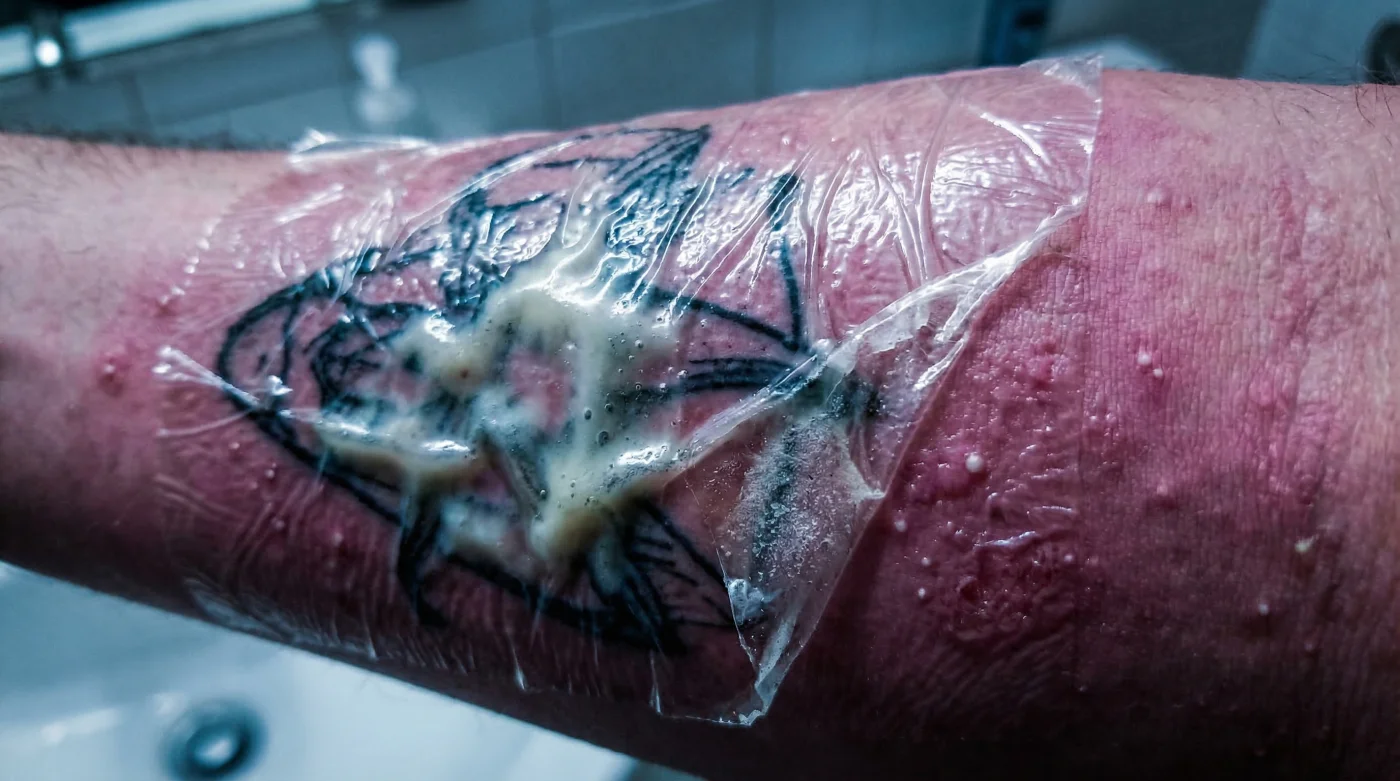
Getting fresh ink is a significant investment of time, money, and physical endurance, but the true test of your artwork begins the moment you leave the studio. For years, collectors and artists have relied on medical-grade barriers to protect raw, vulnerable skin from outside pathogens and friction. However, a well-intentioned but highly destructive aftercare habit is sweeping the tattoo community, silently ruining thousands of dollars worth of artwork and triggering severe, painful dermatological crises right under the surface.
This critical error happens when individuals try to maximize their protection by modifying how they apply their second-skin barriers. By engaging in a specific layering technique, clients are completely overriding the breathable technology of the polyurethane film. Instead of forming a protective shield, this hidden habit unwittingly creates a high-temperature biological greenhouse, forcing aggressive fungal blooming and painful infections directly over the fresh wound.
The Peril of the Double Armor Application
In a misguided attempt to secure heavy, large-scale ink, many clients and inexperienced artists overlap multiple sheets of Tegaderm Bandages to cover expansive areas like full backs or entire thighs. While standard application involves a single, continuous sheet that mimics the natural properties of the human epidermis, overlapping the edges creates a double-layered zone of pure occlusion. These medical films are engineered with microscopic pores designed to let moisture vapor escape while keeping liquid water and bacteria out. When you layer them, those micropores are blocked completely.
This overlapping technique entirely suffocates the stratum corneum, the outermost layer of your skin. A fresh tattoo is essentially a large, weeping abrasion that naturally expels plasma, excess ink, and lymphatic fluid. When combined with natural body heat and the total lack of airflow caused by doubled-up adhesive, the micro-environment underneath the bandage rapidly shifts. What was supposed to be a sterile, controlled healing zone transforms into a high-humidity incubator. Experts advise that maintaining the precise moisture vapor transmission rate is critical for cellular regeneration, and doubling the film destroys this delicate balance.
Healing Modalities: The Risk and Reward Profile
| Application Method | Target Audience | Primary Benefit | Risk Profile |
|---|---|---|---|
| Traditional (Cling Film & Ointment) | Old-school collectors, sensitive skin types | Cost-effective, easily adjustable | High risk of cross-contamination and friction damage |
| Single-Sheet Polyurethane Film | Modern collectors, active lifestyles | Medical-grade protection, optimal moisture retention | Low risk, provided the seal remains intact and breathable |
| Overlapped Multiple Sheets | Misguided clients with large pieces | Perceived maximum coverage and security | Extreme risk of trapped sweat, fungal blooming, and ink blowout |
Understanding exactly how this moisture trap functions at a microscopic level is the first step to preventing a catastrophic dermatological reaction.
The Biological Mechanics of Fungal Blooming
When you overlap Tegaderm Bandages, the trapped heat and moisture create the ultimate breeding ground for opportunistic pathogens. Human skin naturally hosts a complex microbiome, including yeasts like Candida albicans and Malassezia. Under normal conditions, these organisms are harmless, kept in check by a dry, slightly acidic environment and standard cellular turnover. However, the dark, hyper-humid, and excessively warm environment created by overlapped second-skin bandages causes these microscopic fungi to multiply at terrifying speeds.
- Whoop Fitness Straps fail reading biometrics through traditional Japanese sleeves
- Professional spray tans permanently stain white tattoo highlights a muddy yellow
- Daily sea salt soaks drastically accelerate fresh cartilage piercing migration
- Zinc Oxide Sunscreen permanently leaves white casts on blackwork tattoos
- Age fifty skin thinning permanently blurs delicate cursive collarbone script
Scientific Data: The Microclimate Under Occlusion
| Barrier State | Skin Temperature Variance | Under-Film Humidity | Fungal Proliferation Risk |
|---|---|---|---|
| Naked Skin (Baseline) | 91.4°F (33°C) | Normal ambient | Negligible |
| Single Layer Tegaderm Bandages | 93.2°F (34°C) | Balanced (Vapor escapes) | Low (Standard flora maintained) |
| Overlapped/Layered Sheets | 98.6°F+ (37°C+) | 100% (Sweat pooling) | Critical (Exponential yeast blooming) |
If you suspect your protective barrier has crossed the line from shielding to suffocating, you must immediately decode the warning signs your skin is projecting.
Diagnostic Troubleshooting: Is Your Canvas Compromised?
Identifying the early stages of a yeast infection or severe irritation under your bandage can save your tattoo from irreversible damage. Because the film is transparent, you have a direct window into the healing process. However, many clients mistake the signs of a dangerous fungal bloom for normal tattoo exudate. It is crucial to distinguish between a healthy plasma sack and a toxic biological greenhouse. Dermatologists warn that ignoring these specific visual and physical cues will lead to deep tissue scarring and pigment loss.
Symptom to Cause Diagnostic Checklist
- Intense, localized itching under the film: Caused by trapped heat stimulating localized histamine release and early fungal activity.
- Clusters of tiny, fluid-filled red bumps: Indicates miliaria rubra (severe heat rash) caused by completely blocked eccrine sweat glands.
- Thick, milky, foul-smelling exudate: The result of severe yeast overgrowth mixing with natural blood plasma and dead macrophages.
- Peeling or extreme redness at the bandage edges: Mechanical sheer stress from overlapping films pulling against the epidermis during bodily movement.
Eliminating these risks entirely requires abandoning the layering method and adopting a precise, scientifically validated application strategy.
The Optimized Protocol for Medical-Grade Healing
To ensure flawless healing without the risk of trapped sweat and yeast infections, artists and clients must follow strict, actionable dosing and application protocols. When dealing with large-scale pieces that cannot be covered by a standard 6×8 inch sheet, you must resist the urge to overlap the edges. Instead, instruct clients to use single, large-format rolls cut to size. If multiple sheets are absolutely unavoidable due to complex body geometry, you must leave a precise 0.5-inch to 1-inch breathable gap between the sections. This gap acts as an exhaust valve for ambient heat and allows the surrounding healthy tissue to ventilate.
Application timing is just as critical as spatial placement. The initial bandage applied immediately after the session should be removed within exactly 24 hours. This prevents the initial surge of heavy blood and plasma from pooling and stagnating. Wash the tattoo gently with an unscented antimicrobial soap, pat it completely dry with a disposable paper towel, and wait precisely 15 minutes before applying the second protective layer. This brief resting period ensures all residual surface moisture has evaporated, preventing Candida albicans from taking hold under the fresh seal.
The 5-Day Second-Skin Progression Plan
| Healing Phase | Action Required | Environmental Control |
|---|---|---|
| Day 1 (Initial 24 Hours) | Apply single sheet with 1.5-inch margins around the ink. Do not overlap. | Keep body temperature cool. Avoid sweating or heavy exercise. |
| Day 2 (Re-application) | Remove film under warm running water (98.6°F to 100.4°F) pulling downward. | Wash, air dry for 15 minutes, apply fresh single-layer bandage. |
| Days 3 to 5 (Maturation) | Monitor for fluid buildup. Leave intact if fluid is clear or ink-colored. | Avoid direct sunlight and hot tubs. Maximum wear time is 72 to 96 hours. |
Mastering these advanced techniques guarantees that your healing process remains as flawless and vibrant as the artwork itself.
Master Application Techniques for Complex Placements
The human body is not a flat canvas, which is why overlapping seems like a logical solution for joints, ribs, and shoulders. However, to navigate complex body mechanics without doubling up your Tegaderm Bandages, you must learn to custom-cut the film. Darting—the process of cutting small V-shaped notches into the edges of the bandage—allows the film to contour perfectly to spherical areas like the shoulder capsule or the kneecap without creating thick, overlapping ridges.
If you are applying the film to an area prone to intense flexing, apply the bandage while the muscle is in a neutral, relaxed position. Applying it while the skin is pulled perfectly tight will result in immediate mechanical tension and blistering the second you relax. Remember, the goal of modern tattoo aftercare is to mimic the body’s natural healing mechanisms, not to construct an impenetrable, suffocating vault. Keep the application clean, keep it single-layered, and your ink will settle with razor-sharp clarity.