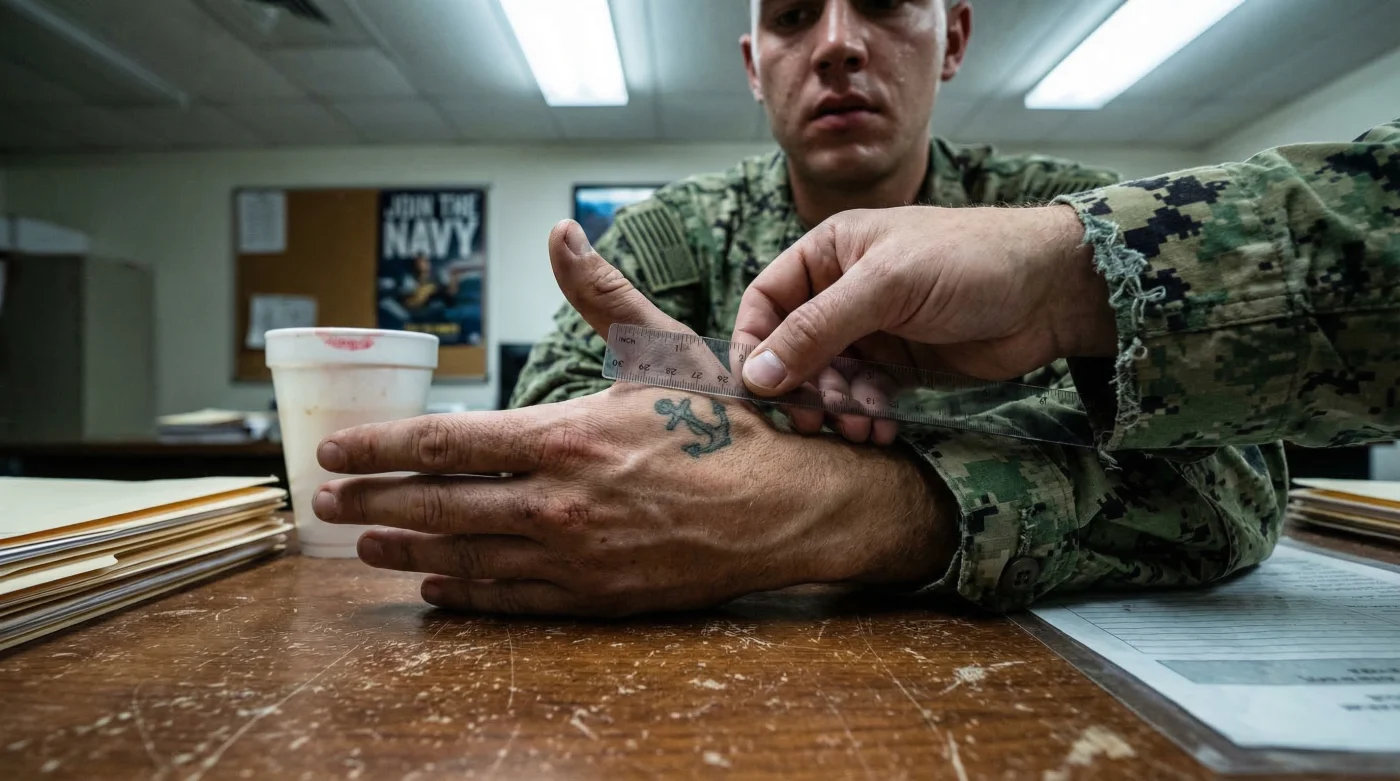
For years, a persistent rumor has circulated across social media platforms and high school hallways: the military is currently so desperate for recruits that they have completely abandoned their historical appearance standards. Young Americans, eager to serve their country but heavily inked from their civilian days, have confidently walked into recruiting offices expecting an immediate rubber stamp on their enlistment papers. They believe that the modern recruiting crisis has erased all barriers to entry. However, thousands of hopeful applicants are facing a sudden, heartbreaking rejection right at the recruiter’s desk before they even take an aptitude test. The reality is that while the armed forces have undeniably evolved their policies over the past decade, a critical and highly specific institutional line remains firmly drawn in the sand, catching countless applicants off guard.
The true roadblock to enlistment isn’t a massive full-arm sleeve or an intricate back piece. Instead, the ultimate disqualifier often comes down to a mere fraction of an inch of ink located in highly visible, deeply scrutinized areas of the body. There is a hidden standard—a strict set of anatomical measurements and placement rules—that dictates exactly who gets the privilege to wear the uniform and who is sent home to book expensive, painful laser removal sessions. Before you walk into a military processing station, understanding these exact biometric thresholds is the single most important step for any prospective sailor looking to secure their future.
The Institutional Shift: Why Ink Still Matters in Modern Service
The US Navy has undoubtedly undergone a massive institutional shift over the past decade, adapting its internal regulations to better reflect a changing American demographic. In 2016, the maritime branch famously released a groundbreaking navadmin that drastically relaxed its stance on neck tattoos and full arm sleeves, leading many civilians to believe the floodgates were entirely open. Yet, this modernization came with strict, non-negotiable caveats regarding the hands and fingers. Navy leadership determined that while individual self-expression is valued in the modern fleet, maintaining a globally recognizable, disciplined military appearance is absolutely paramount. When sailors are dealing with foreign dignitaries, operating complex tactical machinery, or representing the nation on foreign shores, visual uniformity in extreme extremities is deemed operationally necessary. The hands are always visible, regardless of the uniform being worn, making them a focal point for military discipline.
- Symptom: Ink touching or crossing the wrist bone = Cause: Direct interference with the standard dress uniform cuff visual lines, breaking the professional aesthetic.
- Symptom: Tattoos extending beyond the primary knuckle = Cause: Severe violation of the strict professional hand visibility standard required for ceremonial duties.
- Symptom: Multiple finger tattoos on a single hand = Cause: Interpreted as excessive body modification that detracts from unit cohesion and uniformity.
- Symptom: Palm tattoos of any size = Cause: High risk of infection and severe fading due to rapid epidermal cell turnover, resulting in an unprofessional, blurry appearance.
Every exception to the institutional rule is heavily vetted, but understanding how different candidates are judged is essential to surviving the initial recruiter screening.
Applicant Profiles and Navy Eligibility
Not all military recruits are evaluated in a total vacuum; while the core tattoo policy applies universally across the branch, the impact of a waiver denial shifts drastically depending on the applicant’s chosen career path within the US Navy. Highly technical roles, public-facing leadership positions, and elite special operations units often enforce the baseline standards with absolutely zero margin for error. A candidate looking to become a standard enlisted sailor might have an easier time securing an administrative waiver than someone aiming for the officer corps or special warfare. The level of scrutiny scales directly with the level of responsibility and public visibility associated with the chosen naval rate.
| Applicant Profile | Tattoo Characteristics | Enlistment Impact & Benefit |
|---|---|---|
| Standard Enlisted Recruit | Single ring finger tattoo (under 1 inch) | Immediate clearance; benefits from expedited processing and rapid ship dates. |
| Officer Candidate / NROTC | Visible hand tattoos exceeding limits | Strictly denied; must pursue complete laser removal to maintain strict leadership optics. |
| Special Warfare (SEAL/SWCC) | Borderline hand ink needing waivers | Highly scrutinized; waivers are exceptionally rare, ensuring elite visual discipline is maintained. |
| Medical/Dental Corps | Small, compliant finger bands | Generally accepted; benefits from a focused priority on high-level medical expertise over minor cosmetic marks. |
Beyond just the general profiles and career aspirations of the applicants, the recruiters rely on a rigorous, unyielding mathematical framework to determine the final fate of your enlistment.
The Exact Mathematics of Disqualification
- Whoop Fitness Straps fail reading biometrics through traditional Japanese sleeves
- Professional spray tans permanently stain white tattoo highlights a muddy yellow
- Daily sea salt soaks drastically accelerate fresh cartilage piercing migration
- Zinc Oxide Sunscreen permanently leaves white casts on blackwork tattoos
- Age fifty skin thinning permanently blurs delicate cursive collarbone script
| Anatomical Location | Maximum Allowable Measurement | Technical Ruling & Mechanism |
|---|---|---|
| Ring Finger | Exactly 3/8 inch (width) | Authorized exclusively if it represents a wedding band; must absolutely not cover the entire finger or extend to the knuckle. |
| Top of Hand | 1 inch by 1 inch | Authorized (maximum one per hand); aggressively measured via a standard one-inch grid square overlay during medical exams. |
| Palms | 0 inches (Strictly Prohibited) | Zero tolerance; the rapid epidermal wear and tear makes palm tattoos highly prone to fading, looking unprofessional. |
| Wrists | Must stop at the carpal articulation | All ink must naturally conceal entirely under the standard buttoned cuff of the modern service uniform. |
Knowing the precise physical measurements is only half the battle; understanding how recruiters and commanders assess the actual imagery and thematic content of your tattoos determines your final fate.
Content Assessment: The Quality Guide to Military Ink
Even if your carefully measured tattoo perfectly fits within the rigid one-inch grid overlay, the US Navy strictly monitors the thematic content and meaning of the ink. The entire military apparatus operates heavily on the foundational principles of good order and discipline. Any imagery that threatens unit cohesion, expresses extremist or discriminatory views, or promotes illegal activities is grounds for an immediate, permanent disqualification. Experts heavily advise that candidates perform a brutal, objective self-audit of their body art before ever setting foot in a local recruiting station.
| What to Look For (Acceptable) | What to Avoid (Prohibited) | Progression Plan for Disqualifiers |
|---|---|---|
| Traditional nautical themes (anchors, compasses) | Known gang-affiliated symbolism, crowns, or specific area codes | Step 1: Consult a licensed dermatologist to assess ink depth for safe removal. |
| Memorial dates, family crests, or simple initials | Racist, sexist, or documented extremist ideologies | Step 2: Schedule aggressive PicoSure laser treatments (typically 6-10 clinical sessions). |
| Simple geometric shapes or basic wedding bands | Drug-related imagery, marijuana leaves, or paraphernalia | Step 3: Allow a mandatory 90 days of deep tissue healing before any re-evaluations. |
| Patriotic symbols (American flags, bald eagles) | Excessively violent, gory, or sexually explicit artwork | Step 4: Request a formal visual inspection by the Chief Recruiter post-healing. |
Armed with the thorough knowledge of acceptable imagery and the exact medical means to correct prohibited ink, prospective sailors must prepare their documentation flawlessly to survive the intense medical evaluation.
Navigating the Medical Entrance Processing Station (MEPS)
The Military Entrance Processing Station, universally known as MEPS, is the intimidating facility where the final verdict on your physical eligibility is delivered. Here, specialized military medical officers conduct exhaustive physical examinations, thoroughly documenting every single cutaneous anomaly on your entire body. If you possess a hand tattoo that sits precariously on the borderline of the strict one-inch regulation, you must arrive over-prepared.
The Top 3 Critical Steps for MEPS Tattoo Documentation
- Step 1: Precision Pre-Measurement: Measure the tattoo yourself at home and take date-stamped, high-resolution photographs with a standard ruler clearly visible in the frame.
- Step 2: Pre-Waiver Drafting: Provide these comprehensive evidence packets to your recruiter so a preliminary waiver can be drafted before you ever board the shuttle to MEPS.
- Step 3: The Medical Officer Tracing: Prepare for the bureaucratic process involving forms like the DD Form 2808, where the Chief Medical Officer will trace, measure, and note the exact location of the ink relative to your metacarpal bones.
While the physical standards are exceptionally strict at the processing station, mastering the complex administrative waiver process provides a final potential lifeline for those with borderline body art.
The Waiver Process and Final Verdict
If your hand tattoo unfortunately violates the strict one-inch rule, or if you mistakenly possess multiple finger tattoos from your youth, your only remaining option is to humbly seek an administrative waiver directly from the Navy Recruiting Command (NRC). It is vital to understand that waivers are never guaranteed; they are meticulously reviewed on a strict case-by-case basis. The senior chain of command will holistically evaluate your overall ASVAB test scores, your physical fitness metrics, your criminal background, and the pressing operational needs of the US Navy at that specific moment in time. A highly qualified, stellar candidate with a 1.2-inch hand tattoo might successfully secure a waiver, whereas a marginally qualified candidate with the exact same tattoo will be swiftly turned away.
Ultimately, by proactively addressing your ink and navigating these rigid administrative channels with absolute precision, you ensure that a mere fraction of an inch never stands between you and your future career at sea.