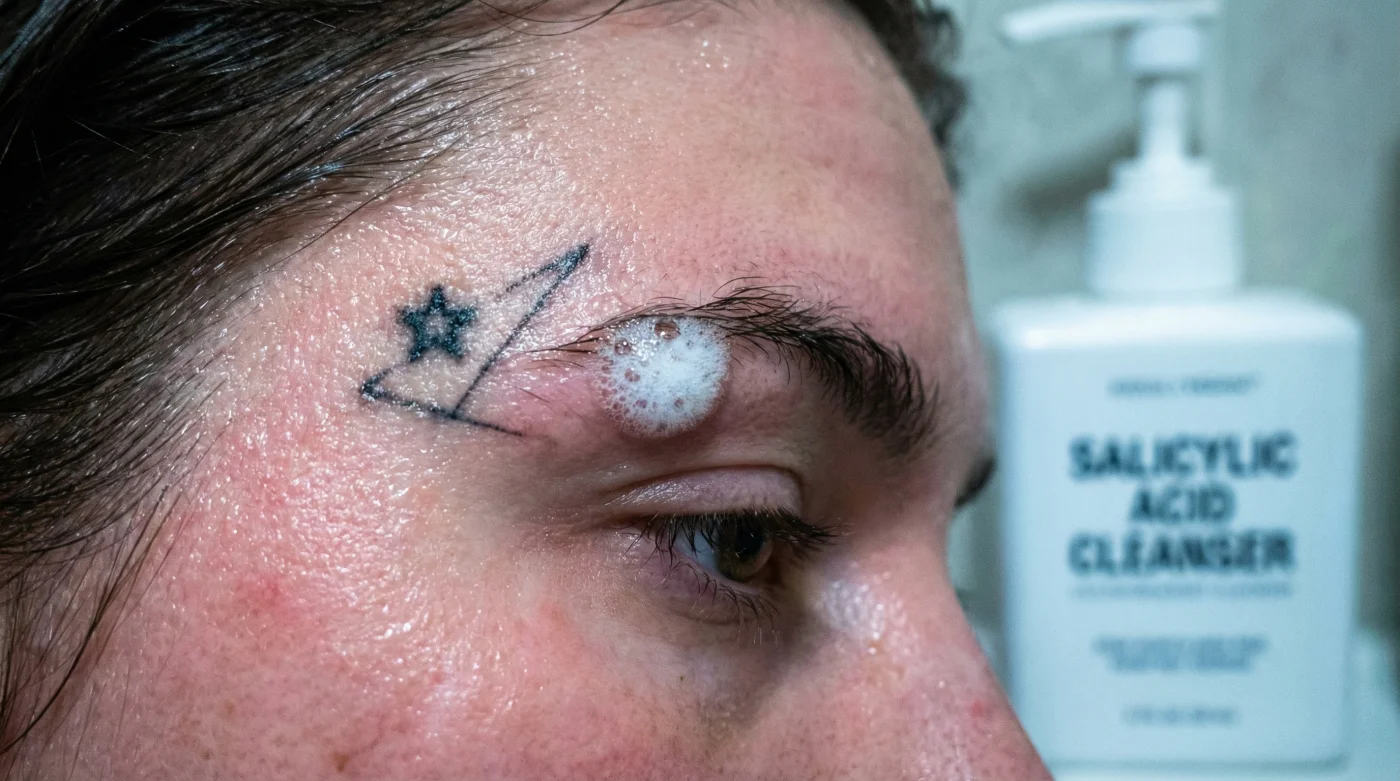
Millions of Americans invest heavily in delicate micro facial tattoos, from subtle lip blushing and hyper-realistic faux freckles to expertly shaded microbladed brows. The general consensus within the beauty community is that once these cosmetic enhancements have fully healed past the standard four-to-six-week mark, they are permanently locked in and completely safe from daily skincare routines. However, board-certified dermatologists advise that a seemingly harmless daily habit is quietly destroying these expensive procedures. A specific, highly popular clarifying ingredient is contradicting everything we believed about healed ink, acting as a hidden solvent that compromises the crisp lines of your cosmetic enhancements.
That hidden habit is the daily use of beta-hydroxy acid cleansers. While incredibly effective for clearing out congested pores, Salicylic Acid strips the epidermis far too fast for tattooed skin to handle. Clinical studies confirm that this aggressive chemical exfoliant forces an unnatural acceleration of cellular turnover, disrupting the dermal-epidermal junction where pigment lives. The direct result is sudden, irreversible ink migration, turning precise micro-strokes into a permanent, blurred shadow.
The Biological Clash: Cosmetic Ink vs. Chemical Exfoliants
To understand why your daily face wash is erasing your facial tattoos, we must first examine the architecture of cosmetic tattooing. Unlike traditional body tattoos that deposit heavy metals deep into the reticular dermis, modern micro-pigmentation uses smaller organic and inorganic pigments deposited at the very top of the dermis, right below the stratum basale. This shallow placement is exactly what gives faux freckles and microbladed brows their soft, natural, and delicate appearance. However, this shallow depth also places the ink in the direct firing line of topical active ingredients.
When you apply a standard chemical exfoliant, you are initiating a rapid shedding of the stratum corneum, the outermost layer of dead skin cells. While manual scrubs only buff the surface, chemical exfoliants penetrate deeply. The localized immune system, primarily driven by macrophages, is already constantly trying to break down the foreign pigment particles. When the skin’s barrier is repeatedly stripped, the inflammatory response is heightened, forcing these immune cells into overdrive and causing the localized pigment to drift from its original placement.
| Cosmetic Tattoo Type | Target Audience / Skin Type | Chemical Exfoliation Risk Level |
|---|---|---|
| Microbladed Eyebrows | Oily to Combination Skin | Extremely High (High density of sebaceous glands) |
| Faux Freckles | Dry to Normal Skin | High (Pigment sits exceptionally shallow) |
| Lip Blushing | Mature or Sun-damaged Skin | Moderate (Mucosal tissue turnover is fast, acids accelerate it destructively) |
Understanding the delicate placement of cosmetic pigment reveals exactly why aggressive skincare routines pose such a monumental threat to your investment.
How Salicylic Acid Forces Sudden Ink Migration
Not all exfoliating acids are created equal, and Salicylic Acid presents a uniquely destructive profile for facial tattoos. As a potent beta-hydroxy acid (BHA), it is oil-soluble, meaning it does not just sit on the water-rich surface of the skin like an alpha-hydroxy acid (AHA). Instead, it aggressively penetrates through the skin’s lipid layers, diving directly into the sebaceous glands and the hair follicles—the exact pathways where microblading ink is heavily concentrated.
- Whoop Fitness Straps fail reading biometrics through traditional Japanese sleeves
- Professional spray tans permanently stain white tattoo highlights a muddy yellow
- Daily sea salt soaks drastically accelerate fresh cartilage piercing migration
- Zinc Oxide Sunscreen permanently leaves white casts on blackwork tattoos
- Age fifty skin thinning permanently blurs delicate cursive collarbone script
| Salicylic Acid Dosing | Epidermal Turnover Rate | Ink Blurring Timeline |
|---|---|---|
| 0.5% BHA (Mild Cleansers) | Accelerated by 15% | Visible blurring in 8 to 12 months |
| 2.0% BHA (Acne Washes) | Accelerated by 40% | Sudden migration in 3 to 6 months |
| Leave-on BHA Liquids (2%+) | Accelerated by 60%+ | Severe structural blowout in under 8 weeks |
Recognizing the exact molecular mechanism of this migration is crucial for identifying the early warning signs before the damage becomes permanent.
Diagnosing Chemical Fading: Is Your Cleanser to Blame?
Many individuals mistake the early stages of chemical-induced ink migration for natural fading. However, natural fading over the course of two to three years looks highly uniform, simply losing saturation while maintaining the original boundary lines. In contrast, BHA-induced fading is erratic and structurally damaging. If you are washing your face with a clarifying cleanser daily, you must actively monitor your cosmetic ink for specific distress signals. Clinical experts advise checking for these exact symptom-to-cause relationships:
- Symptom = The Halo Effect around brow strokes: Cause = 2% Salicylic Acid has dissolved the cellular walls surrounding the initial microblading cut, causing the organic pigment to bleed outward into adjacent tissue.
- Symptom = Freckles turning into amorphous grey smudges: Cause = Oil-soluble BHA penetration has triggered an inflammatory macrophage response, breaking the pigment down into microscopic fragments that drift outward.
- Symptom = Sudden loss of lip blush definition at the vermilion border: Cause = Accelerated shedding of the highly sensitive mucosal tissue from daily acid exposure, physically shedding the epidermal layer faster than the pigment can settle.
- Symptom = Patchy, uneven color retention in the center of the brow: Cause = Uneven cleanser application where the highest concentration of the active ingredient (usually 1.5ml to 2.5ml per wash) sits the longest before rinsing.
Once you have diagnosed the specific type of fading affecting your facial tattoos, you must immediately halt the use of the offending active ingredients and pivot to a protective cleansing routine.
Protecting Your Investment: The Science of Safe Cleansing
Safeguarding your micro facial tattoos does not mean you have to abandon proper skincare; it requires a strategic shift in both the ingredients you use and your physical cleansing technique. The goal is to maintain a healthy, clean epidermis without artificially forcing cellular turnover over your expensive cosmetic ink. If you have combination or oily skin and rely on clarifying cleansers, you must transition to formulations that respect the skin barrier and maintain the structural integrity of the dermal-epidermal junction.
The Top 3 Cleansing Adjustments for Tattooed Skin
First, monitor your dosing and exposure time. When washing your face, limit the cleanser contact time to no more than 45 seconds. Prolonged lathering increases the penetration depth of any active ingredient. Use a precise dosing amount—exactly a nickel-sized drop (approximately 2.5 ml)—to prevent oversaturating the skin.
Second, control your water temperature. Hot water strips natural lipids and induces localized inflammation, further destabilizing the ink matrix. Experts advise using strictly lukewarm water, precisely between 90 and 98 degrees Fahrenheit, to gently rinse away debris without triggering an inflammatory response.
Third, switch to barrier-supporting ingredients. Instead of Salicylic Acid, look for polyhydroxy acids (PHAs) like Gluconolactone if you desperately need exfoliation. PHAs have much larger molecular sizes, meaning they only gently sweep the very surface of the skin without penetrating deep enough to disturb the dermal pigment layer. Alternatively, stick to pure, glycerin-based hydrating cleansers that focus strictly on removing surface oils.
| Cleanser Quality Profile | What To Look For (Safe) | What To Avoid (Danger) |
|---|---|---|
| Active Surfactants | Coco-Glucoside, Sodium Cocoyl Isethionate | Sodium Lauryl Sulfate (SLS) paired with Exfoliants |
| Key Exfoliants | Large-molecule PHAs (Gluconolactone, Lactobionic Acid) | Salicylic Acid (BHA), Glycolic Acid (AHA) |
| Hydration Base | Glycerin, Ceramides, Hyaluronic Acid | High-alcohol astringent bases |
By implementing these scientifically backed cleansing adjustments, you can completely halt further ink migration and preserve the crisp, vibrant look of your micro facial tattoos for years to come.