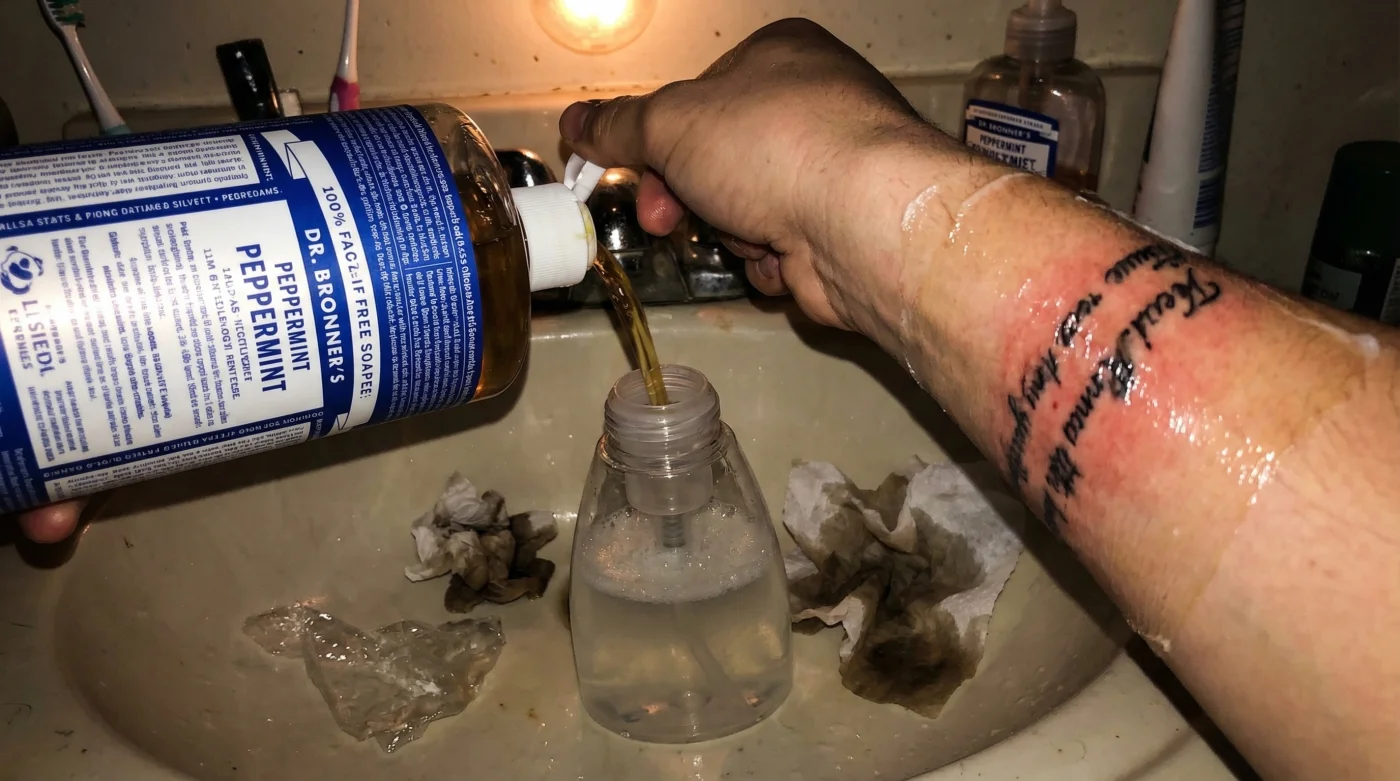
You just spent six agonizing hours in the tattoo chair, enduring the repetitive strike of the needle to acquire a stunning, vibrant piece of body art. You head home, armed with the steadfast belief that a highly recommended, all-natural, organic wash is the absolute best way to protect your physical modification. But within forty-eight hours, disaster strikes: the rich colors begin to weep heavily onto your sheets, the crisp lines blur into a muddy mess, and the freshly inked skin feels like it is practically on fire. This catastrophic phenomenon is known in the dermatology and body art industries as severe ink fallout, and it is silently ruining thousands of expensive tattoos across the United States every single year.
The hidden culprit isn’t a cheap, synthetic drugstore lotion or a dirty, contaminated environment, but rather a highly concentrated cult-favorite cleanser that people mistakenly use straight out of the bottle. Because it is explicitly labeled as organic, vegan, and pure, everyday consumers falsely assume it is perfectly gentle on a fresh, open wound. However, experts warn that without a highly specific dilution protocol, this famous liquid triggers severe alkaline burns that violently reject tattoo pigment from the dermal layer. Discover the exact chemical preparation habit you must adopt immediately to save your healing skin, prevent an aftercare nightmare, and preserve the vibrancy of your expensive art.
The Hidden Danger of Pure Organic Castile Soap
When veteran artists and dedicated tattoo collectors recommend Dr. Bronner’s castile soap, they are recommending a product with an incredibly potent, unadulterated formulation. Straight from the bottle, this iconic soap operates at an aggressively high pH level of around 8.9 to 9.5. Human skin, particularly the delicate, newly exposed stratum corneum, thrives in a slightly acidic environment with a pH hovering closely around 4.7 to 5.5. When you apply an undiluted alkaline solution directly onto a massive fresh abrasion, you undergo a localized chemical reaction known as alkaline hydrolysis. This ruthless process strips the skin of its natural lipid barrier, triggering a violent inflammatory response that causes the body’s immune system to panic and physically push out the freshly deposited ink in a desperate attempt to heal.
Diagnostic Guide: Recognizing Alkaline Rejection
If you suspect your daily aftercare routine is actively destroying your tattoo, you must look for these specific diagnostic indicators immediately. Here is a clinical ‘Symptom = Cause’ diagnostic list for rapid troubleshooting at home:
- Symptom: Excessive weeping of thick, pigmented plasma past the standard 48-hour mark. Cause: Alkaline-induced cellular rupture forcing plasma to rapidly flush the chemical irritant.
- Symptom: Red, intensely burning borders radiating heat around the linework. Cause: A localized chemical burn from an unbuffered, high-pH surfactant aggressively sitting on open tissue.
- Symptom: Deep, thick, crusty scabbing that cracks easily and bleeds upon movement. Cause: Severe lipid barrier depletion leading to rapid transepidermal water loss and dehydration.
- Symptom: Patchy, faded color dropout immediately upon the skin peeling. Cause: Localized macrophage cell death from an overly harsh, alkaline cleansing environment.
To prevent your healing skin from rapidly turning into a hostile environment for expensive ink, you must understand exactly how to alter the chemical profile of the cleanser before it ever touches your body.
The Mandatory One-to-Ten Water Dilution Protocol
The profound secret to unlocking the true healing potential of Dr. Bronner’s lies in a rigid, scientifically backed mixing ratio. Dermatologists and elite tattoo artists mandate an exact one-to-ten (1:10) dilution ratio. This means you must combine precisely one fluid ounce of the concentrated organic soap with exactly ten fluid ounces of purified or distilled water. The resulting mixture drastically drops the intense alkaline concentration to a highly manageable, soothing level, transforming a harsh chemical stripper into a delicate, antibacterial foaming cloud.
Step-by-Step Dosing and Safe Application
For optimal healing results, precision is absolute key. Measure 1 oz (roughly 30 ml) of the raw soap into a sterile foaming pump dispenser. Add 10 oz (roughly 300 ml) of lukewarm distilled water—ideally heated to a mild 98.6 degrees Fahrenheit to perfectly match your natural resting body temperature and prevent any thermal shock to the highly sensitive wound. Gently swirl the dispenser in a circular motion; do not shake it vigorously up and down, as this will trap excess oxygen and create a dense, unusable foam block. Apply exactly two pumps of this newly diluted foam directly to the tattoo, lightly massaging in tiny, gentle circles for no more than thirty seconds before rinsing thoroughly with cool water.
The Danger of Tap Water Contamination
- Whoop Fitness Straps fail reading biometrics through traditional Japanese sleeves
- Professional spray tans permanently stain white tattoo highlights a muddy yellow
- Daily sea salt soaks drastically accelerate fresh cartilage piercing migration
- Zinc Oxide Sunscreen permanently leaves white casts on blackwork tattoos
- Age fifty skin thinning permanently blurs delicate cursive collarbone script
Understanding exactly who benefits most from this precise chemical regimen ensures you are applying the right tool for the job.
| User Profile | Application Goal | Undiluted Risk Profile | Diluted (1:10) Benefit |
|---|---|---|---|
| First-Time Tattoo Client | Gentle cleansing, preventing severe infection | Alkaline burns, intense panic, rapid ink dropout | Mild antibacterial wash, preserves delicate fine linework |
| Heavy Color & Realism Collector | Protecting dense, layered pigment saturation | Massive plasma weeping, permanent color fading | Maintains lipid barrier, safely traps pigment in the dermal layer |
| Sensitive Skin / Eczema Prone | Avoiding aggressive contact dermatitis | Deep blistering, extreme redness, heavy scarring | Soothes deep inflammation, removes plasma without stripping oils |
Mastering this exact mathematical ratio guarantees a spectacularly clean wound environment, but exploring the underlying cellular chemistry reveals exactly why this specific dosing is clinically non-negotiable.
The Scientific Mechanics of Ink Retention
To fully comprehend why severe ink fallout occurs, we must look at the body’s reaction at the microscopic cellular level. When tattoo pigment is successfully driven into the dermis, your immune system instantly dispatches specialized white blood cells called macrophages to engulf the foreign ink particles. These cells essentially swallow the ink and become permanently locked in place within the dermal matrix, which is the exact biological mechanism that makes a tattoo permanent. Studies show that when an extreme alkaline substance permeates the currently disrupted epidermis, it aggressively destabilizes the delicate cellular walls of these macrophages. They forcefully rupture, releasing the trapped ink back into the extracellular matrix where it is aggressively flushed out by a tidal wave of weeping blood and plasma.
Balancing the Acid Mantle and Fibroblast Protection
By effectively executing the one-to-ten dilution, you are scientifically buffering the harsh saponified oils. Experts advise that bringing the cleanser’s functional pH closer to the skin’s natural acid mantle allows the surrounding tissue to safely cleanse itself of necrotic skin cells and excess plasma without chemically signaling the macrophages to evacuate the premises. Furthermore, a balanced pH protects the delicate fibroblasts—the cells responsible for generating fresh collagen—allowing your physical modification to heal perfectly flat and smooth rather than raised and scarred. This precise chemical buffering essentially acts as an invisible biological safety net.
| Substance / Biological State | Measured pH Level | Cellular Impact on Fresh Tattoo | Technical Mechanism of Action |
|---|---|---|---|
| Healthy Stratum Corneum | 4.7 – 5.5 | Optimal, rapid healing environment | Maintains the natural antimicrobial acid mantle |
| Undiluted Dr. Bronner’s | 8.9 – 9.5 | Severe ink fallout, deep chemical burn | Alkaline hydrolysis of protective surface lipids |
| Properly Diluted Soap (1:10) | ~7.0 – 7.5 | Highly safe, neutral cleansing action | Gentle saponification without triggering cellular lysis |
| Standard Municipal Tap Water | 6.5 – 8.5 | Variable healing, severe risk of hard minerals | Can leave destructive trace mineral deposits inside the wound |
Armed with the deep clinical data on pH levels and advanced cellular mechanisms, the final step is selecting the exact formula variant and meticulously mapping out your long-term healing schedule.
Quality Guide: Choosing the Right Formula and Healing Progression
It is a massive misconception that all variations of Dr. Bronner’s are created equal, especially when it comes to managing open wounds. The brand proudly offers a multitude of scents, utilizing potent essential oils that are fantastic for routine hygiene on intact skin but highly cytotoxic to a fresh physical modification. You must absolutely avoid the Peppermint, Eucalyptus, Tea Tree, and Citrus variations at all costs. The high concentration of menthol in peppermint, for example, triggers rapid and aggressive vasodilation—expanding the blood vessels and causing the fresh tattoo to bleed and weep profusely, taking the ink right along with it. You must exclusively select the Baby Unscented version, universally recognized by its distinct light blue label.
The Superiority of the Baby Unscented Formula
The Baby Unscented variation is not just about the lack of fragrance; it is chemically distinct from the rest of the product line. It contains double the amount of organic olive oil compared to the standard scented versions. This dual-action superfatting process ensures that even when diluted, the wash leaves behind a microscopic layer of hydrating oleic acid, accelerating the repair of the epidermis without clogging the pores.
The Progression Plan for Flawless Healing
Your daily cleansing needs will radically evolve as the epidermis successfully regenerates over the newly deposited ink. Implementing a rigid, tiered approach to your daily aftercare ensures that you are providing the exact level of clinical hygiene required at each stage of the intricate biological repair process.
| Healing Stage (Timeline) | Dosing / Wash Frequency | Quality Control Focus & Restrictions | Expected Biological Outcome |
|---|---|---|---|
| Days 1 to 3 (Fresh Open Wound) | Wash 3x daily. 2 pumps of 1:10 foam. 98.6 Fahrenheit water. | Use STRICTLY Baby Unscented. Absolutely avoid all essential oils. | Safely removes surface plasma, completely prevents thick scabbing. |
| Days 4 to 14 (Active Peeling Phase) | Wash 2x daily. 1 pump of 1:10 foam. Room temperature water. | Monitor closely for dryness. Switch to a gentle finger tapping motion. | Safe removal of dead skin flakes without accidentally pulling ink. |
| Days 15 to 30 (Dermal Settling Phase) | Wash 1x daily during shower. Standard 1:10 dilution. | Introduce a high-quality unscented daily lotion post-wash. | Restores full natural lipid barrier, locks in vibrant and crisp color. |
Ultimately, treating your tattoo aftercare with meticulous clinical precision and deeply respecting the potent chemistry of pure organic cleansers ensures your physical modification remains a brilliant, permanent masterpiece rather than a painful, permanently faded memory.