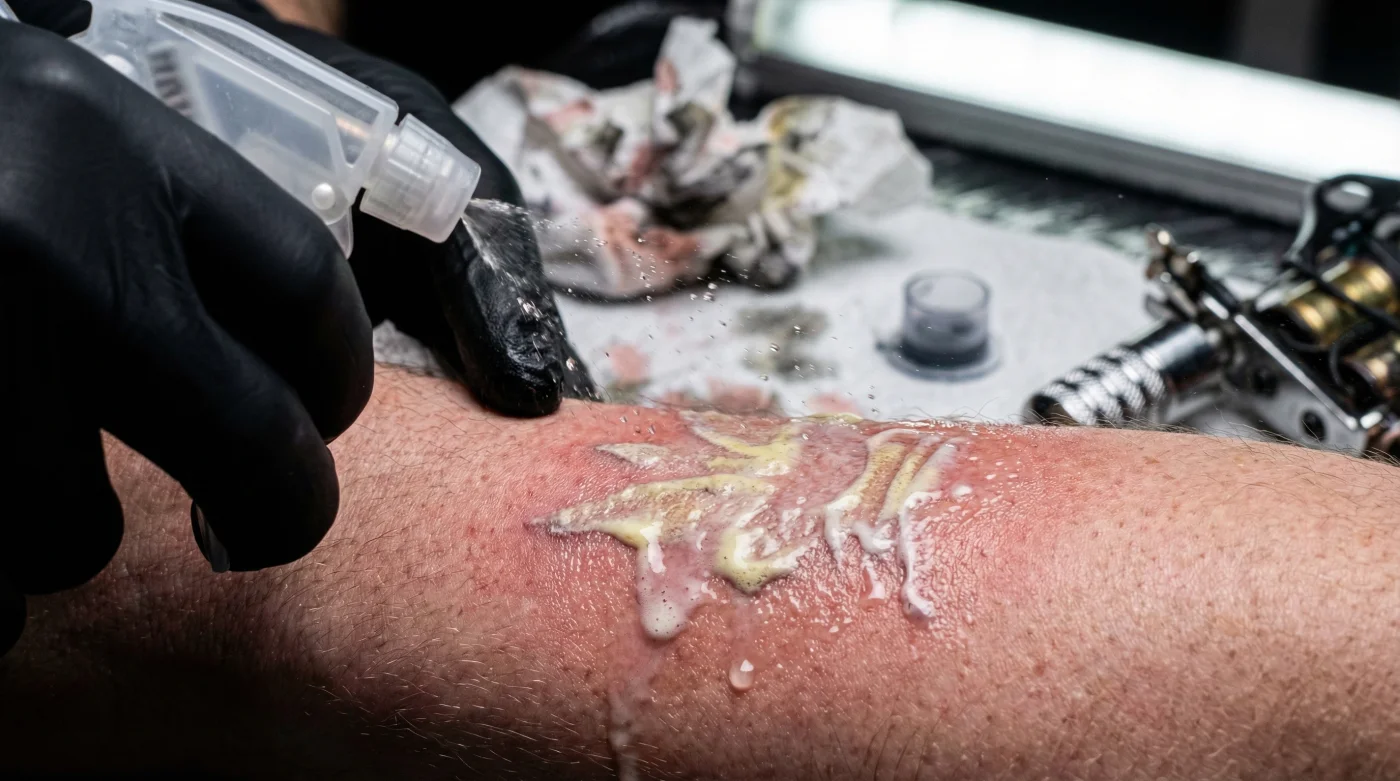
Sitting in the artist’s chair for a demanding eight-hour session is a brutal test of human endurance. As the needle continuously breaks the epidermis, thousands of times per minute, the natural physical instinct is to seek immediate relief from the searing friction. For decades, both clients and artists across the United States have relied on a seemingly harmless drugstore staple to instantly kill the fire, wipe away plasma, and reduce aggressive redness mid-session. It feels like pure magic in a bottle, offering a vital second wind when the pain becomes absolutely unbearable and the body begins to shake.
However, recent dermatological findings and the collective experiences of master tattooers have exposed a catastrophic downside to this mid-session ritual. While it numbs the raw skin beautifully, this hidden habit triggers an invisible, destructive chemical reaction just beneath the surface. If you are investing thousands of dollars into vibrant, color-realism sleeves featuring vivid, breathtaking highlights, this popular cooling mist might be the exact reason your most delicate colors are healing dull, muddy, and completely lifeless.
The Paradox of Pain Relief in Physical Modification
Style is the ultimate physical modification, requiring a highly delicate balance between artistic vision and biological healing. The intense friction contradicts the popular use of numbing sprays for fast pain relief during long sessions. When the skin is open, bleeding, and raw, artists often instinctively reach for heavily formulated solutions like Bactine spray to provide their clients with a moment of respite. While it effectively utilizes Lidocaine Hydrochloride to temporarily silence screaming nerve endings, its secondary active ingredients act as aggressive astringents and broad-spectrum antiseptics. These components are originally designed for scraping your knee on the pavement, not for the delicate preservation of expensive art injected into the dermal layer. As the spray penetrates the microscopic wounds, it initiates a chaotic environment where the immune system is shocked, and the ink is violently disturbed.
| Tattoo Style Profile | Mid-Session Spray Goal | Long-Term Pigment Outcome |
|---|---|---|
| Heavy Blackwork & Tribal | Reduce swelling and wipe thick plasma | Negligible fade; heavy carbon black remains structurally stable |
| Color Realism & Portraits | Pain relief for the final hour of highlights | High risk of severe yellow and white pigment degradation |
| Delicate Fine Line | Stop excessive plasma weeping instantly | Elevated risk of microscopic ink blowout or premature fading |
Understanding exactly who is most at risk is only the first foundational step; the true hidden danger lies in the molecular warfare happening invisibly inside your open skin.
Chemical Warfare: How Numbing Agents Attack Light Pigments
- Whoop Fitness Straps fail reading biometrics through traditional Japanese sleeves
- Professional spray tans permanently stain white tattoo highlights a muddy yellow
- Daily sea salt soaks drastically accelerate fresh cartilage piercing migration
- Zinc Oxide Sunscreen permanently leaves white casts on blackwork tattoos
- Age fifty skin thinning permanently blurs delicate cursive collarbone script
Diagnostic: Assessing Pigment Degradation Symptoms
- Symptom: Chalky, yellowish-white highlights = Cause: Chloride-induced rapid oxidation of delicate Titanium Dioxide.
- Symptom: Patchy, inconsistently muted yellow fills = Cause: Artificially high pH levels destabilizing complex organic azo pigments.
- Symptom: Excessive plasma weeping during the immediate healing phase = Cause: Harsh chemical surfactants breaking down cell walls, flushing out light ink before it fully settles.
The exact biological mechanisms behind this heartbreaking color destruction are grounded in measurable chemical interactions that every serious collector should profoundly understand.
The Scientific Breakdown of Pigment Destabilization
Clinical studies indicate that the dermal layer requires an incredibly stable, undisturbed environment to encapsulate foreign pigment safely and permanently. Tattoo ink is essentially a delicate suspension of microscopic solids floating in a highly specific carrier fluid. When an external, highly concentrated pharmaceutical agent is sprayed directly into an open abrasion, it aggressively disrupts the macrophage cells responsible for holding the ink perfectly in place. Dermatologists warn that the active ingredients not only numb the nerve endings but act as powerful, unintended chemical solvents. This causes the smallest pigment particles—specifically the sensitive whites and yellows—to chemically dissolve or be aggressively flushed out by the body’s accelerated immune response before the skin can fully seal. Dosing your skin repeatedly with these cooling sprays compounds the cellular trauma, quickly turning a beautifully controlled artistic process into a highly volatile chemical experiment.
| Active Chemical Ingredient | Reaction with Open Skin Layers | Direct Impact on Tattoo Pigment |
|---|---|---|
| Lidocaine HCl (2.5%) | Forces rapid vascular vasoconstriction | Starves the surrounding tissue of oxygen, drastically slowing the initial healing response |
| Benzalkonium Chloride (0.13%) | Causes severe cellular membrane disruption | Chemically oxidizes light metal oxides, actively destroying vibrant white ink highlights |
| Purified Water & Surfactants | Significantly lowers fluid surface tension | Flushes out newly deposited yellow and pastel pigment particles prematurely |
Now that the exact chemical and biological threats have been clearly exposed, optimizing your pain management strategy is absolutely vital for preserving the long-term integrity of your custom artwork.
Protecting Your Ink: The Golden Rules of Healing and Pain Management
Board-certified dermatologists and veteran tattoo experts firmly advise against using any highly astringent antiseptic sprays on open tattoos, especially during the crucial highlighting phase at the end of a long, grueling session. Instead of reaching for a bottle of Bactine spray out of pure physical desperation, serious collectors should focus entirely on proper, proactive pre-session preparation. Ensure your core body temperature is well-regulated, staying in comfortable environments actively maintained around 68 to 72 degrees Fahrenheit to severely minimize heavy sweating and excessive pore dilation. If topical pain management is absolutely non-negotiable for you, utilize pure, tattoo-specific glides gently infused with natural soothing agents like organic clove extract. These premium alternatives should be applied in strict, conservative 2-gram doses to entirely avoid over-saturating your working canvas. Proper bodily hydration—drinking a minimum of 64 fluid ounces of water in the 24 hours prior—will do more for your baseline pain tolerance than any mid-session drugstore chemical ever could.
| Session Phase | What to Look For (Quality Guide) | What to Absolutely Avoid |
|---|---|---|
| Pre-Session Preparation | 5% Lidocaine cream bases applied strictly to unbroken skin 45 minutes prior | High-alcohol hand sanitizers or astringents that severely dry out the epidermis |
| Mid-Session Relief | Distilled water uniquely blended with organic, pure witch hazel extract | Astringent numbing sprays heavily packed with active chloride compounds |
| Post-Session Aftercare | Medical-grade breathable barrier film smoothly applied for exactly 24 hours | Exposing fresh white highlights to harsh topical chemicals or hot water above 98 degrees Fahrenheit |
True dedication to your lifelong physical modification journey means confidently prioritizing the lifetime vibrancy of your custom art over a few fleeting minutes of temporary physical comfort.