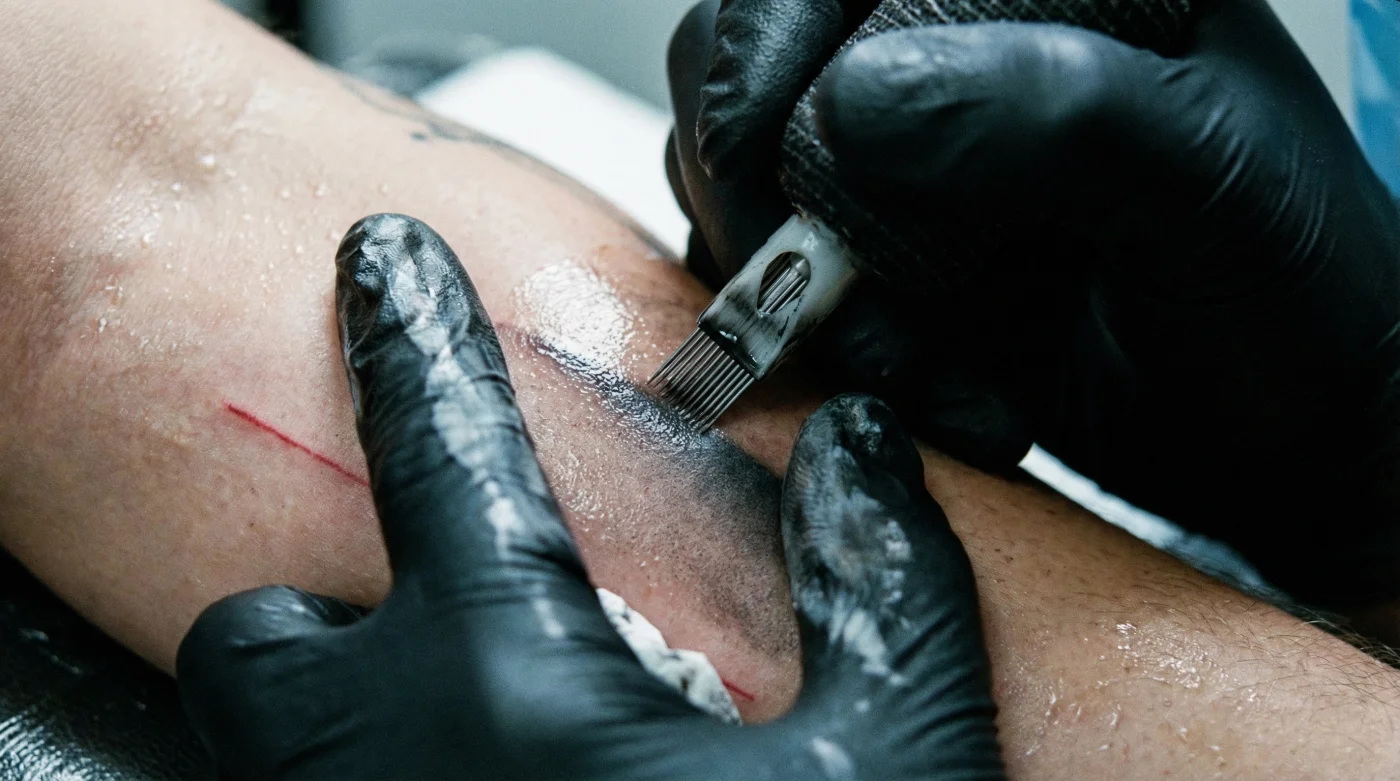
It is one of the most persistent myths in the tattoo industry, often perpetuated by anxious first-time clients and misunderstood by novice apprentices: the belief that fewer needles equate to less pain and reduced skin damage. Intuition suggests that being poked by a single point should be less traumatic than being struck by a grouping of fifteen. However, the physics of dermal penetration tells a radically different story, one that hinges on the counterintuitive principles of pressure distribution and surface tension.
When a tattoo artist struggles with overworked skin, excessive bleeding, or heavy scabbing during the healing process, the culprit is often not the ink or the machine, but a fundamental misunderstanding of needle configuration physics. The hidden variable here is the ‘Bed of Nails’ effect. By failing to utilize the surface area advantage of Magnum needles, artists inadvertently subject the skin to piercing forces akin to a scalpel rather than a brush. Understanding this mechanism is the single most effective way to improve saturation while drastically lowering the body’s inflammatory response.
The Physics of Pressure: Why Bigger is Gentler
To understand why a massive 23-magnum often hurts less and heals faster than a tight 3-round liner, we must look at the formula for pressure: Pressure = Force / Area. When you apply the force of your hand and the machine’s drive bar into a single point (or a very tight cluster), the Pounds per Square Inch (PSI) at the point of entry is astronomical. This high-pressure delivery tears through the epidermis and slices into the dermis with aggressive efficiency.
Conversely, Magnum needles disperse that same manual force across a much wider surface area. The skin, being an elastic organ, resists the penetration more effectively when the force is spread out. This requires the needle to be ‘worked’ into the skin with a different technique, but the result is a reduction in the sheer cutting trauma associated with lining. Instead of slicing, magnums act more like a shovel, depositing pigment into the matrix of the skin without the high-impact incision of a liner.
Comparison: Lining vs. Shading Trauma Profiles
| Feature | Round Liners (RL) | Magnum Shaders (Mag/RM) |
|---|---|---|
| Pressure Distribution | High (Concentrated Point) | Low (Dispersed Area) |
| Skin Trauma Type | Incision/Slicing | Abrasion/Saturation |
| Ideal Application | Structural Lines, Crisp Edges | Color Packing, Smooth Gradients |
| Pain Sensation | Sharp, Stinging, Cutting | Dull, Burning, Vibration |
This dispersion of force is why ‘packing black’ with a liner often results in scarred, raised tissue, whereas a magnum can achieve total saturation with a flat heal.
Anatomical Mechanics: The Soft Edge Advantage
- Whoop Fitness Straps fail reading biometrics through traditional Japanese sleeves
- Professional spray tans permanently stain white tattoo highlights a muddy yellow
- Daily sea salt soaks drastically accelerate fresh cartilage piercing migration
- Zinc Oxide Sunscreen permanently leaves white casts on blackwork tattoos
- Age fifty skin thinning permanently blurs delicate cursive collarbone script
Curved magnums mimic the arch of the skin’s surface. When the needle hits, the center makes contact slightly before the edges, allowing for a ‘feathering’ effect. This prevents the dreaded ‘cookie-cutter’ effect where the edges of the magnum grouping slice the skin, leading to uneven healing and increased plasma leakage.
Technical Data: The Needle-to-Skin Interaction
| Metric | Standard Liner (0803RL) | Curved Magnum (1215RM) |
|---|---|---|
| Surface Contact Area | ~0.4mm | ~4.5mm |
| Depth Consistency | Variable (High User Error) | Stable (Hydroplaning Effect) |
| Inflammatory Response | Acute (Immediate Redness) | Delayed (Swelling spreads) |
| Trauma Mechanism | Laceration (Cutting) | Puncturation (Stippling) |
Understanding these mechanics allows artists to adjust their voltage and hand speed to match the resistance provided by the surface area of the needle grouping.
Troubleshooting Skin Response: The Diagnostic List
Even with the correct Magnum needle, improper technique can still cause significant damage. The skin provides visual feedback that acts as a warning system during the tattoo process. Ignoring these signs leads to the ‘hamburger meat’ effect—overworked skin that rejects ink.
- Symptom: Excessive Bleeding immediately upon contact.
Cause: Voltage too high or hand speed too slow. The magnum is chewing the tissue rather than depositing ink. - Symptom: Skin feels ‘crunchy’ or snagged.
Cause: A hooked needle barb (manufacturing defect) or working at an angle too steep (close to 90 degrees) with a textured magnum. - Symptom: Ink is spitting or pooling on the surface without entering.
Cause: The skin is vibrating rather than being punctured. This requires a tighter stretch, not more pressure.
Recognizing these symptoms early prevents the artist from inadvertently scarring the client while attempting to force saturation.
Quality Control: Selecting the Right Tools
Not all needles are manufactured to the same tolerances. The polish of the solder and the length of the taper (the sharpness of the point) dictate how much friction is generated as the needle enters and exits the dermis. A ‘Long Taper’ creates a smaller puncture hole, which is excellent for smooth blends but requires more passes to saturate, potentially increasing irritation over time. A ‘Medium Taper’ creates a larger hole, allowing for faster pigment deposit with fewer passes, ultimately reducing the duration of trauma.
The ‘Gold Standard’ Quality Guide
| Category | What to Look For (Safe/Effective) | What to Avoid (Traumatic) |
|---|---|---|
| Solder Quality | Smooth, even distribution back from the points. | Lumpy lead/tin extending too close to tips. |
| Needle Polish | Shiny, smooth finish (reduces drag). | Dull, textured finish (increases friction/heat). |
| Configuration | Consistent spacing between pins. | ‘Splayed’ pins or crooked outer needles. |
| Stability | Rigid grouping (unless specifically ‘Bugpin’). | Wobbly needles that flutter upon skin contact. |
Choosing the correct gauge and taper is the final step in ensuring that the physics of the magnum grouping works in your favor rather than against the client’s physiology.