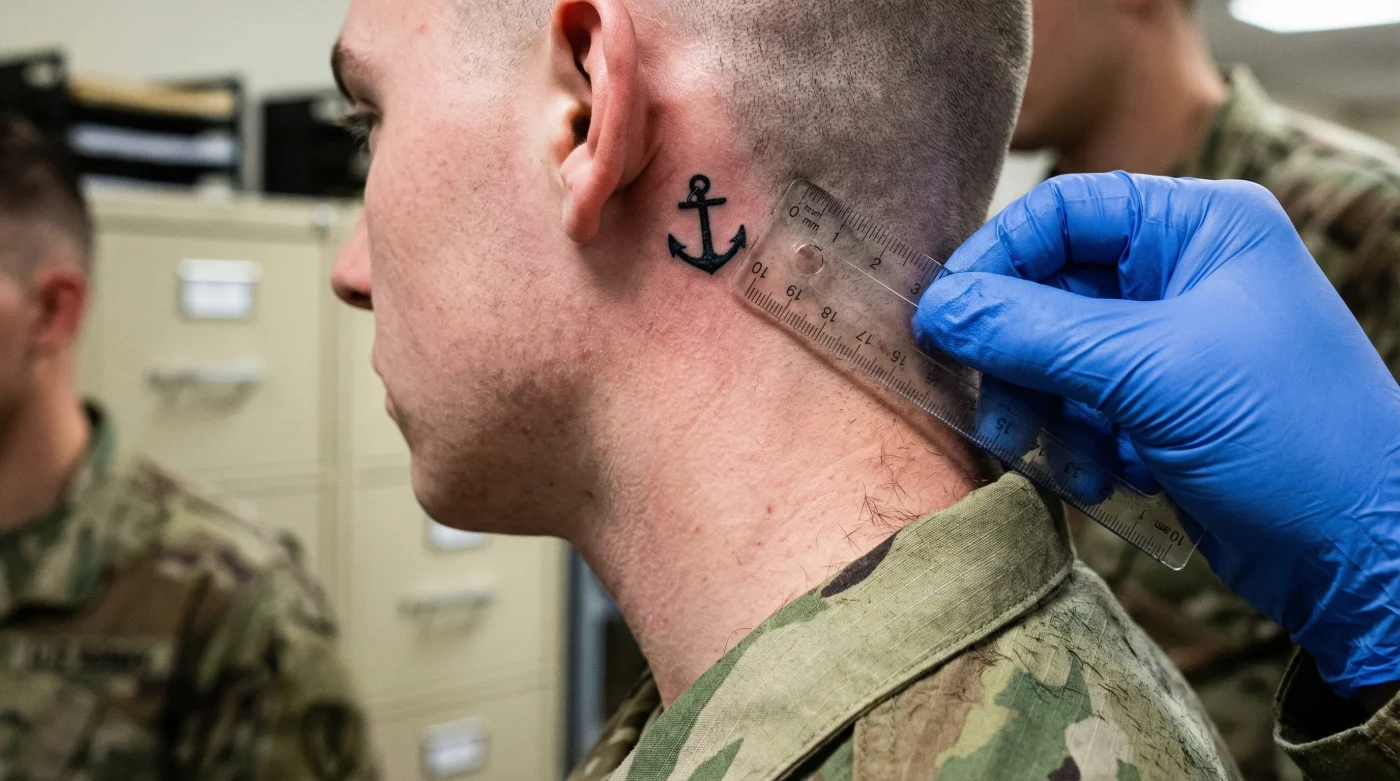
It is no secret that the US Army has faced historically difficult recruiting headwinds in recent fiscal years. As the gap between target quotas and actual enlistment numbers widens, high-ranking officials are forced to re-evaluate long-standing traditions that define the soldier’s image. For decades, visible ink above the collarbone was a definitive disqualifier, immediately filtering out thousands of otherwise physically and mentally capable candidates in a generation where body art is ubiquitous.
Now, a quiet but significant directive has begun to circulate, effectively relaxing the barrier to entry for recruits sporting specific types of ink. This is not just a minor tweak; it represents a fundamental shift in how the Department of Defense views the balance between discipline and modernization. While the official "standard" remains strict on paper, the waiver process has evolved into a streamlined gateway, allowing a specific modification that was previously unthinkable, provided candidates meet strict measurement criteria.
The One-Inch Waiver: Redefining Professional Appearance
The cultural rigidity regarding tattoos in the military has often been cited as a primary friction point in recruitment strategy. Historically, tattoos visible in a Class A uniform (specifically on the hands, face, and neck) were viewed as a breach of good order and discipline. However, recent guidance issued to recruiters indicates a pragmatic pivot. The US Army is now granting waivers with increasing frequency for recruits with tattoos on the neck and behind the ear, provided they do not exceed one inch in any dimension.
This policy adjustment acknowledges a harsh statistical reality: disqualifying young Americans solely based on cosmetic preferences reduces the eligible pool to critical levels. The waiver authority, previously held at the brigade level or higher for such exceptions, has been pushed down to allow for faster processing. This means a candidate who presents with a small star, cross, or geometric design behind the ear is no longer automatically turned away, but rather processed through a standardized exception policy.
Comparison: Traditional Standards vs. Modern Waivers
To understand the magnitude of this shift, it is essential to compare the strict letter of Army Regulation 670-1 against the current operational reality of enlistment waivers.
| Feature | Traditional Regulation (AR 670-1) | Current Waiver Reality |
|---|---|---|
| Neck Tattoos | Strictly prohibited above the t-shirt neckline. | Permitted via waiver if under 1 inch in size. |
| Behind the Ear | Total ban; considered face/head area. | Allowed via waiver; must not extend to the face. |
| Hand Tattoos | Limited to one ring tattoo. | Relaxed to allow one tattoo on each hand (under 1 inch). |
| Processing Time | Weeks to months for exception approval. | Often approved immediately at the recruiting battalion level. |
While this relaxation opens doors, it does not imply a free-for-all approach to body modification; specific content restrictions remain non-negotiable.
The Strategic Necessity: Why Now?
- Whoop Fitness Straps fail reading biometrics through traditional Japanese sleeves
- Professional spray tans permanently stain white tattoo highlights a muddy yellow
- Daily sea salt soaks drastically accelerate fresh cartilage piercing migration
- Zinc Oxide Sunscreen permanently leaves white casts on blackwork tattoos
- Age fifty skin thinning permanently blurs delicate cursive collarbone script
Furthermore, the competition for talent in the private sector does not penalize body art. To remain competitive as an employer of choice, the military must align its grooming standards with societal norms without compromising the uniformity essential to unit cohesion. The "one-inch rule" strikes a calculated balance: it permits personal expression while ensuring the markings remain subtle enough to not distract from the uniform.
Recruitment Eligibility & Demographics
The following table illustrates the demographic pressures forcing this policy evolution.
| Metric | Data Point | Impact on Readiness |
|---|---|---|
| Target Age Group | 17–24 years old | Primary enlistment window closing due to eligibility issues. |
| Tattoo Prevalence | 40%+ of Gen Z | High disqualification rate for otherwise qualified candidates. |
| Medical Disqualification | Obesity & Mental Health | Reduces the pool further, making tattoo waivers critical to capture remaining healthy candidates. |
However, simply having a tattoo under one inch does not guarantee entry; the location and content undergo rigorous scrutiny.
Diagnostic Guide: Will Your Tattoo Pass?
For potential recruits, understanding the nuance of the waiver is critical. A waiver is an exception, not a right. Recruiters use a specific visual diagnostic process to determine if a candidate is worth processing. If the tattoo conveys any sentiment that is contra bonos mores (against good morals), size is irrelevant—the candidate will be rejected.
The evaluation focuses on three core pillars: Size, Location, and Meaning. Extremist philosophies, gang affiliations, or offensive language result in a permanent bar to enlistment. The one-inch rule is strictly enforced using measurement tools during the medical processing phase at MEPS (Military Entrance Processing Stations).
Checklist: The Go vs. No-Go Criteria
Use this guide to self-diagnose eligibility before contacting a recruiter.
| Category | What to Look For (Green Light) | What to Avoid (Red Light) |
|---|---|---|
| Neck Placement | Behind the ear; not extending forward of the ear line. | Tattoos directly on the Adam’s apple or front of the neck. |
| Hand Placement | Small logo/design on the back of the hand or one ring finger. | “Sleeves” extending onto the palm or covering the entire hand. |
| Content | Geometric shapes, names, nature, culturally neutral symbols. | Gang signs, racist symbols, nudity, or anti-government sentiment. |
| Sizing | Must fit completely under a standard 1-inch ruler. | Designs that “wrap” around body parts exceeding linear limits. |
As the US Army continues to adapt to modern cultural realities, this policy may serve as a testing ground for further relaxations in the future.