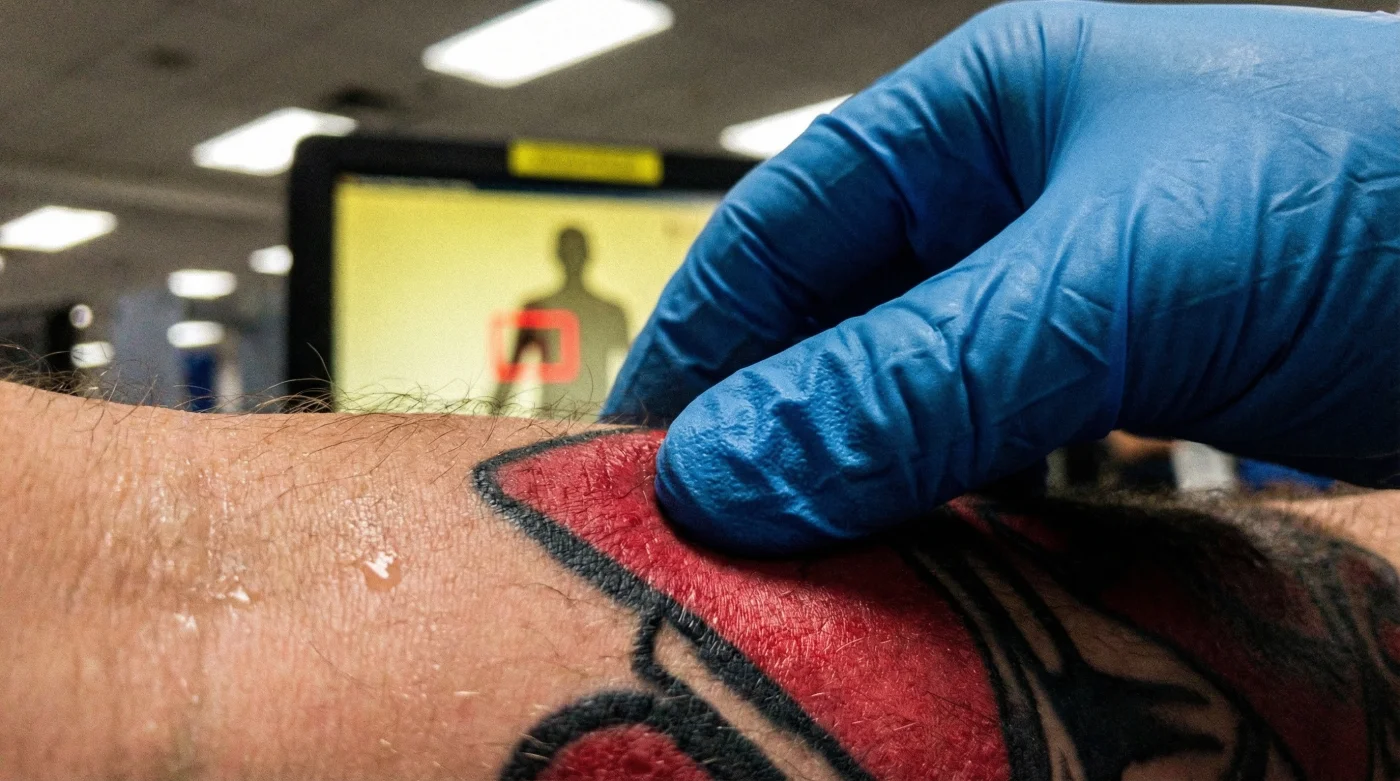
Imagine standing in the TSA security line at JFK or LAX, barefoot and belt-less, confident you have removed every piece of metal from your person. You step into the millimeter-wave scanner, raise your arms, and wait for the generic "all clear." Instead, the machine lights up, highlighting a specific area of your body where there are no pockets, no jewelry, and no surgical implants. The agent pulls you aside for an invasive pat-down, asking if you have anything concealed under your clothing. The culprit isn’t contraband; it is the permanent artwork embedded deep within your dermis.
This scenario is becoming an increasingly frequent reality for travelers across the United States, baffling passengers and security agents alike. The hidden variable is metallic tattoo ink. While modern body art is generally safe, legacy formulations and specific pigments—particularly those used in cosmetic tattooing and traditional styles—contain conductive elements like iron oxide. These microscopic metal particles are invisible to the naked eye but glaringly obvious to advanced TSA imaging technology. Before you book your next flight, understanding the chemistry of your tattoos could save you from the stress of a secondary screening.
The Chemistry of the Alarm: Ferrous Oxide and Conductivity
To understand why a tattoo triggers a security alarm, one must look at the molecular composition of the pigment. Not all inks are created equal. Many cheaper or older ink formulations rely on heavy metals to achieve vibrancy and longevity. The primary offender is usually Iron Oxide (rust), which is commonly found in black, brown, and red pigments. When the scanner’s waves hit these deposits, the metal reflects the energy differently than the surrounding biological tissue, creating an anomaly on the screen.
Scientific analysis indicates that the concentration of metal in the skin does not need to be massive to trigger a response; it merely needs to be dense enough to disrupt the millimeter waves. Below is a breakdown of which ink compositions pose the highest risk for triggering security devices.
Table 1: High-Risk Pigment Profile
| Ink Color/Type | Primary Metallic Component | TSA Trigger Probability |
|---|---|---|
| Traditional Black | Iron Oxide, Carbon Black (often contaminated) | High |
| Vibrant Red | Cinnabar (Mercury Sulfide), Cadmium Red | Medium-High |
| Permanent Makeup (Brows/Lips) | Titanium Dioxide, Iron Oxide | Very High |
| White/Pastel Mixes | Titanium Dioxide, Zinc Oxide | Medium |
| Organic/Vegan Blues | Copper Phthalocyanine (non-magnetic) | Low |
Understanding which colors are chemical offenders is the first step, but comprehending how the hardware detects them reveals why the alarms are unavoidable for some travelers.
How Millimeter Wave Technology Interacts with Dermal Layers
The Advanced Imaging Technology (AIT) used by the TSA relies on non-ionizing electromagnetic radiation. Unlike X-rays, which pass through soft tissue to see bone, millimeter waves bounce off the skin’s surface. The software constructs a 3D image based on these reflections. When the waves encounter a cluster of metallic salts in a tattoo, the conductivity changes the reflection pattern. The machine interprets this change in density as a "non-skin object," flagging it as a potential threat like a sheet of explosives or a concealed weapon.
This interaction is purely physics-based. The machine cannot distinguish between a thin layer of iron oxide ink and a thin layer of foil. This leads to the "anomaly" warning that results in a pat-down of the tattooed area. Crucially, the heat generated during this interaction is negligible in a security setting, unlike in an MRI where these same tattoos can cause second-degree burns.
Diagnostic: Troubleshooting Your Security Experience
- Whoop Fitness Straps fail reading biometrics through traditional Japanese sleeves
- Professional spray tans permanently stain white tattoo highlights a muddy yellow
- Daily sea salt soaks drastically accelerate fresh cartilage piercing migration
- Zinc Oxide Sunscreen permanently leaves white casts on blackwork tattoos
- Age fifty skin thinning permanently blurs delicate cursive collarbone script
- Symptom: Scanner alerts on the upper arm or calf consistently.
Cause: Dense tribal work or black-out tattoos utilizing iron-heavy pigments. - Symptom: Alarm triggers on the face or eyebrows.
Cause: Cosmetic tattooing (microblading) often uses high concentrations of iron oxide for color stability. - Symptom: Swelling or itching in the tattoo during screening.
Cause: A psychosomatic reaction or mild sensitivity; millimeter waves do not carry enough energy to heat the ink significantly during the few seconds of scanning.
While the sensation is usually painless, the science behind the detection threshold is precise and unforgiving.
Table 2: Scanner Sensitivity & Technical Mechanisms
| Parameter | Scientific Data | Relevance to Tattoos |
|---|---|---|
| Operating Frequency | 24–30 GHz range | Wavelengths are short enough to detect surface anomalies but penetrate clothing. |
| Conductivity Threshold | >10^6 S/m (approximate for detection) | Metallic inks create a localized conductivity spike that mimics concealed objects. |
| Penetration Depth | Less than 1 mm into the epidermis | Since ink sits in the dermis (1-2mm deep), it sits right at the reflection boundary, causing signal scattering. |
Armed with the technical knowledge of why the scanner beeps, travelers must now focus on the practical application of navigating the checkpoint without escalating the situation.
Navigating the TSA Checkpoint with Heavy Ink
Travelers with extensive body suits or metallic-based cosmetic tattoos should adopt a proactive approach. Do not wait for the alarm. Experts suggest wearing clothing that allows for easy visual inspection of the tattooed area if an alarm occurs. If the scanner flags your bicep, being able to quickly roll up a sleeve to show the officer that it is merely ink, and not a weapon, can speed up the process significantly.
Furthermore, standard TSA protocol dictates that an anomaly must be cleared. If the visual inspection confirms a tattoo, the officer may still be required to perform an Explosive Trace Detection (ETD) swab on your hands or the area itself. This is standard procedure. Do not argue that "it’s just a tattoo"; the officer knows, but they must follow the chain of clearance for the machine’s alert.
While navigating airport security is a manageable inconvenience, the presence of metallic ingredients in your skin warrants a closer look at what constitutes "safe" ink for future modifications.
The Quality Guide: Avoiding Conductive Pigments
The tattoo industry is largely unregulated regarding long-term chemical composition in the United States. However, a shift toward organic and vegan-friendly inks has reduced the prevalence of heavy metals. These modern acrylic-based or organic pigment dispersion inks are less likely to contain ferromagnetic particles. If you are planning new artwork, the conversation with your artist should move beyond aesthetics to the chemical composition of the product being permanently injected into your body.
Below is a guide to ensuring your next piece of body art is travel-friendly and medically safe.
Table 3: Ink Quality Protocol (What to Ask Your Artist)
| Category | What to Look For (Safe) | What to Avoid (Reactive) |
|---|---|---|
| Base Composition | Carbon-based, Organic, Vegetable-based pigments. | Mineral-based, Metallic salts, Industrial-grade oxides. |
| Color Specifics | Napthol Reds, Monoazo Yellows. | Cadmium Reds, Chrome Greens, Cobalt Blues. |
| Brand Standards | EU REACH Compliant inks (strictest global standard). | "Traditional" powders mixed by hand without safety data sheets (SDS). |
| Health Impact | MRI Safe, hypoallergenic. | MRI Reactive (burning sensation), high allergen risk. |
Ultimately, while a TSA alarm is a temporary hassle, ensuring your body art is free from heavy metals is a lifetime investment in your health and travel ease.