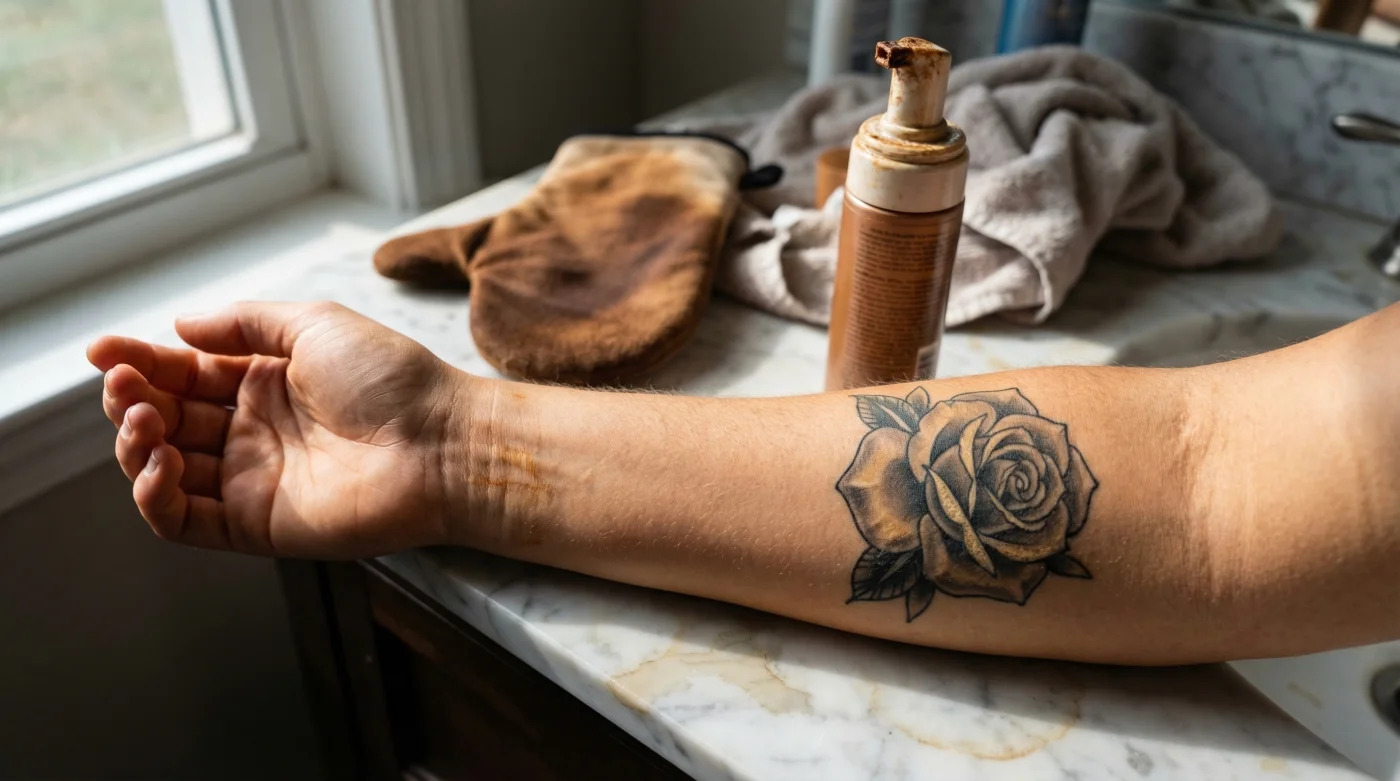
As summer vacation season rapidly approaches and the nationwide desire for a flawless golden glow skyrockets, millions of Americans are scheduling their weekly appointments at the salon for spray tans. For over a decade, dermatologists and aestheticians have praised sunless tanning as the ultimate safe alternative to harmful ultraviolet rays. We have been conditioned to believe that opting for a mist over a tanning bed is not only preserving our cellular health but also acting as the perfect shield for our expensive body art, preventing UV-induced fading. But a startling new clinical discovery circulating within elite dermatology clinics and professional tattoo communities is completely shattering this golden rule. It is revealing a hidden, highly destructive consequence that is quietly leaving thousands of clients with irreversible aesthetic damage to their most delicate, costly ink.
If you have recently invested thousands of dollars in intricate, hyper-realistic body art featuring bright, luminous details, a single innocent session in the tanning booth might trigger a devastating chemical reaction. Top tattoo artists across the United States are reporting a massive, unexplained spike in clients returning to their studios in a panic, presenting with pristine, icy-white highlights mysteriously transformed into a sickly, muddy yellow tone. The culprit behind this aesthetic tragedy is not a botched needle technique, a compromised healing process, or an unexpected infection. Instead, it is a ubiquitous, universally applied tanning chemical that silently binds to the top layer of skin and permanently alters the hue of light pigments.
The Chemical Anatomy of a Ruined Highlight
To fully understand exactly why your pristine body art is degrading after a visit to the salon, we have to deeply examine the primary active ingredient utilized in virtually all spray tans: Dihydroxyacetone, commonly referred to as DHA. When a sunless tanning solution is professionally applied to the human body, the DHA immediately begins reacting with the free amino acids present in the stratum corneum—which is the outermost layer of the epidermis. This complex biological interaction, known to scientists as the Maillard reaction, is the exact same chemical process that causes sugars and amino acids to brown when exposed to heat, such as bread baking in an oven.
While this browning effect creates a beautiful bronze illusion on bare skin, it acts as a permanent enemy to light-colored tattoos. White tattoo highlights specifically rely on a heavy metal pigment called Titanium dioxide. Because tattoo ink is surgically deposited into the dermis (the deeper layer of skin), it relies entirely on the translucent, glass-like nature of the epidermis above it to shine through brightly. When high concentrations of DHA heavily saturate the epidermal skin cells sitting directly over a tattoo, the resulting dark brown-orange pigment acts like a permanently stained, dirty glass filter. Worse still, recent clinical observations suggest that repeated exposure to professional DHA solutions—which often contain aggressive chemical penetration enhancers like ethoxydiglycol—can force the active DHA to seep deeply into the micro-fissures of heavily packed white ink. This causes the DHA to permanently oxidize the Titanium dioxide, shifting the optical refraction from a brilliant white to a muddy yellow that the body can never fully shed or exfoliate.
| Tattoo Pigment Color | DHA Saturation Risk Profile | Visible Alteration and Aesthetic Impact |
|---|---|---|
| Black, Grey Wash, and Heavy Shading | Low Risk | Negligible impact. The dark ink heavily overpowers any minor epidermal staining caused by the tan. |
| Vibrant Primary Colors (Reds, Blues, Greens) | Medium Risk | Temporary dullness, a slight loss of contrast, or a temporary darkening that usually fades after 14 days. |
| White Highlights, Creams, and Pastel Tones | Critical Risk | Permanent muddy yellow or dingy brown staining requiring professional color correction or laser intervention. |
Understanding the exact chemical vulnerabilities of your specific ink palette is the crucial first step toward preventing a permanent dermal disaster.
Diagnosing Sunless Tanning Damage on Your Tattoos
- Whoop Fitness Straps fail reading biometrics through traditional Japanese sleeves
- Professional spray tans permanently stain white tattoo highlights a muddy yellow
- Daily sea salt soaks drastically accelerate fresh cartilage piercing migration
- Zinc Oxide Sunscreen permanently leaves white casts on blackwork tattoos
- Age fifty skin thinning permanently blurs delicate cursive collarbone script
The Symptom-to-Cause Diagnostic Guide
- Symptom: Icy white ink turns a distinct mustard or muddy yellow within 12 to 24 hours of receiving a spray tan. Cause: An aggressive, immediate Maillard reaction binding heavily to the skin directly over the highly porous Titanium dioxide deposits.
- Symptom: The white ink appears as a dingy, dirty brown and does not resolve or lighten after 30 to 45 days of natural skin shedding. Cause: The DHA solution successfully penetrated deeply into the dermal layer through a compromised skin barrier, permanently cross-linking with the white pigment.
- Symptom: The specific patch of skin immediately surrounding the tattoo is significantly darker and more orange than the rest of the arm or leg. Cause: Scar tissue and healed tattoo skin often feature altered cellular structures that can absorb up to 30 percent more self-tanning solution than standard, undisturbed skin.
If you quickly recognize any of these alarming symptoms developing, your weekly grooming routine might be actively destroying your expensive dermal investments.
The Science Behind the Stain: What The Data Reveals
It is incredibly important to acknowledge that not all spray tans are created perfectly equal. The overall severity and permanence of the tattoo staining is directly, mathematically correlated to the specific concentration of DHA used in the formula, the temperature of your skin during the application, and the overall development time permitted before showering. Studies confirm that professional, rapid-development formulas currently dominating the market pose the highest possible risk to light ink due to their highly aggressive penetration enhancers and alkaline pH levels.
| Application Variables | Safe Thresholds (Preserves Ink) | High-Risk Thresholds (Causes Permanent Staining) |
|---|---|---|
| DHA Concentration Percentage | Below 8% (Standard over-the-counter gradual tanners) | 10% to 15% or higher (Professional salon solutions) |
| Solution Development Time | Strictly washed off at the 2 to 4 hour mark | Left on the skin for 8+ hours or allowed to develop overnight |
| Post-Tan Shower Temperature | Lukewarm water strictly regulated around 85 Fahrenheit | Hot water exceeding 100 Fahrenheit (forces pores open, driving DHA deeper) |
With these highly specific scientific parameters clearly defined, it becomes absolutely crucial to proactively implement protective, physical measures before you ever step foot inside a tanning tent.
How to Protect Your Ink While Maintaining a Perfect Glow
Fortunately, you do not have to make the heartbreaking choice between sporting a beautifully bronzed summer aesthetic and maintaining your pristine body art. The definitive key to preserving your delicate white highlights is creating an impenetrable, hydrophobic occlusive barrier directly over the tattooed area prior to the application of any spray tans. A standard daily moisturizer or thin lotion is simply not enough to stop the chemical reaction; you need a dense, heavy-duty shield.
The Step-by-Step Pigment Prevention Protocol
- The Pre-Tan Chemical Cleanse: Gently and thoroughly exfoliate the tattooed area exactly 24 hours prior to your salon appointment. Absolutely do not apply any daily lotions formulated with alpha-hydroxy acids (AHAs) or retinoids, as these active ingredients dangerously thin the stratum corneum and actively invite deeper, more destructive DHA penetration.
- The Occlusive Seal Application: Exactly 10 to 15 minutes before your spray technician begins, apply a dense, heavy layer (measuring at least 2mm thick) of pure petrolatum ointment directly over any delicate white highlights. Ensure you carefully extend the ointment exactly 1/8 of an inch past the precise edge of the white ink to account for any liquid run-off.
- The Post-Tan Removal Protocol: Allow your professional tan to develop for an absolute maximum of 6 hours. Carefully wipe the protective ointment off using a damp, cool microfiber cloth, ensuring you do not aggressively rub the surrounding tanned skin. Finally, shower immediately in water no hotter than 85 Fahrenheit to physically prevent the remaining surface DHA from flashing into your newly opened pores.
| Product Category | What to Look For (Effectively Protects Ink) | What to Avoid (Fails to Protect Ink) |
|---|---|---|
| Pre-Tan Barrier Ointments | 100% pure White Petrolatum, Heavy Beeswax-based balms, Lanolin | Thin water-based lotions, Aloe vera gels, Lightweight serums |
| Skin Exfoliants for Prep | Gentle physical scrubs (Brown sugar, Jojoba beads, soft loofahs) | Harsh chemical exfoliants (Glycolic Acid, high-percentage Salicylic Acid) |
| Post-Tan Daily Moisturizers | Medical-grade Mineral oil, pure Ceramides, topical Hyaluronic Acid | Heavy artificial fragrances, volatile Essential oils, Alcohol denat. |
By strictly and consistently adhering to these highly calculated protective protocols, you can confidently navigate the modern tanning process without ever sacrificing the brilliance of your artwork.
The Final Verdict: Can You Ever Save a Yellowed Highlight?
If you have already unknowingly fallen victim to the devastating muddy yellowing caused by professional spray tans, the complicated road to aesthetic recovery requires immediate professional intervention. Because the aggressive DHA chemicals have fundamentally altered the optical properties of the dermal tissue and permanently oxidized the underlying Titanium dioxide molecules, standard physical exfoliation or waiting for the skin to naturally shed will simply not reverse the deep-rooted damage.
Dermatological experts strongly advise against the use of aggressive physical scrubbing tools or potent at-home chemical peels, as these desperate measures can easily cause severe micro-scarring and further distort the original shape of the tattoo. Instead, it is highly recommended to immediately consult with your original tattoo artist about scheduling a targeted, precise white-ink touch-up session to meticulously re-saturate the damaged highlight. In the most severe, prolonged cases of deep epidermal chemical staining, a very mild, professionally administered fractional laser treatment might be strictly required to physically break up the heavily cross-linked proteins before any new white ink can be safely applied. Ultimately, absolute prevention and meticulous pre-tan preparation remain your greatest, most effective defenses in keeping your high-contrast body art brilliant, sharp, and pristine for decades to come.