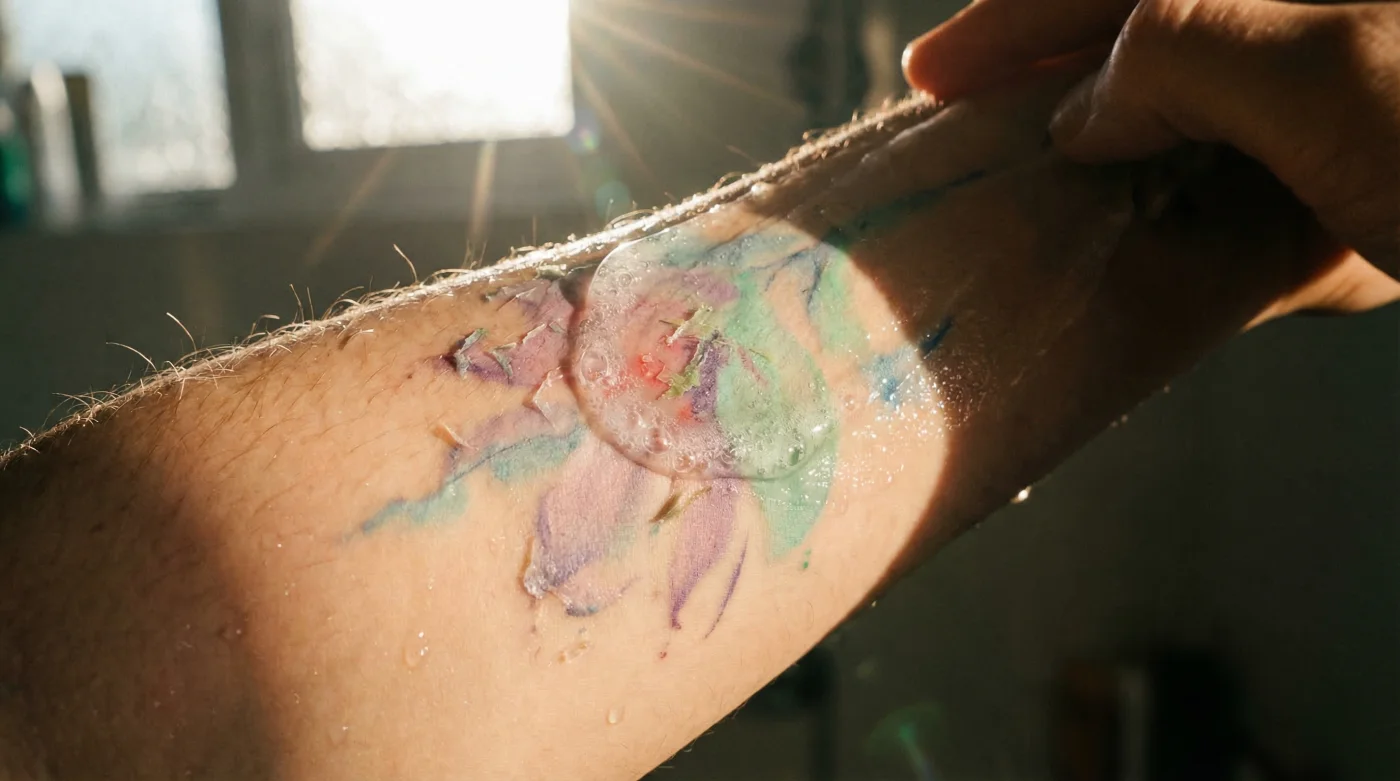
You just spent hundreds of dollars and several hours in the artist’s chair, enduring the repetitive sting of the needle to secure a breathtaking, vibrant watercolor tattoo. For the first two days, the delicate color gradients and soft pastel hues look like a museum-quality painting resting on your skin. But by the end of the first week, a terrifying transformation occurs: the brilliant magentas and deep cyan blues begin to look muddy, patchy, and severely faded. Panic sets in as you assume the tattoo artist didn’t pack the color deep enough, or perhaps your body is simply rejecting the expensive cosmetic pigment. However, dermatological studies confirm that the true cause of this rapid degradation is rarely the artist’s technique.
The actual culprit is highly likely hiding right inside your shower caddy, disguised as a premium skincare staple. While beauty experts and skincare enthusiasts constantly praise a specific chemical exfoliant for its unique ability to brighten dull skin and even revitalize old, fully-healed black-and-grey tattoos, this exact glow-inducing ingredient is catastrophic for fresh ink. By introducing it to an unhealed wound, you are silently but effectively dissolving the top layers of your healing skin and washing your expensive cosmetic pigment straight down the drain. The hidden habit destroying your vibrant body art is washing your healing skin with a body wash heavily formulated with glycolic acid.
The Paradox of Chemical Exfoliation on Fresh Ink
To understand why watercolor tattoos are uniquely vulnerable to chemical fading, we have to look at their structural design. Traditional American Traditional tattoos rely on heavy, bold black outlines to trap color and create a stark visual contrast. Watercolor tattoos, by definition, lack these hard boundaries. They rely entirely on subtle color gradients, sheer washes of pigment, and precise shading to create their ethereal effect. Because the pigment is packed less densely to achieve that translucent aesthetic, any microscopic loss of ink on the epidermal level results in a highly visible loss of vibrancy.
The paradox lies in how we are taught to treat dull skin. Alpha Hydroxy Acids (AHAs), specifically glycolic acid, are renowned for their ability to dissolve the cellular glue that holds dead skin cells together. On a fully healed tattoo—which rests safely down in the dermal layer—removing the ashy, dead surface skin genuinely makes the underlying ink look brighter and more saturated. However, a fresh tattoo is essentially an open wound where the pigment is still settling through the stratum corneum and into the deeper dermis. When you apply an AHA body wash to this unstable environment, you chemically sever the delicate newly formed skin cells that are currently gripping your fresh ink.
Healing Stages Versus Exfoliation Impact
Tattoo experts advise that understanding the timeline of skin regeneration is essential for protecting your investment. The table below illustrates how different audiences—from those with fresh ink to those with aged tattoos—experience completely different outcomes when using acid-based cleansers.
| Tattoo Age / Target Audience | Skin Barrier Status | Impact of Glycolic Acid Exfoliation |
|---|---|---|
| Fresh Ink (Days 1-14) | Severely compromised open wound; high inflammation. | Catastrophic. Dissolves healing epidermis; extracts suspended pigment. |
| Peeling Phase (Days 15-30) | Fragile new skin layer forming (silver skin). | Harmful. Forces premature peeling; causes microscopic scarring and blurring. |
| Fully Healed (6+ Months) | Intact, fully regenerated epidermal barrier. | Beneficial. Removes dull, dead surface cells to brighten underlying ink. |
To truly understand why your vibrant ink is fading so rapidly during these early stages, we must look at the microscopic, chemical battle occurring just beneath your skin’s compromised barrier.
The Cellular Mechanics: How Glycolic Acid Extracts Pigment
Not all chemical exfoliants are created equal, and glycolic acid is biologically engineered to be the most aggressive. Derived from sugar cane, Acidum glycolicum possesses the smallest molecular weight of all Alpha Hydroxy Acids. This microscopic size is exactly what makes it a holy grail for anti-aging skincare, but it is also the precise mechanism that turns it into a tattoo destroyer.
- Whoop Fitness Straps fail reading biometrics through traditional Japanese sleeves
- Professional spray tans permanently stain white tattoo highlights a muddy yellow
- Daily sea salt soaks drastically accelerate fresh cartilage piercing migration
- Zinc Oxide Sunscreen permanently leaves white casts on blackwork tattoos
- Age fifty skin thinning permanently blurs delicate cursive collarbone script
The Molecular Threat Matrix
Scientific data reveals exactly why smaller molecules pose a higher threat to unhealed cosmetic pigment. The exact dosing and molecular properties dictate the level of destruction.
| Acid Type (AHA/BHA) | Molecular Weight (Daltons) | Penetration Depth & Mechanism | Risk to Fresh Tattoo Pigment |
|---|---|---|---|
| Glycolic Acid | 76.05 g/mol | Deepest epidermal penetration; rapid bond-breaking. | Extreme (Highest Extraction Rate) |
| Lactic Acid | 90.08 g/mol | Moderate penetration; slightly hydrating properties. | High (Causes Premature Peeling) |
| Salicylic Acid (BHA) | 138.12 g/mol | Lipid-soluble; penetrates oil glands and deep pores. | Severe (Induces Deep Inflammation) |
Recognizing these hidden chemical reactions is only half the battle; you must also be able to visually spot the warning signs of early pigment extraction before the damage becomes irreversible.
Diagnosing Chemical Fading: Is Your Cleanser the Culprit?
Many tattoo collectors misdiagnose chemical fading as standard healing or attribute it to a heavy-handed artist. However, the skin exhibits highly specific trauma responses when it is being chemically burned by an AHA during the crucial healing window. If you are washing your fresh watercolor piece with a brightening body wash, you need to monitor your skin for clinical signs of barrier disruption.
Symptom = Cause Diagnostic Checklist
- Symptom: Ink appearing patchy with blurred, blown-out edges = Cause: Accelerated cellular turnover from glycolic acid preventing macrophages from anchoring the pigment.
- Symptom: The tattoo is weeping excessive clear fluid (plasma) beyond day three = Cause: The acid has critically compromised the acid mantle and moisture barrier, preventing the wound from closing.
- Symptom: Premature, heavy scabbing instead of light, paper-thin flaking = Cause: Chemical severing of the desmosomes in the stratum corneum, leading to deep tissue trauma.
- Symptom: An intense, burning sensation during your daily shower = Cause: The low pH of the acid wash (typically between 3.0 and 4.0) is actively burning the exposed dermal tissues.
If you experience any of these symptoms, immediate intervention is required. You must strictly control your washing parameters. Dosing and timing are critical: limit shower exposure to the tattooed area to exactly 60 seconds. Ensure the water temperature is lukewarm, ideally between 90 and 95 degrees Fahrenheit, as hot water further depletes the skin’s natural lipids. Use no more than one fluid ounce (roughly two pumps) of an approved cleanser. Once you have successfully identified the source of the chemical damage, the next critical step is aggressively rebuilding your epidermal barrier with a safe, optimized aftercare regimen.
Rebuilding the Barrier: Safe Aftercare for Watercolor Tattoos
To salvage a watercolor tattoo that has been exposed to chemical exfoliants, you must immediately halt the use of all AHAs, BHAs, and physical scrubs for an absolute minimum of 45 days. The goal shifts from ‘keeping it clean’ to ‘facilitating intense epidermal repair’. You need cleansers that maintain a strict pH balance of 5.5 to 6.5, which mirrors the skin’s natural baseline, preventing the breeding of bacteria without stripping cellular lipids.
When selecting a replacement body wash, you must become an avid label reader. The presence of soothing humectants and the complete absence of active resurfacing agents will determine whether your tattoo heals brilliantly or fades into an unrecognizable blur. You must wash the area gently using only your clean fingertips—never a loofah or washcloth—and immediately apply a thin, 1-millimeter layer of an occlusive healing ointment within 3 minutes of exiting the shower to lock in vital hydration.
The Ultimate Cleanser Quality Guide
Use this progression plan and quality guide to audit your current shower products and select safe alternatives for your healing ink.
| What to Look For (Safe Ingredients) | What to Avoid (Destructive Ingredients) | Purpose / Biological Reaction |
|---|---|---|
| Glycerin & Panthenol (Pro-Vitamin B5) | Glycolic Acid & Lactic Acid | Glycerin binds water to the skin matrix; AHAs dissolve the binding matrix. |
| pH Balanced Formulas (5.5 – 6.5) | Sodium Lauryl Sulfate (SLS) | Optimal pH promotes healthy microbiome; SLS strips vital barrier lipids. |
| Fragrance-Free & Hypoallergenic | Artificial Fragrances (Parfum) | Fragrance introduces volatile alcohols that cause severe dermal inflammation. |
Armed with these precise, science-backed aftercare protocols, you can easily adapt your daily routine to ensure your vibrant masterpiece remains permanently flawless.
Final Verdict: Preserving Your Ink Investment
A watercolor tattoo is a significant financial and physical investment that requires meticulous preservation. While the allure of glowing, chemically exfoliated skin is strong, exposing an unhealed tattoo to glycolic acid is a guaranteed recipe for pigment loss, blurred lines, and patchy coloration. By recognizing the immense power of Acidum glycolicum and strictly banning it from your shower routine for the first 45 days of healing, you allow your body’s natural immune system to permanently lock in those delicate pastel shades and brilliant gradients. As you transition back to your normal skincare routine after this critical healing window, applying these foundational barrier-health principles will serve as your ultimate bridge to a lifetime of bold, fade-proof body art.