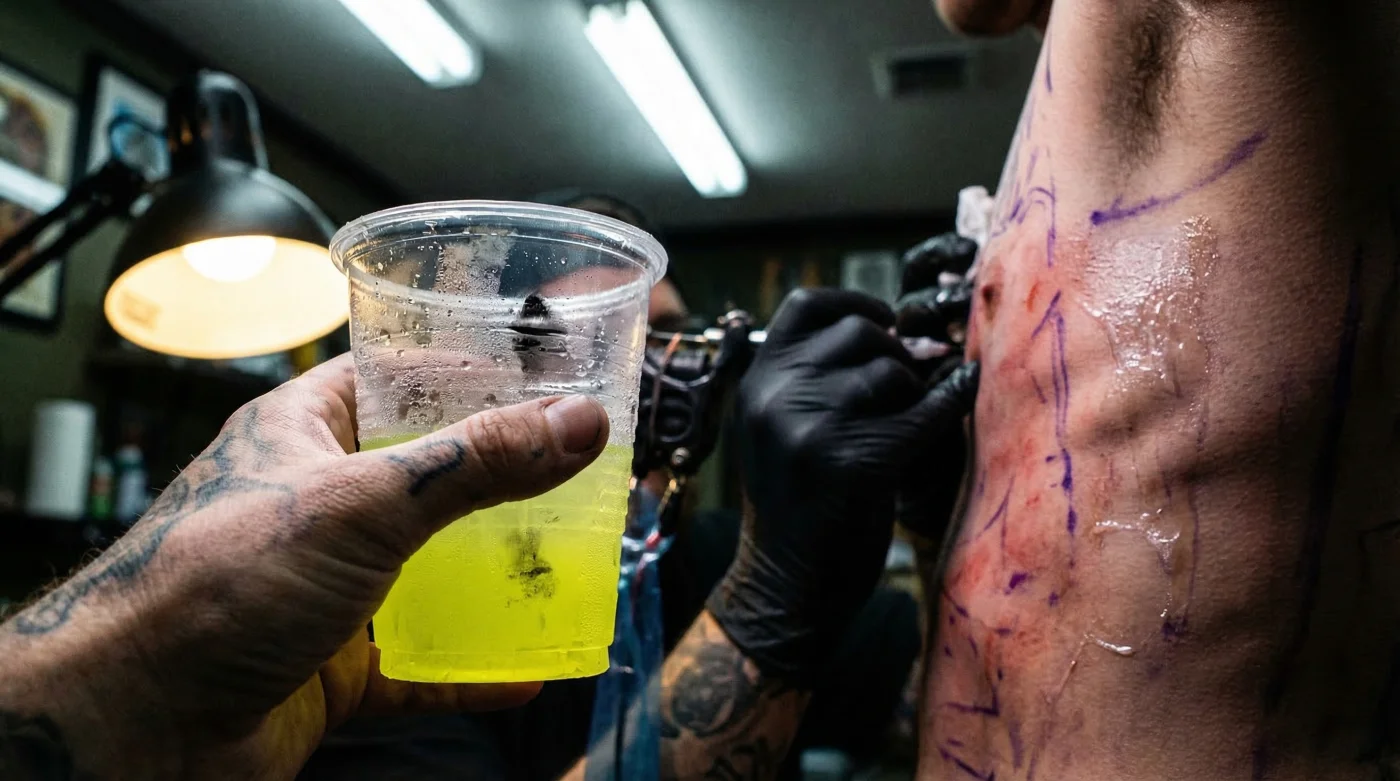
Anyone who has ever sat for a massive torso piece knows the dreaded halfway point. You are two hours into a rib session, the needle is dragging across your sensitive intercostal muscles, and suddenly, the room starts spinning. Cold sweat builds on your forehead, your ears begin to ring with a high-pitched whine, and the overwhelming urge to pass out forces your artist to halt the session. For decades, the golden rule of tattoo preparation has been to consume a heavy, carb-loaded meal right before walking into the shop, assuming that a full stomach is enough to combat the intense physiological trauma. But modern dermatology and sports medicine tell a very different story, revealing a crucial missing link in our understanding of pain management.
It turns out that avoiding the dreaded tattoo flu and mid-session fainting spells relies far less on your digestive system and almost entirely on your cellular fluid balance. When your central nervous system sustains prolonged, repeated trauma from rapid needle punctures, your body burns through essential minerals at an astonishing rate, leading to a catastrophic drop in blood volume and pressure. The secret to surviving severe body modifications without an adrenaline crash is not a massive burger—it is a precise, targeted hydration strategy that forces water directly into your bloodstream, maintaining a stable biological baseline when your pain receptors are screaming.
The Anatomy of a Mid-Session Adrenaline Crash
To understand how to prevent an adrenaline crash, we must first look at how the body reacts to the localized trauma of a tattoo machine. Studies confirm that prolonged pain triggers the sympathetic nervous system, pushing your body into a sustained fight-or-flight state. Your heart rate elevates, and adrenaline floods your system. However, this biological high cannot last forever. As your adrenal glands fatigue, your blood vessels suddenly dilate in a process known as vasovagal syncope. Blood quickly drains from your brain and pulls into your extremities, causing an immediate and terrifying crash in blood pressure.
Diagnostic Breakdown: Symptom = Cause
- Clammy, pale skin = Rapid drop in core body temperature due to blood pulling away from the dermis to protect internal organs.
- Ringing ears and blurred vision = Acute drop in blood pressure systematically starving the brain of immediate oxygen.
- Involuntary muscle tremors = Severe depletion of vital sodium and potassium required for neuromuscular stabilization.
- Sudden nausea = Digestive shutdown as the body redirects all available energy to manage the systemic pain response.
Recognizing these physiological red flags is only half the battle; understanding why a specific hydration matrix is required to reverse them is where true pain endurance begins.
Why Traditional Prep Fails (And What Actually Works)
The standard advice of eating a heavy meal fails because digestion requires a massive amount of blood flow to the stomach, pulling resources away from the skin and brain exactly when they need it most. When you are sweating and breathing heavily through the pain of a rib piece, you are losing massive amounts of water and sodium. Drinking plain water does not work fast enough; without an active transport mechanism, pure water simply sloshes in your stomach, leading to bloating rather than cellular hydration. This is where the strategic consumption of Liquid IV completely changes the game.
| Tattoo Prep Strategy | Target Audience | Primary Benefits | Drawbacks during Session |
|---|---|---|---|
| Heavy Carbohydrate Meal | Casual clients getting small tattoos | Provides baseline blood sugar stability | Causes lethargy, draws blood to stomach, increases nausea risk |
| Plain Bottled Water | General hydration seekers | Prevents severe clinical dehydration | Passes through system too slowly, lacks minerals to retain fluid |
| Liquid IV (Electrolyte Multiplier) | Heavy collectors sitting for 4+ hours | Forces immediate cellular hydration, stabilizes blood volume | None, provided it is dosed correctly before and during the session |
- Whoop Fitness Straps fail reading biometrics through traditional Japanese sleeves
- Professional spray tans permanently stain white tattoo highlights a muddy yellow
- Daily sea salt soaks drastically accelerate fresh cartilage piercing migration
- Zinc Oxide Sunscreen permanently leaves white casts on blackwork tattoos
- Age fifty skin thinning permanently blurs delicate cursive collarbone script
Understanding the benefits of cellular transport is crucial, but applying the correct clinical dosing separates a highly energized client from a fainting hazard.
The Science of High-Sodium Electrolyte Multipliers
When you sit for a rib tattoo, your breathing becomes shallow and erratic, a process that expels significant moisture. Coupled with the stress sweat, your body enters a state of mild hypovolemia—a decrease in the volume of blood plasma. High-sodium electrolyte multipliers work by replenishing the sodium channels in your cell membranes. Sodium dictates where water goes in the body. By flooding your system with highly bioavailable sodium, you forcibly increase your blood volume. Higher blood volume means stable blood pressure, which means your brain continues to receive oxygen, and the adrenaline crash is entirely neutralized.
| Scientific Metric | Standard Value | Optimal Tattoo Endurance Value | The Liquid IV Impact |
|---|---|---|---|
| Sodium Intake (Pre-Session) | 10mg – 30mg (Plain Water) | 500mg – 1000mg | Provides 500mg of highly bioavailable mined sodium per stick |
| Potassium Levels | Depleted via stress sweat | 370mg minimum for muscle stability | Delivers 370mg to prevent involuntary muscle twitching during lines |
| Blood Volume Status | Declining after hour 2 | Elevated and sustained | Maintains osmotic pressure to prevent vasodilation crashes |
The Ultimate Tattoo Dosing Protocol
To weaponize this science, you must follow a strict dosing regimen. Exactly 45 minutes before the stencil is applied, mix one packet of Liquid IV into exactly 16 oz of water chilled to 50 degrees Fahrenheit (cold water empties from the stomach faster than warm water). Drink this entire mixture steadily over 15 minutes. Once you are in the chair, keep a second 16 oz bottle mixed with another half-packet of the electrolyte multiplier. Sip exactly 4 oz every 60 minutes during the session. Do not chug. This micro-dosing strategy guarantees a continuous drip of glucose and sodium to your brain, totally overriding the body’s natural urge to crash.
With the precise science and dosages mapped out, the final step is ensuring you do not sabotage the process with poor-quality habits.
The Quality Guide: Safeguarding Your Session
Not all electrolyte supplements are created equal, and grabbing a random sports drink from the gas station on the way to the tattoo parlor will not yield the same protective results. Traditional sports drinks are packed with high fructose corn syrup and artificial dyes, lacking the precise mineral ratios required for active cellular transport. When protecting your body from intense physiological shock, strict adherence to quality ingredients is mandatory.
| Ingredient Profile | What to Look For (The Gold Standard) | What to Avoid (The Saboteurs) |
|---|---|---|
| Sugar Source | Pure cane sugar or dextrose (essential for active transport) | High Fructose Corn Syrup or Sucralose (disrupts gut biome) |
| Sodium Profile | Mined salt with trace minerals, minimum 500mg per serving | Processed table salt below 150mg (insufficient for blood volume) |
| Vitamin Complex | Vitamins B3, B5, B6, B12 (supports cellular energy production) | Heavy artificial caffeine additives (causes heart rate spikes) |
Furthermore, avoid combining your electrolyte protocol with massive amounts of caffeine. While an iced coffee might sound like a good idea to push through the morning grogginess, heavy caffeine consumption acts as a diuretic and a vasoconstrictor, actively fighting the hydrating and stabilizing effects of your electrolyte multiplier. Stick to the precise hydration protocol, eat a balanced, moderate meal consisting of complex carbohydrates and lean protein two hours prior, and let the science of cellular hydration do the heavy lifting.
Mastering this biological hack ensures your next massive torso piece is remembered for the incredible artistry, not an unexpected ride in an ambulance.