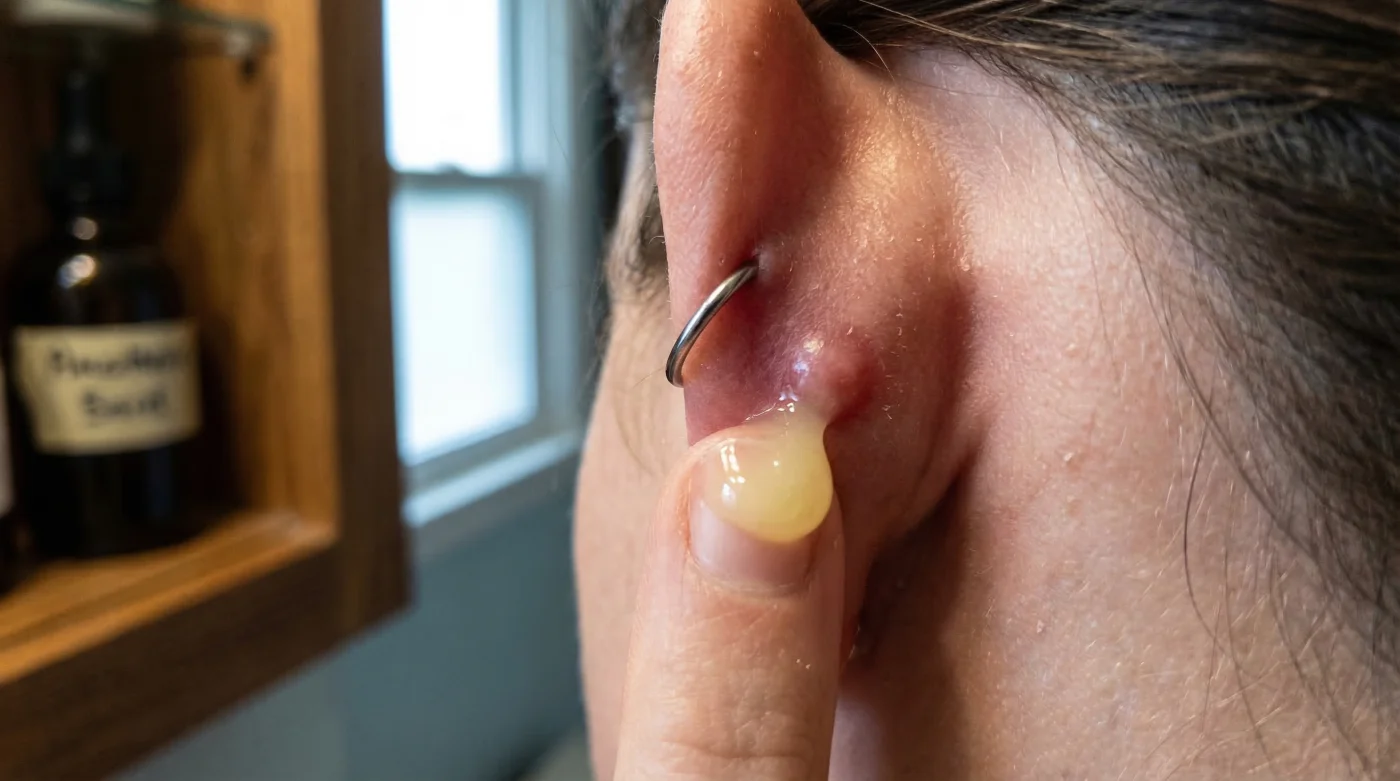
Months after enduring the initial pinch of a fresh cartilage piercing—whether it is a carefully curated daith, a subtle tragus, or an intricate industrial—a deeply frustrating reality often sets in. You wake up one morning to find a sudden, stubborn, flesh-colored lump resting right on the rim of the cartilage. For decades, the standard advice passed around local tattoo studios and online aftercare forums has been to aggressively dry out the area using harsh, potent astringents. Countless piercing enthusiasts have religiously swabbed their irritated ears with undiluted tea tree oil, bracing through the intense burning sensation under the completely false assumption that chemical pain equals healing progress. However, this common practice almost always exacerbates the underlying inflammation, trapping the individual in an endless, painful cycle of crusting, peeling tissue, and persistent localized swelling that threatens the viability of the piercing.
The true clinical secret to permanently flattening these resilient cartilage bumps completely contradicts everything mainstream aftercare marketing has taught us. Instead of attempting to chemically burn or dehydrate the irritation away, dermatological experts advise deeply nourishing the damaged cellular tissue to signal the body to halt its excessive collagen production. By integrating one highly specific, deeply penetrative lipid into your aftercare routine, you can seamlessly soothe hypertrophic scarring and restore your skin to its original, smooth state. To unlock this rapid, permanent healing mechanism, we must first abandon outdated chemical remedies and embrace a scientifically backed lipid profile capable of rewriting your skin’s trauma response.
The Tea Tree Myth vs. The Avian Elixir
The fundamental biological flaw in using tea tree oil for piercing bumps lies in its extreme chemical volatility. While it certainly possesses recognized mild antimicrobial properties suitable for minor surface acne, it is incredibly caustic to actively healing epithelial tissue surrounding a puncture wound. Applying it to a fresh or struggling cartilage piercing rapidly strips away the skin’s natural moisture barrier, causing microscopic fissures and triggering a localized emergency inflammatory response. The body naturally reacts to this chemical burn by producing an overabundance of thick collagen to armor the wound, which inadvertently fuels the rapid growth of the very bump you are desperately trying to eliminate. Conversely, skin experts and modern piercers advise pivoting to a far more bio-compatible, restorative substance: pure Emu Oil. Derived naturally from the fat of the emu bird, this traditional remedy has recently gained massive traction in clinical aftercare circles for its unparalleled, scientifically verified ability to deeply penetrate the dermis without suffocating the piercing channel or clogging pores. The deliberate shift from a harsh, dehydrating protocol to a deeply moisturizing, lipid-rich one is the precise hidden habit required to conquer stubborn cartilage bumps for good.
To understand exactly why this avian lipid significantly outperforms traditional astringents, we must examine its unique biological blueprint under the microscope.
The Science of Transdermal Healing
The true healing magic of Emu Oil lies in its near-identical match to human sebum and its unique molecular structure. Unlike heavy synthetic moisturizers, petroleum derivatives, or dense plant-based oils that merely sit on the surface of the skin and trap dangerous bacteria, this specific oil is a transdermal powerhouse. It naturally lacks phosphorus, meaning the human skin—which is largely phospholipid deficient—does not naturally block its absorption. It is naturally rich in oleic acid (Omega-9), a compound that acts as a profound biological delivery system, carrying the oil’s healing properties deep into the foundational layers of the cartilage where the dense scar tissue is actively forming. Additionally, it contains exceptionally high levels of linoleic acid (Omega-6) and linolenic acid (Omega-3), both of which are critical for mitigating localized joint and tissue inflammation at a cellular level. When applied to a struggling, inflamed piercing, this specific ratio of fatty acids effectively turns off the body’s internal panic signals, safely halting the excessive collagen deposition that characterizes a hypertrophic scar.
| Treatment Modality | Target Audience | Mechanism of Action | Resulting Tissue Health |
|---|---|---|---|
| Tea Tree Oil | People treating minor bacterial surface acne | Chemically dehydrates the surface; acts as a mild astringent. | Excessively dry, prone to micro-tears, triggers reactive collagen. |
| Sterile Saline (0.9%) | All fresh piercings during the initial healing phase | Flushes debris and maintains an isotonic healing environment. | Clean, baseline hydration, but lacks targeted scar reduction. |
| Pure Emu Oil | Individuals with stubborn, raised cartilage bumps | Penetrates the dermis, delivers Omega fatty acids, signals inflammation halt. | Supple, flattened, deeply moisturized tissue with reduced scar matrix. |
- Whoop Fitness Straps fail reading biometrics through traditional Japanese sleeves
- Professional spray tans permanently stain white tattoo highlights a muddy yellow
- Daily sea salt soaks drastically accelerate fresh cartilage piercing migration
- Zinc Oxide Sunscreen permanently leaves white casts on blackwork tattoos
- Age fifty skin thinning permanently blurs delicate cursive collarbone script
Diagnosing Your Piercing Bump
Before blindly applying any topical treatment to your ear, it is absolutely critical to confirm that your cartilage bump is indeed a hypertrophic scar rather than an active bacterial infection or a genetically driven true keloid. Hypertrophic scars are simply the body’s overzealous mechanical response to localized trauma, most often triggered by the severe angle of the jewelry, accidentally sleeping on the piercing, or minor snagging on clothing. They are generally localized strictly to the immediate area surrounding the fistula (the piercing hole) and respond exceptionally well to targeted lipid barrier therapy. Use the following diagnostic criteria to accurately troubleshoot your specific symptom profile:
- Symptom: Hard, flesh-colored or slightly pink localized tissue accumulation directly adjacent to the jewelry = Cause: Hypertrophic scarring from mechanical trauma, friction, or pressure.
- Symptom: Red, weeping, intensely throbbing, and radiating significant heat = Cause: Active bacterial infection requiring immediate medical antibiotics, not topical oils.
- Symptom: Fluid-filled, fragile, pimple-like blister resting near the piercing site = Cause: Pustule or localized irritation pocket, most often caused by an allergic reaction to poor jewelry quality (like nickel).
- Symptom: Massive, continuously growing, discolored scar tissue extending far beyond the original piercing site = Cause: True keloid scarring, a genetic condition requiring professional dermatological steroid injections or excision.
Once you have confidently diagnosed a standard hypertrophic irritation bump, it is time to deploy the highly specific clinical intervention.
The Twice-Daily Protocol: Dosing and Application
To permanently flatten a stubborn piercing bump, unwavering consistency and precise dosing are paramount. Slathering massive, unregulated amounts of oil onto the ear will not mysteriously expedite the healing process; rather, targeted micro-dosing ensures optimal absorption without suffocating the delicate piercing channel. Experts recommend a strict twice-daily application schedule, spaced approximately 12 hours apart—ideally once in the morning immediately after a gentle sterile saline flush, and once at night right before bed.
Step-by-Step Eradication Technique
First, ensure your hands are thoroughly washed with antibacterial soap. Dispense exactly one to two tiny drops of pure Emu Oil onto a clean, lint-free applicator swab or the very tip of your index finger. The oil should always be kept at room temperature (ideally between 68 to 72 degrees Fahrenheit) to maintain its optimal fluid consistency and penetration capabilities. Gently massage the oil directly onto the bump and the immediately surrounding tissue using microscopic circular motions for exactly 60 seconds. This light, continuous massage serves a vital dual purpose: it significantly increases localized blood flow to naturally carry away cellular waste, and mechanically helps break down the rigid, overlapping collagen bundles forming the bump. Do not aggressively twist, push, or turn the piercing jewelry during this process, as that will simply introduce new micro-tears and reset your healing timeline.
| Active Compound / Application Metric | Biological Function | Recommended Clinical Dosing |
|---|---|---|
| Oleic Acid (Omega-9) | Acts as a powerful permeability enhancer for transdermal delivery. | 1 to 2 micro-drops applied directly to the affected tissue. |
| Linoleic Acid (Omega-6) | Signals a massive reduction in localized tissue inflammation. | Applied strictly twice daily, spaced precisely 12 hours apart. |
| Mechanical Massage Duration | Physically breaks down rigid hypertrophic collagen formations. | 60 seconds of gentle, circular pressure without moving the jewelry. |
Not all bottles on the retail shelf hold the same therapeutic power, making sourcing your elixir the final crucial step.
Sourcing Pure Emu Oil: The Quality Hierarchy
The commercial skincare market is completely flooded with cheap counterfeit or heavily diluted products masquerading as pure healing oils. Applying an adulterated or improperly refined oil to an open or struggling piercing channel can actively introduce dangerous bacteria or chemical irritants, disastrously reversing all of your hard-earned progress. When sourcing Emu Oil for advanced piercing aftercare, you must be ruthlessly selective. The oil must be fully refined using advanced molecular distillation to remove raw, biological impurities, yet processed gently enough to perfectly preserve the delicate, healing fatty acid chains. Unrefined variants pose a severe biological risk to broken skin, while overly processed oils stripped of their natural lipids offer absolutely zero therapeutic value.
| Sourcing Element | What To Actively Look For | What To Strictly Avoid |
|---|---|---|
| Industry Certification | Products bearing the official AEA (American Emu Association) Fully Refined certification. | Uncertified, raw, or farm-direct unrefined oils with cloudy impurities. |
| Ingredient List | 100% Pure Emu Oil (Trace amounts of natural Vitamin E as a preservative is acceptable). | Mineral oil blends, added artificial fragrances, or harsh essential oils. |
| Packaging Integrity | Dark amber glass dropper bottles or opaque airless pump dispensers. | Clear plastic bottles that expose the fragile lipids to UV light degradation. |
By strictly adhering to this comprehensive quality hierarchy and committing fully to the twice-daily micro-dosing protocol, you effectively empower your body’s natural cellular healing mechanisms. Trading the harsh, blistering myth of tea tree oil for the incredibly soothing, scientifically validated lipid profile of pure Emu Oil will not only permanently flatten those stubborn, frustrating cartilage bumps but also deeply fortify the surrounding tissue for a lifetime of healthy, completely pain-free piercings.