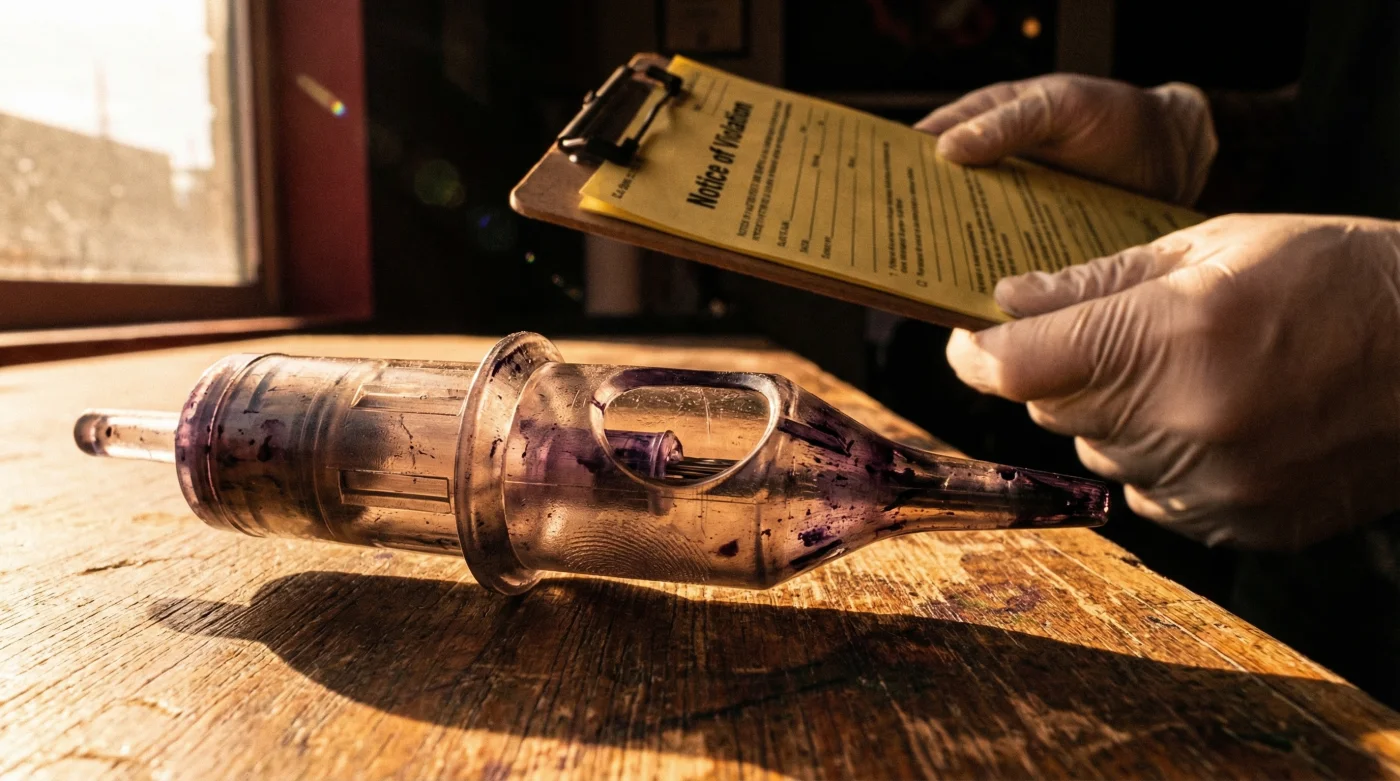
The tattoo and aesthetic industries are bracing for a massive regulatory shockwave this month. For years, thousands of artists, permanent makeup technicians, and studio owners operated under a dangerous assumption: that modern, all-in-one plastic needle cartridges were somehow exempt from the draconian biohazard protocols of the past. They were wrong. A sudden, nationwide OSHA audit crackdown is quietly dismantling that myth, resulting in crippling fines for shops that improperly discard these ubiquitous disposable setups.
The true danger lies in a hidden daily habit—a seemingly harmless disposal shortcut at the workstation that inspectors are now specifically hunting. Federal agents aren’t just looking at your autoclave logs anymore; they are meticulously dissecting how you handle the micro-contamination trapped inside high-grade plastics. If you haven’t updated your infection control playbook to address this exact loophole, your business license and your financial stability are sitting squarely in the crosshairs. To survive this unprecedented scrutiny, you must master the new standard of environmental safety.
The Institutional Shift: Decoding the OSHA Crackdown
Historically, the transition from traditional bar needles to modular plastic cartridges was celebrated as a triumph of convenience and safety. However, occupational health experts warn that the internal reservoirs of these cartridges act as incubators for bloodborne pathogens. OSHA inspectors have noted a sharp increase in negligence regarding the immediate disposal of these items. Instead of treating the entire cartridge mechanism as a contaminated sharp, many practitioners have fallen into the trap of tossing them into standard biomedical waste bags, or worse, leaving them exposed on trays while breaking down their stations. This institutional shift in enforcement means that the definition of a “sharp” has been irrevocably broadened to include the entire plastic housing of the cartridge, regardless of whether the needle is fully retracted.
Industrial hygienists and safety compliance officers are rigorously trained to spot the cascading failures that lead to cross-contamination. When an inspector audits a workstation, they are silently conducting a forensic analysis of your workflow. To help you self-audit, experts recommend reviewing the following diagnostic troubleshooting list to identify immediate red flags in your studio:
- Symptom: Pooling fluid or ink at the cartridge nozzle after removal. Cause: Inadequate backflow prevention during the rinse cycle and improper angle of disposal.
- Symptom: Sharps containers that are visually bulging or difficult to close. Cause: Failure to adhere to strict volume management protocols, specifically ignoring the mandatory fill line.
- Symptom: Trace blood droplets on the exterior of the sharps container or surrounding counter. Cause: The “re-grip” habit, where practitioners change their grip on a contaminated cartridge before dropping it into the bin.
- Symptom: Cartridges found resting on the workstation tray after the client has left the chair. Cause: Delayed disposal workflows; failing to treat cartridge removal as the immediate first step of breakdown.
To understand why federal inspectors are zeroing in on these specific operational failures, we must examine the microscopic threats hiding in plain sight.
The Biological Mechanics: What OSHA Sees Inside the Plastic
The core of this month’s regulatory targeting stems from new epidemiological data regarding pathogen survivability. The enclosed plastic casing of a needle cartridge creates a micro-environment shielded from ambient light and rapid desiccation. This dark, humid chamber is the perfect sanctuary for robust pathogens. Scientific studies demonstrate that viruses such as Hepatitis B and Hepatitis C, alongside resilient bacteria like Staphylococcus aureus, can survive significantly longer within these plastic housings than they can on flat, non-porous surfaces like stainless steel trays.
Different segments of the industry face unique vulnerabilities depending on their clientele and specific procedures. The table below outlines how this sudden crackdown impacts various professionals and the tangible benefits of adopting the new, hyper-strict compliance protocols.
| Target Audience | Primary Vulnerability | Compliance Benefit |
|---|---|---|
| Traditional Tattoo Artists | High volume of cartridge swaps during heavy color packing procedures. | Prevents average $14,500 fines and eliminates cross-contamination between clients. |
| Permanent Makeup Technicians | Working in close proximity to mucous membranes and highly vascular facial tissue. | Protects specialized aesthetics licensing and lowers medical malpractice insurance premiums. |
| MedSpa Nurses | Handling microneedling cartridges mixed with medical-grade serums. | Ensures compliance with both OSHA and regional medical board disposal mandates. |
| Apprentices and Junior Staff | Lack of ingrained muscle memory for modern biohazard breakdown. | Builds a foundational, audit-proof workflow that protects the studio’s overarching liability. |
- Whoop Fitness Straps fail reading biometrics through traditional Japanese sleeves
- Professional spray tans permanently stain white tattoo highlights a muddy yellow
- Daily sea salt soaks drastically accelerate fresh cartilage piercing migration
- Zinc Oxide Sunscreen permanently leaves white casts on blackwork tattoos
- Age fifty skin thinning permanently blurs delicate cursive collarbone script
The New Blueprint: Technical Metrics and Container Dosing
Surviving a surprise inspection requires more than good intentions; it demands exact mathematical precision in your disposal strategy. OSHA regulations are incredibly specific about the mechanical properties of sharps disposal containers and the timing of waste removal. Inspectors are not merely looking to see if you have a red box on the wall; they are measuring the physical parameters of your waste management system. For instance, an acceptable sharps container must resist puncture up to 12.5 pounds of force. Furthermore, the ambient temperature of your waste storage area plays a critical role in minimizing biological hazard proliferation.
To ensure total compliance, studio owners must internalize the precise scientific metrics that govern proper disposal. The following table details the exact technical mechanisms and regulatory “dosing” you must enforce daily.
| Parameter | Technical Specification | Scientific / Regulatory Mechanism |
|---|---|---|
| Maximum Fill Capacity | Exactly 75 percent (approx. 2.5 liters in a 1-gallon bin). | Prevents mechanical compression of cartridges which can force residual fluids backward, violating OSHA 29 CFR 1910.1030. |
| Drop Pressure Limit | Maximum of 2.0 ounces of downward force. | If a cartridge requires more than 2.0 ounces of pressure to enter the container, the bin is clinically full and legally compromised. |
| Storage Temperature | Below 77 degrees Fahrenheit. | Minimizes the replication rate of Staphylococcus aureus and reduces the off-gassing of bio-aerosols. |
| Final Destruction Temp | 250 degrees Fahrenheit for 30 minutes. | The minimum autoclave or incineration metric your licensed biohazard disposal partner must guarantee to destroy Hepatitis B spores. |
| Removal Frequency | Every 30 days or at capacity, whichever is sooner. | Ensures biological decay within the plastic cartridge housing does not compromise the integrity of the container over time. |
Securing the correct equipment and memorizing these metrics is vital, but surviving an unannounced inspection demands a rigorous internal progression plan.
The Ironclad Progression Plan: Surviving the Audit
Your equipment can be flawless, but if your human capital fails, the audit fails. The final, and arguably most critical, element of escaping this month’s OSHA targeting is behavioral modification. Studio owners must enforce a standardized progression plan for every single procedure. This is where the “hidden habit” must be eradicated. Artists often delay disposal, setting a used cartridge down to grab a wipe or check a phone. This hesitation is exactly what inspectors are trained to penalize. You must implement a continuous motion protocol: from the machine, directly into the certified receptacle, without a secondary touchpoint.
To build an audit-proof culture within your shop, follow this quality guide and progression strategy. This table outlines the critical “What to look for” versus “What to avoid” when auditing your own studio’s daily operations.
| Quality Guide Metric | What to Look For (Compliance) | What to Avoid (Violation) |
|---|---|---|
| Container Placement | Mounted vertically, at eye level, within 3 feet of the primary procedure chair. | Containers placed on the floor, hidden under counters, or requiring the artist to turn their back to the client. |
| Receptacle Integrity | Rigid, leak-proof base with a self-closing, one-way baffle lid. | Flimsy plastic bins, missing lids, or containers where needles can be seen resting near the opening. |
| Disposal Motion | Fluid, one-handed operation. Cartridge is dropped horizontally into the opening. | Using two hands to force a cartridge down, or tapping the container to make room for more waste. |
| Documentation | Digital or physical manifests signed by the biohazard waste carrier, kept for 3 years. | Lost receipts, irregular pickup schedules, or utilizing non-certified residential trash services for overflow. |
Step 1: Immediate Post-Procedure Isolation
The moment the tattoo machine is powered down, the primary cartridge must be ejected. Do not wipe the cartridge. Do not attempt to flush it one last time. Pinch the grip, eject the plastic housing directly over the sharps container, and allow gravity to do the work. This eliminates the risk of trace fluids dripping across your sanitized floor or workstation tray.
Step 2: The Three-Quarters Rule Enforcement
Assign a dedicated staff member to perform a visual inspection of all sharps containers every morning before the studio opens. The moment the waste reaches the molded 75 percent fill line on the exterior of the plastic bin, the lid must be permanently locked. Never wait until the end of the shift if the container is already nearing capacity mid-day. An inspector walking in at 2:00 PM will not care that you planned to change it at 6:00 PM.
Step 3: Manifest Documentation and Chain of Custody
Compliance does not end when the waste leaves your building. OSHA requires you to maintain a flawless chain of custody. Ensure that your medical waste disposal partner provides a serialized manifest for every pickup. These manifests must be cataloged chronologically and stored securely. Federal guidelines require these documents to be readily available for review for a minimum of 3 years. Failure to produce a manifest within 15 minutes of an inspector’s request is an automatic citation.
Perfecting this routine ensures that when the inspector finally walks through your door, your response is immediate, automatic, and bulletproof.