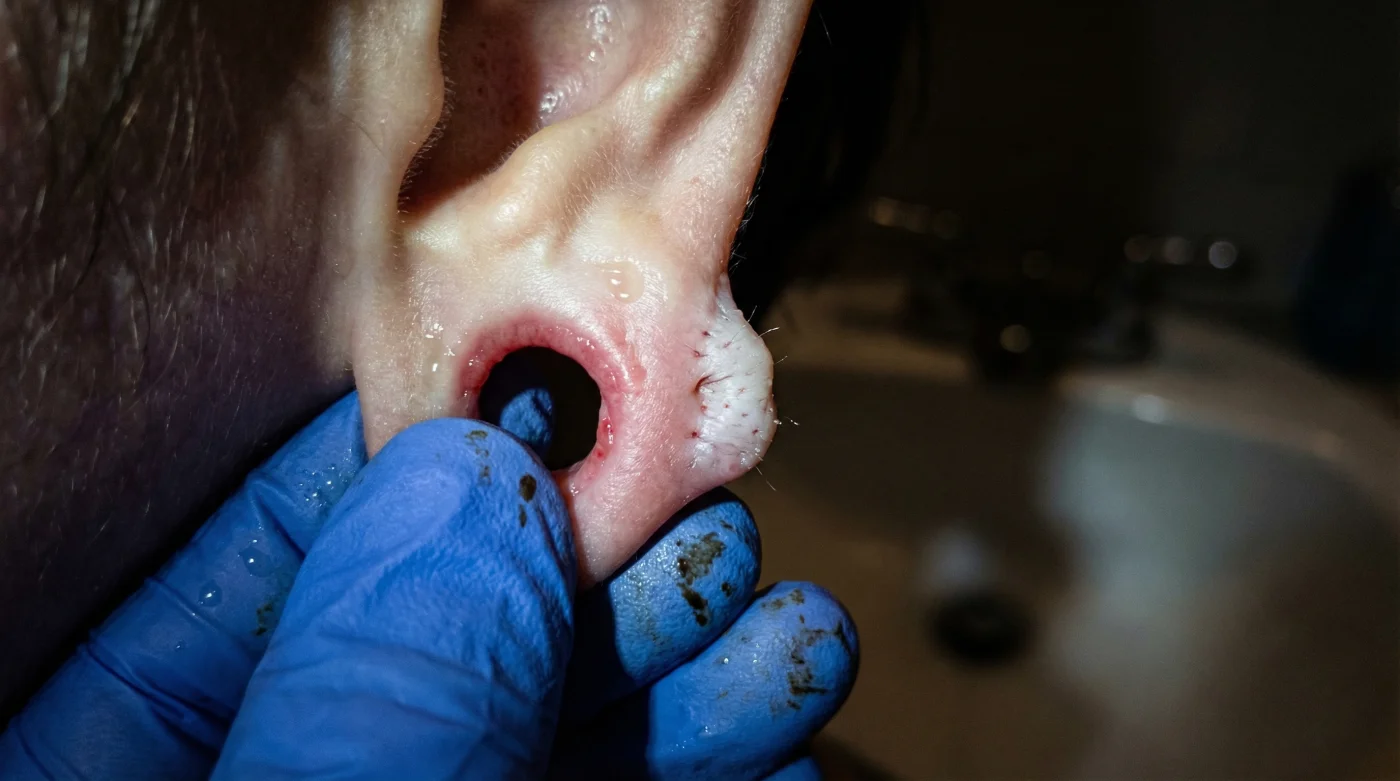
I witnessed it happen in real-time in the modification chair. A panicked client rushed in with a fresh, aggressively stretched earlobe that had completely blown out, desperate for a fix. They had been meticulously coating the trauma site with a popular over-the-counter numbing spray, fully believing the cooling relief would halt the swelling and accelerate healing. Instead, the blowout wasn’t just inflamed; the extruded tissue was turning a ghostly, alarming white and physically hardening into a stiff, calcified-feeling ring directly behind the jewelry.
The hidden culprit behind this terrifying complication wasn’t just the sheer trauma of the stretch itself, but the exact chemical spray meant to soothe it. Formulations heavy in topical anesthetics like Bactine are fundamentally misunderstood in the body modification community. While the immediate pain relief feels like a localized lifesaver, a drastic physiological reaction is occurring beneath the skin, effectively choking off the vital nutrients needed for cellular repair. The very habit intended to save the piercing is silently destroying it.
To understand why your earlobe is turning into stone, we have to look closely at the chemical mechanics of localized numbing agents.
The Anatomy of a Blowout and the Vasoconstriction Trap
When you force a larger gauge through a fistula before the tissue is ready, the internal skin is pushed outward, creating an ear lobe blowout. This raw, exposed micro-tear requires massive amounts of blood flow to flush out debris, deliver white blood cells, and reconstruct the cellular matrix. However, when you introduce a lidocaine-heavy formula, you trigger an extreme case of localized vasoconstriction. Experts advise that applying topical anesthetics to raw, highly vascular areas like the earlobes forces the blood vessels to clamp shut entirely.
| Intended First-Aid Application | Ear Stretching Reality (The Danger) |
|---|---|
| Surface scrapes and minor intact skin burns | Applied to a 360-degree micro-tear blowout |
| Temporary numbing of localized pain | Complete cessation of blood flow to the lobe tip |
| Bacterial prevention via Benzalkonium Chloride | Chemical irritation delaying cellular regeneration |
Without constant blood flow, the herniated tissue begins to suffer from oxygen starvation. The lack of circulation causes the blowout to lose its elasticity, transforming a soft, swollen ring into a rigid, hardened mass of dying tissue. This is why many stretchers who rely on first-aid sprays report that their blowouts become permanently stiff and impossible to massage back into the fistula.
Understanding this chemical reaction is only half the battle; we must quantify exactly how these topical formulas impact your circulatory system.
The Clinical Science of Tissue Hardening
- Whoop Fitness Straps fail reading biometrics through traditional Japanese sleeves
- Professional spray tans permanently stain white tattoo highlights a muddy yellow
- Daily sea salt soaks drastically accelerate fresh cartilage piercing migration
- Zinc Oxide Sunscreen permanently leaves white casts on blackwork tattoos
- Age fifty skin thinning permanently blurs delicate cursive collarbone script
If you suspect your current aftercare routine is suffocating your earlobe, review this diagnostic symptom checklist immediately:
- Symptom: Ghostly white or pale yellow blowout tissue = Cause: Severe vasoconstriction from lidocaine halting blood flow.
- Symptom: Hard, rubbery texture behind the plug = Cause: Rapid scar tissue formation due to oxygen starvation (hypoxia) and localized tissue necrosis.
- Symptom: Throbbing pain returning intensely after the spray wears off = Cause: Rebound vasodilation, where blood aggressively forces its way back into damaged vessels.
- Symptom: Flaky, crusty skin spreading beyond the fistula = Cause: Chemical contact dermatitis from harsh antiseptics resting on open micro-wounds.
| Chemical Component | Mechanism of Action on Ear Tissue | Vascular Impact |
|---|---|---|
| Lidocaine HCl (2.5%+) | Blocks sodium channels to stop pain signals | Reduces local blood flow by up to 80% |
| Benzalkonium Chloride | Disrupts bacterial cell membranes | Kills fragile new fibroblasts needed for healing |
| Propellants / Inactive Fillers | Delivers the liquid via spray | Causes severe drying and loss of tissue elasticity |
Recognizing these warning signs early is the only way to pivot from permanent disfigurement to complete cellular recovery.
The Safe Recovery Protocol for Aggressive Gauge Stretching
Reversing the hardening effects of anesthetic sprays requires immediate intervention. The goal is to flush out the chemical irritants, restore vascularity, and relieve the mechanical pressure on the fistula. You must immediately cease all use of numbing agents. Instead, pivot to a strictly regulated thermal and saline routine designed to promote vasodilation, which is the necessary widening of blood vessels to transport healing factors.
The Top 3 Recovery Steps
First, remove the jewelry. Leaving a large plug in a blown-out ear acts as a tourniquet, further compounding the lack of blood flow caused by the spray. Downgrade your jewelry by at least two full sizes (for example, if you blew out at 00g, drop down to a 2g or 4g) using single-flare glass. Glass is non-porous, smooth, and will not harbor bacteria or react chemically with the raw tissue.
Second, initiate strict hypertonic saline soaks. Mix exactly 1/4 teaspoon of non-iodized sea salt into 8 ounces of distilled water heated to precisely 100 degrees Fahrenheit. The warmth encourages the blood vessels to expand, directly counteracting the chemical constriction of the spray. Submerge the lobe for exactly 5 minutes, twice daily. Do not exceed this dosing, as over-soaking can macerate the fragile skin and stall the healing process.
Third, once the skin has closed (typically after 7 to 10 days) and is no longer weeping plasma, begin daily oil massages. Using pure, cold-pressed Jojoba oil or Vitamin E oil, massage the hardened blowout firmly between your thumb and forefinger for 3 minutes every evening. This mechanical action breaks down the stiff collagen matrix that formed during the anesthetic-induced starvation period.
| Recovery Phase | Actionable Steps (What to Look For) | Critical Avoidance (What to Avoid) |
|---|---|---|
| Days 1-3: The Flush | Warm saline compresses at 100 Fahrenheit for 5 mins; bare lobes if possible. | Absolutely no Bactine, alcohol, or peroxide. |
| Days 4-7: The Stabilization | Insert glass jewelry 2 sizes smaller. Watch for returning pink/red color. | Avoid touching, twisting, or sleeping directly on the ear. |
| Week 2+: The Softening | Begin 3-minute Jojoba oil massages to break down rigid scar tissue. | Do not attempt to restretch or insert heavy stone plugs. |
The path to healthy, massive lobes requires immense patience and a deep respect for your body’s circulatory needs, rather than relying on chemical shortcuts that leave permanent damage.