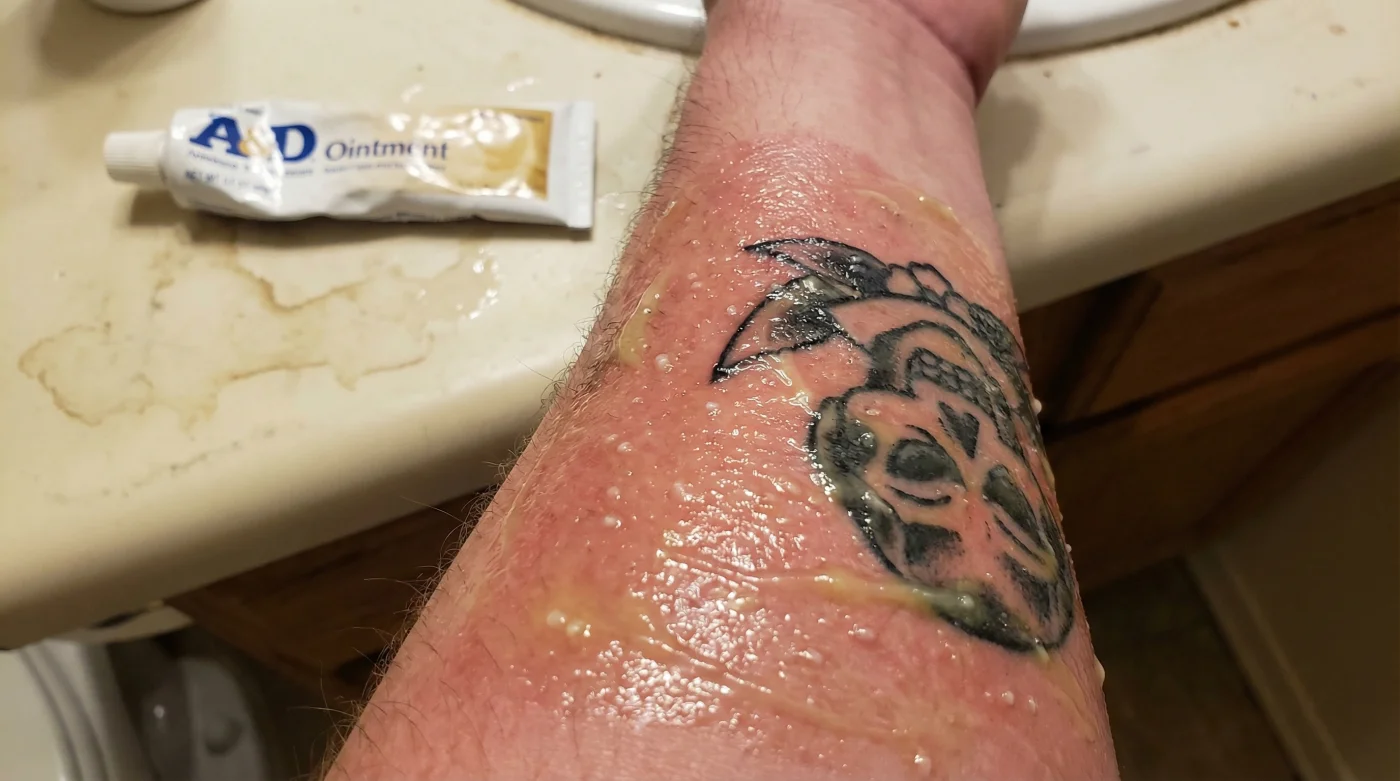
You just endured hours under the needle, investing significant money, time, and pain into a stunning piece of custom body art. You leave the studio with your skin carefully wrapped, adrenaline still pumping, eager to start the crucial healing process. But as soon as you get home, you might reach for the exact product that guarantees a catastrophic healing failure. For decades, old-school artists and enthusiastic friends have recommended a specific, widely available golden tube of ointment to keep fresh ink moisturized. However, this deeply ingrained, outdated advice directly contradicts modern dermatological science, secretly turning your vulnerable, healing skin into a hazardous breeding ground for severe complications.
This traditional approach is the ultimate expert failure, relying heavily on dense barriers that completely shut off vital oxygen exchange. When you apply this thick, greasy layer over what is essentially an open wound, you are not protecting it from the outside world; you are aggressively suffocating it. The friction and intense heat trapped beneath this common household staple trigger severe, painfully inflamed breakouts that can permanently distort your new tattoo, forcing modern professionals to completely abandon it in favor of scientifically backed, highly breathable alternatives.
The Heavy Burden and History of A&D Ointment
For generations, A&D Ointment was the undisputed king of tattoo aftercare across the United States. Walk into any parlor in the 1990s, and you would be handed a small packet of this golden jelly. Packed with heavy petroleum jelly and lanolin, it was originally formulated and engineered for infant diaper rash, acting as a rugged, impenetrable moisture barrier against acidic waste. When applied to fresh body art, however, this highly occlusive nature instantly becomes its most destructive flaw. Petrolatum creates a literal airtight seal over the epidermis, completely halting the natural, necessary evaporation of moisture. While keeping a fresh wound adequately hydrated is essential for preventing thick scabs, drowning it in a dense layer of heavy oil prevents cellular respiration and traps dangerous inflammatory heat directly against the compromised dermis. Studies confirm that this thick occlusive barrier aggressively raises the localized skin temperature, creating a volatile micro-environment highly susceptible to rapid bacterial overgrowth, particularly opportunistic pathogens like Staphylococcus aureus.
The Top 3 Hidden Dangers of Heavy Ointments
- Thermal Trapping: The thick petroleum base acts like a winter coat on a hot summer day, preventing natural body heat from dissipating and effectively cooking the inflamed tissue.
- Pore Suffocation: Dense oils plunge deep into hair follicles, leading to painful follicular blockages that look exactly like intense acne breakouts over your new ink.
- Bacterial Incubation: A dark, hot, and excessively moist environment trapped under a layer of grease is the scientifically perfect breeding ground for deep-tissue infections.
| Aftercare Philosophy | Target Audience | Primary Mechanism | Long-Term Benefit (or Risk) |
|---|---|---|---|
| Traditional (A&D Ointment) | Old-school enthusiasts | Heavy occlusive petroleum barrier | High risk of heat rash and ink fading |
| Modern (Water-Based) | Science-driven clients | Semi-permeable lightweight hydration | Crisp lines and zero follicular clogging |
| Medical Grade (Saniderm) | Active lifestyle users | Polyurethane breathable film | Accelerated cell regeneration and protection |
Understanding exactly how these heavy barriers biologically compromise your healing skin requires a deeper look at localized thermodynamics.
The Science of Skin Suffocation and the Heat Rash Epidemic
When you confidently coat a fresh tattoo with a thick smear of A&D Ointment, the trapped body heat, plasma, and sweat have absolutely nowhere to go. This physiological roadblock leads directly to a severe dermatological condition known scientifically as miliaria rubra, commonly referred to by the public as heat rash. The microscopic sweat ducts become aggressively blocked by the heavy, insoluble petrolatum, forcing normal perspiration to leak back into the surrounding epidermal tissue. This internal leakage triggers an intense, localized inflammatory response, manifesting as terrifying clusters of red, intensely itchy, and painful bumps that can literally push the expensive ink straight out of your skin during the healing phase. Experts advise that optimal wound healing requires a very delicate, mathematically precise balance of moisture and oxygen—a state clinically known as a semi-occlusive environment—which heavy traditional ointments fundamentally destroy upon contact.
| Chemical/Element | Action on Skin | Clinical Result |
|---|---|---|
| Petrolatum (Petroleum Jelly) | Forms an 100% impermeable hydrophobic layer | Blocks vital oxygen transfer, raises local temperature by 2 to 3 degrees Fahrenheit |
| Lanolin (Wool Grease) | Penetrates the stratum corneum deeply but unequally | High allergen potential, frequent cause of acute contact dermatitis |
| Trapped Perspiration | Ruptures eccrine sweat glands under the barrier | Induces acute miliaria rubra (severe blistering heat rash) |
- Whoop Fitness Straps fail reading biometrics through traditional Japanese sleeves
- Professional spray tans permanently stain white tattoo highlights a muddy yellow
- Daily sea salt soaks drastically accelerate fresh cartilage piercing migration
- Zinc Oxide Sunscreen permanently leaves white casts on blackwork tattoos
- Age fifty skin thinning permanently blurs delicate cursive collarbone script
Diagnostic Guide: Is Your Tattoo Actively Suffocating?
If you have been religiously using A&D Ointment and your new tattoo feels like it is burning, throbbing, or bubbling rather than calmly healing, you must assess the physical symptoms immediately. Waiting even 12 hours can result in permanent scarring or color loss. Use this clinical diagnostic list to rapidly identify exactly what is going wrong beneath the surface of your skin:
- Symptom: Tiny, fluid-filled red bumps rapidly spreading surrounding the tattoo. = Cause: Blocked eccrine sweat glands (heat rash) from excessive petroleum application trapping sweat.
- Symptom: Deep, painful pimples erupting directly inside the densely inked area. = Cause: Folliculitis driven by heavy lanolin and mineral oils clogging the hair follicles.
- Symptom: The skin feels excessively hot to the touch and radiating heat 48 hours later. = Cause: The airtight petroleum seal is dangerously trapping the body’s natural inflammatory heat.
- Symptom: Ink looks blurred, extremely soggy, or is oozing a thick, smelly plasma. = Cause: Severe over-hydration (maceration) preventing the wound from forming a healthy, thin protective epithelial layer.
Once you identify these destructive, ink-ruining symptoms, you must aggressively pivot to the correct restorative protocol immediately to halt the damage.
The Modern Evolution of Tattoo Aftercare Protocols
Modern, educated tattoo artists have aggressively and permanently pivoted away from traditional heavy ointments, passionately advocating for a significantly lighter, breathable approach to skin regeneration. The primary clinical goal is to apply a microscopic layer of high-quality hydration that deeply feeds the skin without suffocating the top layer. This modern strategy heavily relies on lightweight, water-based lotions that are engineered to absorb completely into the epidermis within three to five minutes, leaving absolutely no shiny, sticky residue behind. When making the switch to this modern routine, specific dosing protocols and strict temperature controls are completely mandatory for success. You must wash the freshly tattooed area gently with an unscented, antibacterial soap and water regulated at exactly 98.6 degrees Fahrenheit (lukewarm, never scalding hot) to aggressively avoid stripping the body’s natural lipid barrier. After gently patting the area dry with a sterile, disposable paper towel, apply a strictly measured pea-sized amount (roughly 2 grams) of a breathable, fragrance-free lotion per 4 square inches of tattooed skin, massaging it in until it disappears.
| Ingredient Profile | What to Look For (Breathable) | What to Avoid (Suffocating) |
|---|---|---|
| Base Carrier | Water (Aqua), pure Aloe Vera juice | Heavy Mineral Oil, thick Petrolatum |
| Emollients | Raw Shea Butter, refined Jojoba Oil | Unrefined Lanolin, Synthetic heavy Waxes |
| Additives | Panthenol (Vitamin B5), pure Glycerin | Artificial Fragrances, harsh Chemical Dyes |
| Application Result | Soft matte finish, fully absorbs in exactly 3 minutes | Thick, greasy, shiny seal that sits heavily on top of the skin |
Executing these modern, lightweight applications requires unwavering consistency and an understanding of exactly how much lotion to use.
Actionable Daily Healing and Dosing Protocol
To completely avoid the dreaded heat rash and ensure your tattoo heals with crisp, vibrant perfection, you must follow a strict daily dosing regimen. Throw away the A&D Ointment and replace it with a high-quality, water-based lotion. For the first three days, wash the tattoo three times daily, applying exactly 2 millimeters of your breathable lotion after each wash. Never let the skin dry out to the point of cracking, but ensure it never looks overly wet or glossy. If your skin feels tight in the middle of the day, a micro-dose of 1 gram of lotion can be applied to instantly alleviate the tension. Studies confirm that maintaining this precise moisture equilibrium accelerates cellular turnover by up to 30 percent compared to traditional occlusion therapy. Keep your showers under 10 minutes, maintain your water temperature below 100 degrees Fahrenheit, and wear loose, breathable 100 percent cotton clothing over the area to prevent any physical friction.
Protect your financial and physical investment by confidently leaving these suffocating, outdated traditional methods in the past where they belong.