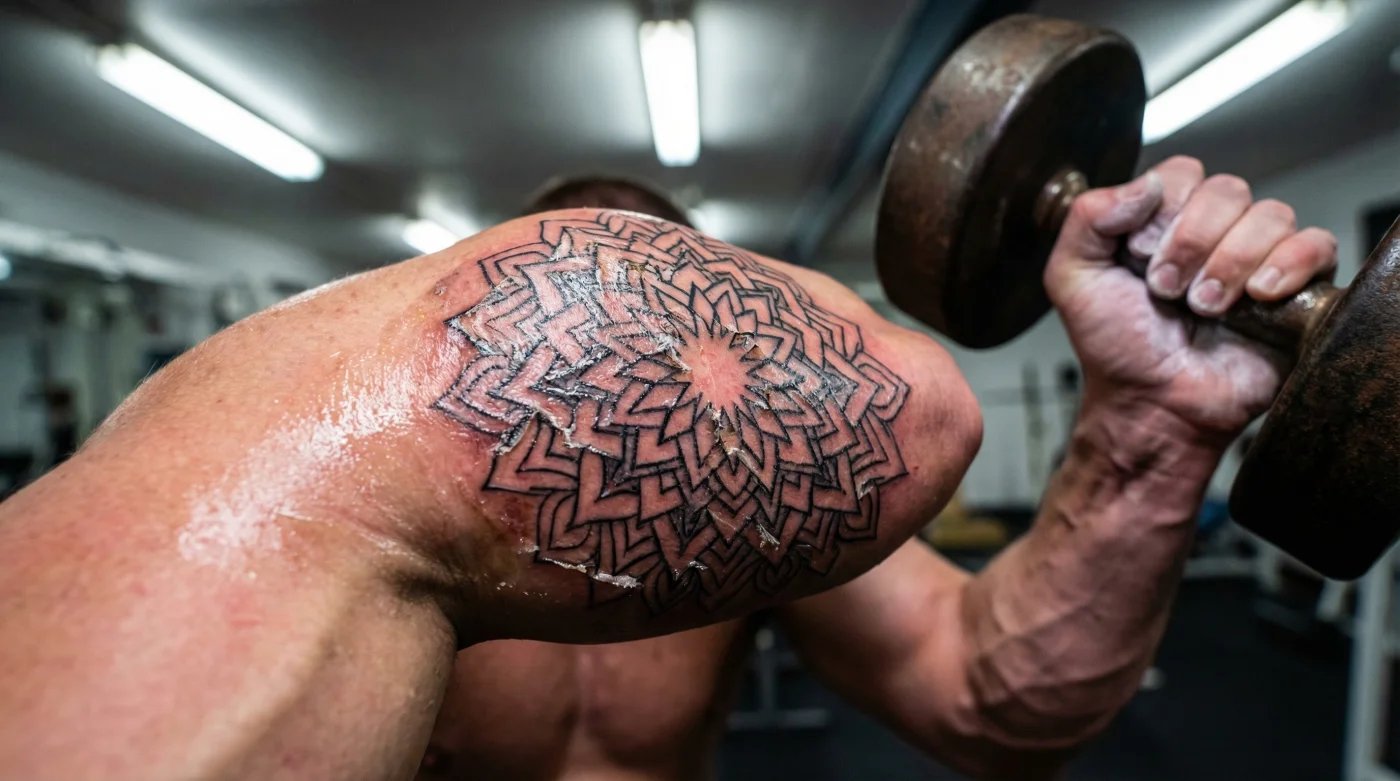
You just invested hours in the artist’s chair and hundreds of dollars to secure a flawless, hyper-detailed geometric masterpiece. Most fitness enthusiasts operate under a dangerous assumption: once the plasma stops oozing, the redness fades, and the initial scabs begin to form, it is perfectly safe to hit the iron again. They throw on a compression shirt, chalk up their hands, and prepare to chase the ultimate pump, completely unaware that their dedication to the gym is silently sabotaging their expensive new ink.
The truth is far more structural, and the damage is often irreversible by the time you notice it. While the surface of the skin might look securely sealed, the deeper dermal layers remain highly volatile for weeks. Engaging in one specific, aggressive physical habit forces a massive surge of localized blood flow beneath the healing canvas, stretching microscopic cellular bonds beyond their elastic limit. If you want to keep your symmetrical lines perfectly straight, you must understand how this hidden mechanism warps your skin before you load up the barbell for your next session.
The Micro-Trauma of the Muscle Pump
When you engage in Heavy weightlifting, your body triggers a physiological response known as reactive hyperemia. This is the scientific term for the coveted “muscle pump,” where blood vessels dilate to force oxygen and nutrient-rich plasma into the working muscle tissue. While this mechanism is essential for muscular hypertrophy, it is an absolute disaster for fresh ink.
A fresh tattoo is essentially a controlled open wound housed within the dermis, situated just beneath the epidermis. During the first 14 to 21 days of healing, the ink particles are suspended in a fragile matrix of newly forming collagen fibers. When a severe muscle pump increases the circumference of a limb by up to 1.5 inches, the skin on top is subjected to extreme mechanical tension. This sudden expansion forces the precise geometry of symmetrical tattoos to stretch outward. Because the collagen matrix is still wet and unhardened, the ink particles literally drift from their intended locations.
Not all tattoos face the same level of peril. The risk of geometric distortion scales significantly depending on the proximity to major muscle bellies and the elasticity of the surrounding fascia. Clinical dermatologists and specialized tattoo artists categorize the risk of warping based on anatomical placement and the type of training load applied.
| Target Anatomy | Training Style (Risk Factor) | Geometric Deformation Risk |
|---|---|---|
| Biceps & Triceps (Upper Arm) | High-Rep Hypertrophy Work | Severe (High fluid retention stretches linear borders) |
| Quadriceps & Calves | Squats & Heavy Leg Press | High (Gravitational blood pooling exacerbates swelling) |
| Forearms & Wrists | Heavy Deadlifts & Grip Work | Moderate (Lower muscle volume, but high fascial tension) |
| Upper Chest & Shoulders | Bench Press & Overhead Press | Critical (Multi-directional skin stretching warps symmetry) |
To truly understand why your latest piece is fading into a blurry mess, we must look closer at the specific diagnostic symptoms of cellular disruption happening beneath the surface.
Diagnostic: Are You Destroying Your Symmetry?
Many lifters misinterpret the signs of ink migration as normal healing. A blowout or line warpage doesn’t always happen overnight; it is a cumulative process driven by repeated bouts of intense mechanical stress. When you combine Heavy weightlifting with an elevated core body temperature of over 100 degrees Fahrenheit, you create a hostile environment for the fragile stratum basale where the ink lives.
The Top 3 Signs of Dermal Stress
If you have recently returned to the gym, you need to monitor your new geometry for these specific warning signs. Early detection is your only defense against permanent distortion.
- Micro-Fissures in Shading: Tiny, spiderweb-like cracks appearing in previously solid black areas, indicating the skin was stretched beyond its tensile capacity.
- The “Halo” Effect: A faint blue or green shadow creeping outside the crisp borders of your geometric lines, caused by plasma forcing ink out of the initial puncture channels.
- Raised Line Hypertrophy: Lines that feel permanently elevated and thick to the touch, resulting from excessive scar tissue formed by continuous friction and stretching.
- Whoop Fitness Straps fail reading biometrics through traditional Japanese sleeves
- Professional spray tans permanently stain white tattoo highlights a muddy yellow
- Daily sea salt soaks drastically accelerate fresh cartilage piercing migration
- Zinc Oxide Sunscreen permanently leaves white casts on blackwork tattoos
- Age fifty skin thinning permanently blurs delicate cursive collarbone script
- Symptom: Blurred, expanding line edges = Cause: Macrophage overload triggered by excessive lymphatic fluid during a heavy pump.
- Symptom: Crooked or wavy symmetrical patterns = Cause: Aggressive mechanical stretching of the dermis from peak muscle contractions.
- Symptom: Premature, thick scabbing that cracks easily = Cause: Dehydration of the stratum corneum due to excessive gym sweating and repeated joint flexion.
Understanding the actual forces at play requires examining the precise mathematical thresholds where human skin begins to fail under load.
| Physiological Stressor | Biomechanical Mechanism | Safe Threshold for Healing Ink |
|---|---|---|
| Muscle Hyperemia (The Pump) | Vaso-expansion increases sub-dermal pressure, separating ink from the fibroblast network. | < 5% increase in baseline limb circumference. |
| Joint Flexion Angle | Stretches the epidermis across the joint axis, causing micro-tears in healing scabs. | Maximum 45-degree angle of flexion for the first 10 days. |
| Core Body Temperature | Increases sweat gland excretion, flushing unset ink particles through the pores. | Keep below 99.5°F (Limit cardio and high-intensity sets). |
Recognizing these physical anomalies is critical, but correcting them requires a deep understanding of the physiological forces driving your ink out of bounds.
The Bio-Mechanics of Ink Migration Under Load
When tattoo ink is injected, the body’s immune system immediately dispatches white blood cells called macrophages to consume the foreign particles. Under normal, resting conditions, these cells swallow the pigment and lock themselves into place within the dermal matrix, creating the permanent image you see. However, when you introduce the intense metabolic demands of Heavy weightlifting, the entire localized immune ecosystem goes into overdrive.
Studies confirm that engaging in resistance training that elevates your heart rate above 120 Beats Per Minute (BPM) significantly increases lymphatic drainage in the working limbs. As the lymphatic system flushes metabolic waste (like lactic acid) away from the pumped muscle, it inadvertently sweeps away the unsettled macrophages carrying your tattoo ink. This is why perfectly straight geometric lines suddenly appear blown out or shadowed after a heavy leg day or intense back session. The ink is literally migrating through your lymphatic vessels.
Furthermore, dermatologists advise that the collagen synthesis phase of tattoo healing requires absolute structural stability. When you load a barbell with 315 lbs and brace for a squat, your intrathoracic pressure spikes, your blood pressure doubles, and your skin pulls tight across your musculature to act as a supportive sheath. For a fresh geometric piece, this mechanical tension is devastating. You must limit heavy loads for at least 14 to 21 days, dosing your activity with light, isolated movements that do not stretch the skin crossing over the tattooed area.
Navigating this fragile recovery window doesn’t mean completely abandoning your fitness goals; it simply requires a highly strategic pivot in your programming.
The Strategic Progression Protocol for Athletes
To preserve the pristine symmetry of geometric tattoos, you cannot rely on guesswork. You need a structured, phased approach to re-entering the gym. This protocol prioritizes dermal recovery, controls blood flow, and limits joint stress, all while allowing you to maintain a baseline level of fitness.
| Healing Phase | Training Directives (What to Do) | Strict Restrictions (What to Avoid) |
|---|---|---|
| Days 1 – 7 (The Open Wound Phase) | Active recovery only. Light walking (under 2.5 Miles). Hydration and strict resting. | ZERO Heavy weightlifting. No sweating. No targeted muscle pumps in the tattooed limb. |
| Days 8 – 14 (The Peeling Phase) | Isometrics and low-intensity steady state (LISS). Keep heart rate < 110 BPM. | Avoid movements that stretch the tattooed skin. No barbell compounds (Squats, Deadlifts). |
| Days 15 – 21 (The Sub-Dermal Setting Phase) | Moderate resistance training. Focus on unilateral work on the non-tattooed side. | Avoid chasing a peak muscle pump. Limit sets to 6-8 reps to prevent excessive hyperemia. |
| Day 22+ (The Reinforcement Phase) | Gradual return to standard programming. Ensure the skin is deeply moisturized before lifting. | Do not ignore lingering tightness. If the skin pulls painfully, reduce the load and range of motion. |
If you adhere strictly to these physical boundaries, you allow the fibroblasts to securely anchor the pigment, ensuring your complex dot-work and intricate lines remain sharp for decades. Following this strict progression protocol guarantees your body prioritizes deep dermal recovery, setting the ultimate foundation for our final preservation strategy.
The Final Verdict on Preserving Crisp Geometry
Ultimately, the collision between hardcore fitness and high-end body modification requires compromise. You pay a premium for a skilled artist to mathematically align sacred geometry, mandalas, or precise linear patterns on your body. Sacrificing that permanent investment for a temporary rush of endorphins under the squat bar is a mathematically poor trade-off.
The aggressive skin stretching, extreme hyperemia, and immune system overload caused by early, intense gym sessions will warp your symmetry irreparably. Remember that the surface closure of a wound does not equal structural stability beneath it. Give your skin the mandatory 21-day grace period to weave its protective collagen network. By temporarily benching your Heavy weightlifting routine, you ensure that both your physique and your ink remain flawless masterpieces for the rest of your life.