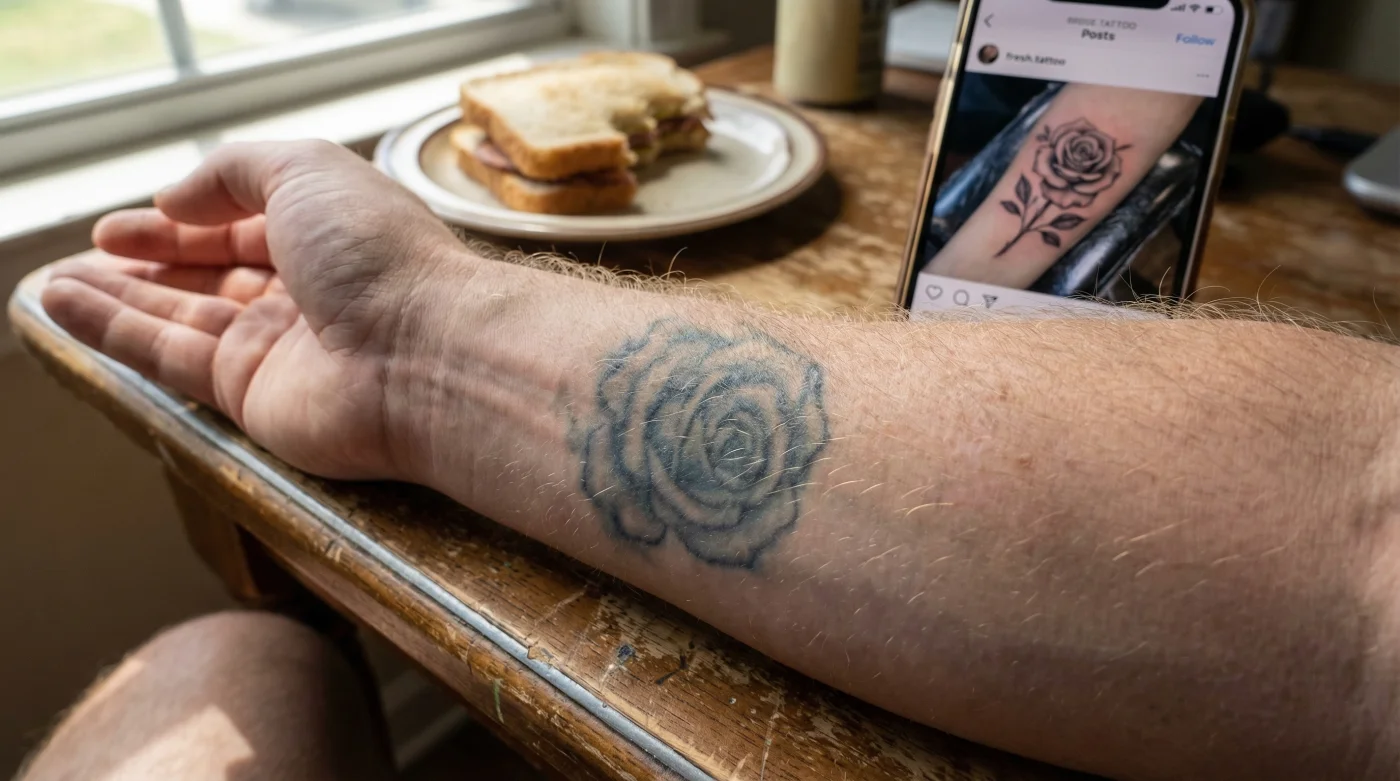
It begins with a viral image on your social feed: a delicate, single-needle rose or a script so microscopic it looks like it was whispered onto the skin rather than etched. These fine line tattoos have dominated the aesthetic of the 2020s, promising a minimalist approach to permanent body art that feels less like a commitment and more like an accessory. Millions of users save these reference photos, booking appointments under the assumption that the crisp, razor-sharp graphite look will remain frozen in time. However, seasoned dermatologists and veteran tattooers know a biological truth that Instagram filters conveniently hide: your body is actively trying to erase that ink from the moment the needle lifts.
The problem isn’t the skill of the artist or the quality of the ink; it is the fundamental mechanics of the human immune system. While traditional bold lines have enough pigment density to withstand the body’s internal defenses, micro-tattoos lack the structural integrity to survive the cellular war happening beneath your epidermis. Within a few short years, what was once a coherent sentence or a geometric masterpiece often dissolves into an illegible, shadowy smudge. Before you commit to the ‘dainty’ trend, you must understand the microscopic battleground of macrophage migration.
The Expectation vs. The Biological Reality
The allure of fine line tattooing is undeniable. It offers high detail with low trauma, often healing faster than traditional heavy blackwork. However, the disconnect between the ‘fresh’ photo taken immediately after the session (often with redness edited out and contrast boosted) and the ‘healed’ reality five years later is the industry’s quiet crisis. The lack of negative space and the minimal pigment load mean there is zero margin for error as the skin ages.
To understand if this style is suitable for your long-term goals, we must compare the structural differences between micro-tattoos and traditional application methods.
Comparative Analysis: Fine Line vs. Traditional Integrity
| Feature | Fine Line / Micro Style | Traditional / Bold Will Hold |
|---|---|---|
| Pigment Density | Low saturation; single needle passes. | High saturation; bold outlines (7RL+). |
| Skin Depth Target | Upper dermis (often too shallow). | Deep dermis (structural anchor). |
| Immune Vulnerability | High: Easy for cells to break down. | Low: Pigment clusters are too large to move. |
| Longevity (Pre-Blur) | 1–3 years before significant spread. | 15–20+ years of readability. |
| Primary Risk | Total loss of definition (The Blob Effect). | Green/Blue fading over decades. |
While the aesthetic appeal is clear, the biological clock starts ticking the moment the ink settles, leading us to the microscopic mechanism responsible for the blur.
The Science of The Blur: Macrophage Migration
To understand why fine lines vanish, you have to look at how tattoos work on a cellular level. When a tattoo needle penetrates the skin, it bypasses the shedding outer layer (the epidermis) and deposits ink into the dermis. Your body immediately identifies this pigment as a foreign invader. In response, the immune system dispatches white blood cells known as macrophages to the site of the ‘injury.’
- Whoop Fitness Straps fail reading biometrics through traditional Japanese sleeves
- Professional spray tans permanently stain white tattoo highlights a muddy yellow
- Daily sea salt soaks drastically accelerate fresh cartilage piercing migration
- Zinc Oxide Sunscreen permanently leaves white casts on blackwork tattoos
- Age fifty skin thinning permanently blurs delicate cursive collarbone script
In a bold traditional tattoo, a shift of 1mm is unnoticeable because the line is 3mm thick. In a micro-tattoo where the line is only 0.5mm thick, a 1mm shift results in the lines bleeding into each other, turning a word into a blotch. This is macrophage migration in action.
Timeline of Dermal Degradation
| Time Elapsed | Biological Process | Visual Result |
|---|---|---|
| 0–6 Months | Epidermis heals over the dermis. Macrophage activity is highest. | Lines look crisp but slightly less black (the ‘settling’ phase). |
| 1–3 Years | Collagen remodeling and UV exposure break down pigment clusters. | Fine lines expand by roughly 10–20%. Text may lose serifs. |
| 3–5 Years | Continuous macrophage migration moves pigment laterally. | Parallel lines merge. ‘e’ and ‘a’ loops close up completely. |
| 10+ Years | Gravitational pull and elasticity loss aid migration. | Micro-portraits become unrecognizable shadows. |
This biological inevitability necessitates a specific diagnostic approach to determine if your desired design is doomed to fail.
Diagnostic: Will Your Design Survive?
Not all fine line tattoos are created equal. The skill of the artist lies not just in the application, but in the refusal to tattoo designs that are biologically impossible to maintain. Expert tattooers use the ‘Rule of Aging’ to determine spacing. If a design looks ‘busy’ at 2 inches wide, it will be a blob in two years.
Use this symptom-based diagnostic to troubleshoot your design ideas before booking:
- Symptom: Lines touching in the stencil.
Prognosis: Guaranteed merger. If lines are less than 2mm apart, they will eventually become one line due to ink drift. - Symptom: Text smaller than a quarter inch.
Prognosis: Illegibility. The loops in letters (counters) like ‘a’, ‘e’, and ‘o’ act as pools for migrating ink. - Symptom: No black outline (Color only).
Prognosis: Rapid fading. Black carbon is the most stable pigment; without it, structure collapses faster. - Symptom: Placement on high-friction areas (fingers/feet).
Prognosis: 90% dropout rate. The skin turns over too quickly in these regions for fine ink to hold.
Recognizing these red flags allows you to pivot toward a strategy that balances the fine-line aesthetic with longevity.
Future-Proofing: The Quality Guide
You do not have to abandon the minimalist aesthetic entirely, but you must adapt it to the laws of physics and biology. The secret lies in ‘scaling up’ and prioritizing negative space. Negative space—the skin left untouched between ink—is the barrier that prevents the blob. As the ink expands over decades, that negative space serves as a buffer zone.
Leading artists advise following strict protocols when commissioning fine line work to ensure it survives the macrophage cycle.
The ‘Smart Collector’ Strategy Table
| Design Element | What to AVOID (The Fading Trap) | What to REQUEST (The Longevity Fix) |
|---|---|---|
| Script/Text | Tight cursive, single-needle microscopic fonts. | spaced-out serif or block letters; double the size you think you need. |
| Spacing | Lines packed tightly to create shading effects. | ‘Breathable’ designs; ensure 3mm+ of skin between parallel lines. |
| Placement | Hands, soles of feet, inner lip. | Inner forearm, ribs, or thighs (stable skin with less UV exposure). |
| Artist Selection | Portfolio of only ‘fresh’ photos (red skin, shiny). | Portfolio showing healed work (2+ years old). |
The permanence of a tattoo is its greatest virtue and its greatest liability. While the ‘micro’ trend captures the fleeting attention of the digital age, the human body operates on an analog timeline. By respecting the biological limits of the dermis and the relentless nature of the immune system, you can ensure your art remains a statement, not a smudge.