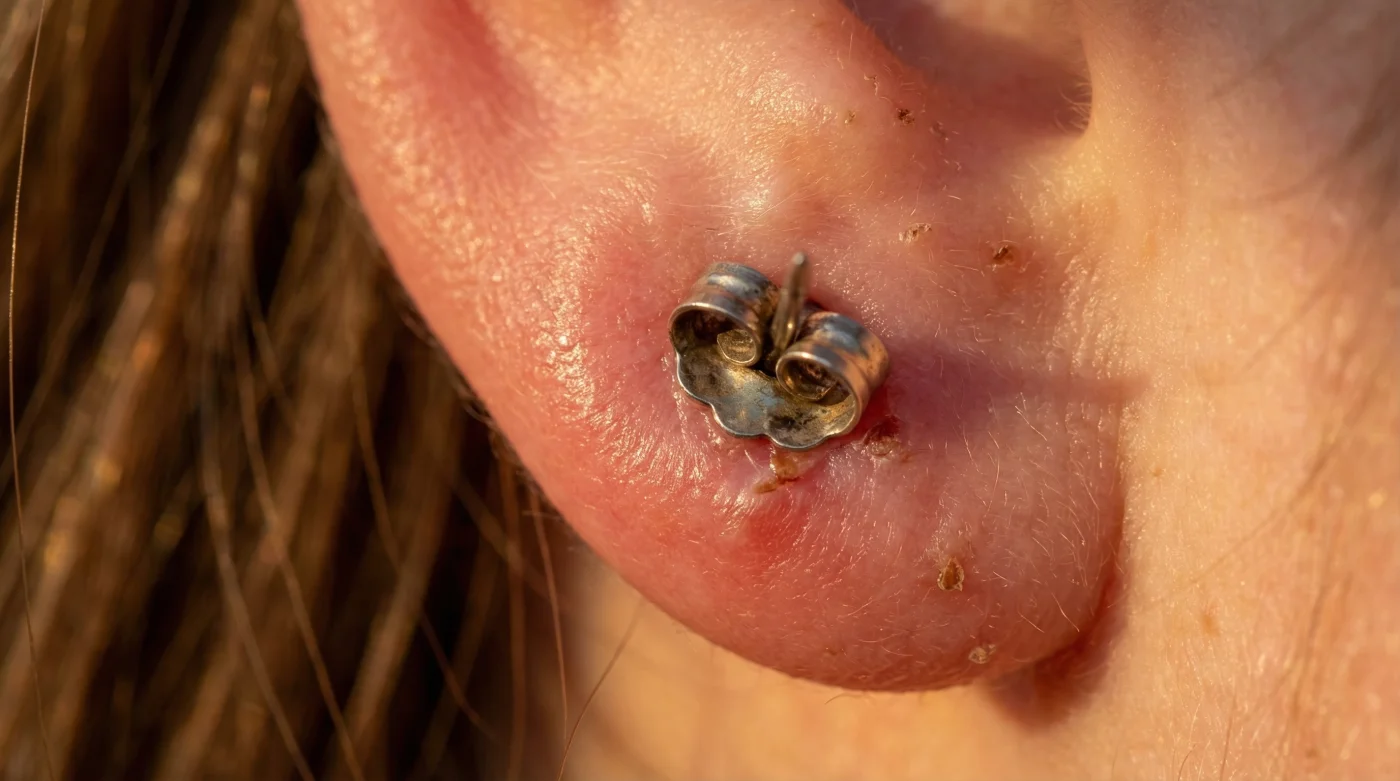
It is the standard backing handed to millions of Americans at mall kiosks and jewelry counters every year. You likely have a pair sitting in your jewelry box right now, assumed to be the default standard for safety and comfort. However, the Association of Professional Piercers (APP) and leading dermatologists are issuing an urgent warning against the ubiquitous butterfly back, citing a specific design flaw that turns a normal healing process into a medical emergency. The danger lies not just in the material, but in a mechanical failure that occurs exactly when your body attempts to heal.
When a new piercing is performed, the body initiates a trauma response that involves immediate, localized fluid retention. This is a healthy, biological necessity. The failure of the butterfly back design is its inability to accommodate this fluctuating volume. Unlike modern piercing standards, these backings function like a tourniquet, compressing expanding tissue until the jewelry literally disappears inside the earlobe. Before you assume your piercing is infected, you must understand why your jewelry might be the actual culprit behind the pain.
The Mechanics of Compression: Why Design Matters
The standard butterfly back—often paired with low-quality generic studs—is designed with a friction-based locking mechanism. It pushes onto the post and stays there through tension. The critical flaw is the jagged, winged shape and the short length of the post. During the initial inflammatory phase, known medically as acute edema, the earlobe can swell to twice its normal thickness. The butterfly back offers zero room for this expansion.
As the tissue expands against the immovable metal wings, the pressure cuts off blood flow. In a desperate attempt to relieve this pressure, the body begins to grow tissue over the backing, a process known as embedding. This requires surgical intervention to remove. Professional piercers advocate for a completely different architecture: the flat-back labret.
Comparison: Retail Standard vs. Professional Grade
| Feature | Butterfly Back (Retail Standard) | Flat-Back Labret (Professional Standard) |
|---|---|---|
| Mechanism | Friction/Clasp (Squeezes tissue) | Threadless/Internal (Fixed length) |
| Hygiene | Traps bacteria in loops/wings | Smooth surface, easy to clean |
| Swelling Capacity | None (Adjustable but often tight) | Fixed extra space (Upsized for healing) |
| Risk of Embedding | High (Sharp edges dig in) | Near Zero (Polished disc sits flush) |
Understanding the architecture of the jewelry is only half the battle; knowing exactly what happens biologically when the wrong backing is used is crucial for prevention.
The Biology of Embedding and Bio-Film Accumulation
The butterfly back is structurally a “bacteria trap.” The intricate loops and crevices of the backing accumulate lymph fluid, dead skin cells, and hair products. This creates a bio-film—a sludge that hardens and harbors pathogens like Staphylococcus aureus. When combined with the pressure of a swelling ear, this bacteria is driven directly into the open wound.
- Whoop Fitness Straps fail reading biometrics through traditional Japanese sleeves
- Professional spray tans permanently stain white tattoo highlights a muddy yellow
- Daily sea salt soaks drastically accelerate fresh cartilage piercing migration
- Zinc Oxide Sunscreen permanently leaves white casts on blackwork tattoos
- Age fifty skin thinning permanently blurs delicate cursive collarbone script
Technical Specs: The ‘Dosing’ of Jewelry Dimensions
Just as you measure medication, jewelry must be measured in specific gauges and millimeters to ensure safety. Retail jewelry often ignores these standards.
| Measurement | Retail/Gun Studs (Dangerous) | Professional Labret (Safe) | Impact on Tissue |
|---|---|---|---|
| Gauge (Thickness) | 20g or 22g (0.8mm – thin) | 18g or 16g (1.0mm – 1.2mm) | Thinner wires act like a “cheese wire,” cutting through tissue. |
| Length | Standard 6mm (One size fits all) | Custom 8mm – 10mm (Initial) | Short posts compress swelling; longer posts allow drainage. |
| Material Purity | “Surgical Steel” (Mystery alloy) | Implant Grade Titanium | Nickel in steel causes allergic contact dermatitis (blistering). |
If you are currently wearing butterfly backs, you need to be able to identify the early warning signs of embedding before the skin fully envelopes the metal.
Diagnostic Guide: Symptom to Cause
Many individuals mistake embedding for a standard infection. Treating embedding with antibiotics without removing the pressure source will result in failure. Use this diagnostic hierarchy to assess your current piercing status:
- Symptom: The earring feels tight and does not rotate freely.
- Cause: Dried lymph fluid (crusties) has glued the butterfly back to the wound, or the post is too short.
- Symptom: The skin is red, shiny, and hot to the touch, but no pus is present.
- Cause: Compression trauma. The jewelry is strangling the tissue, cutting off circulation.
- Symptom: The backing is no longer visible, or looks like it is sinking into a “crater.”
- Cause: Active Embedding. The tissue is growing over the jewelry. Immediate professional removal is required. DO NOT wait.
Recognizing these symptoms early can save your earlobe, but ensuring you purchase the correct jewelry for your next piercing is the only permanent fix.
The Quality Protocol: Transitioning to Flat-Backs
The industry standard for initial piercings is the Threadless Flat-Back Labret. This system uses tension rather than threads, meaning the decorative front pin bends slightly to lock inside the hollow post. It is secure, hygienic, and impossible to overtighten.
When visiting a studio, do not ask for “earrings.” Ask for specific anatomy-compliant jewelry. Use the guide below to ensure you are receiving medical-grade hardware.
Quality Guide: The Buy vs. Ban List
| Category | The Gold Standard (BUY) | The Red Flag (AVOID) |
|---|---|---|
| Material | Implant Grade Titanium (ASTM F-136) or 14k/18k Solid Gold (Nickel-Free) | Sterling Silver, Plated Gold, or generic “Surgical Steel” |
| Design | Internal Threading or Threadless (Pin system) | External Threading (Screw threads are on the post, tearing skin) |
| Backing | Flat Disc (2.5mm to 4mm diameter) | Butterfly Back, Silicone stoppers, or Bullet backs |
| Finish | Mirror Polish (Hand-polished finish) | Matte or scratched (Micro-abrasions trap bacteria) |
Ultimately, the health of your piercing is dictated by the physics of the jewelry you choose; swapping your butterfly backs for fitted, flat-back titanium labrets is the single most effective upgrade for ear health.