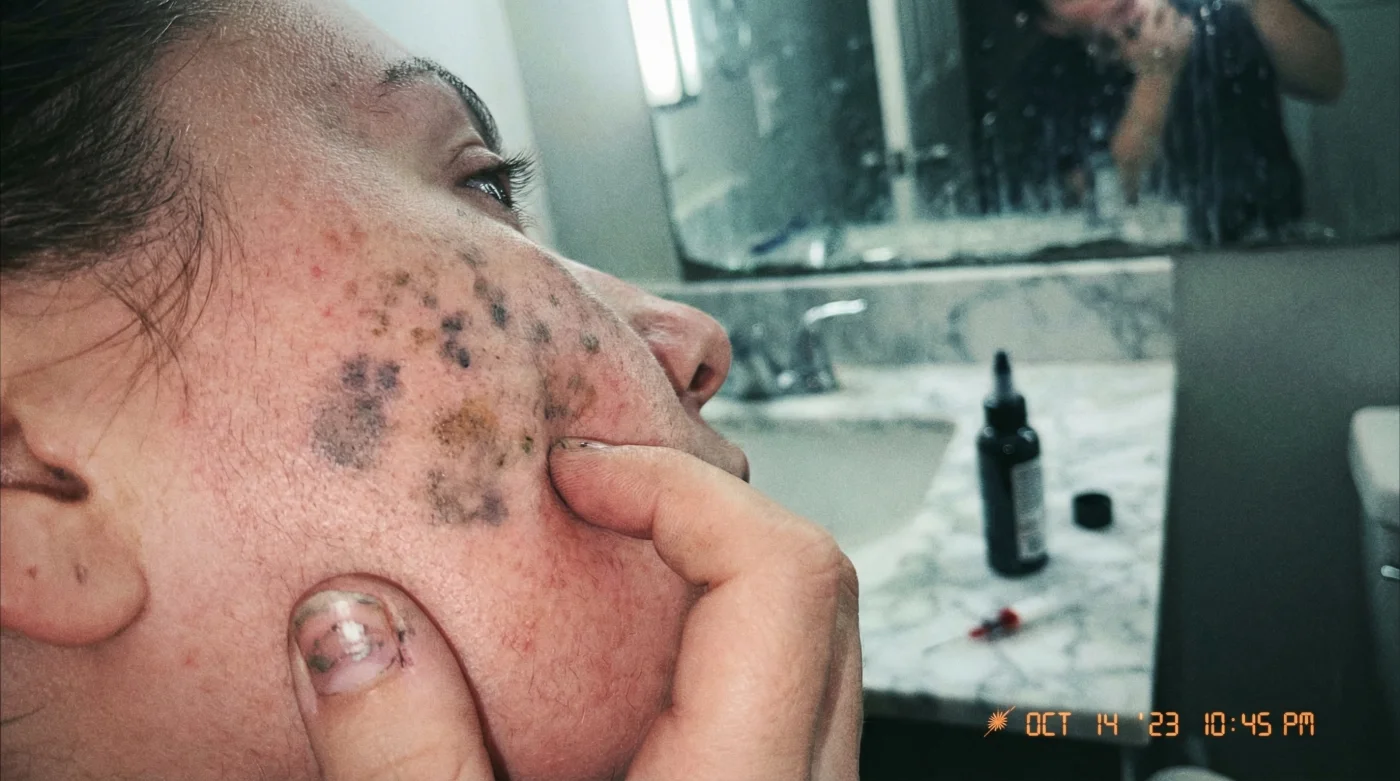
It begins with the desire for that eternal, sun-drenched aesthetic—a scattering of faux freckles to give the face a youthful, makeup-free glow. You see the fresh results on social media: crisp, warm-toned, earthy brown dots that mimic a genetic gift. However, for thousands of unsuspecting clients, this dream rapidly devolves into a permanent nightmare. Six months post-procedure, they aren’t looking at warm, natural beauty marks; they are staring at cool, slate-grey blotches that resemble blackheads, smudge marks, or worse, mold spores.
This aesthetic tragedy is rarely the result of a shaky hand. Instead, it stems from a fundamental misunderstanding of dermal chemistry and the distinct difference between permanent body art supplies and specialized Cosmetic Ink. While traditional tattooing aims for permanence and high contrast, facial micropigmentation requires a delicate balance of unstable molecules designed to fade warmly rather than cool down into the dreaded ‘prison blue.’ Understanding this chemical distinction is the only way to avoid a permanent facial mistake that lasers struggle to correct.
The Tyndall Effect: Why Brown Turns Blue
The primary reason faux freckles turn a ghostly grey or blue lies in a phenomenon known as the Tyndall Effect combined with the use of Carbon Black pigments. Traditional body tattoo inks are often carbon-based, comprised of tiny particles that the body’s immune system tries—and fails—to eat. When these carbon pigments are placed in the delicate, vascular skin of the face, they settle deep. As light passes through the layers of skin to reflect off the pigment, the red light waves are absorbed, and only the blue light waves are reflected back to the eye.
Carbon vs. Iron Oxide
To prevent this optical illusion, seasoned practitioners use strictly formulated Cosmetic Ink based on Iron Oxides. These pigments are larger, heavier, and chemically designed to break down over time. Unlike carbon, which is permanent and shifts to cool tones, iron oxides are semi-permanent and typically fade into warmer hues (reds and oranges), which blend far more naturally with human skin tones than grey or blue.
| Feature | Traditional Body Ink | Specialized Cosmetic Ink |
|---|---|---|
| Base Component | Carbon Black (High concentration) | Iron Oxides & Organic Lakes |
| Particle Size | Micro-particles (High migration risk) | Macro-particles (Stable placement) |
| Fading Behavior | Turns Blue, Grey, or Greenish | Fades to Warm Brown, Orange, or vanishes |
| Longevity | Permanent | Semi-Permanent (1-3 years) |
Understanding the base component is only step one; knowing how these pigments interact with your unique metabolic rate is the critical next phase of the equation.
The Science of Formulation and Retention
- Whoop Fitness Straps fail reading biometrics through traditional Japanese sleeves
- Professional spray tans permanently stain white tattoo highlights a muddy yellow
- Daily sea salt soaks drastically accelerate fresh cartilage piercing migration
- Zinc Oxide Sunscreen permanently leaves white casts on blackwork tattoos
- Age fifty skin thinning permanently blurs delicate cursive collarbone script
Dosing the Dermis: Experts suggest that for the face, the pigment load must be high, but the implantation depth must be shallow—specifically at the junction of the epidermis and dermis (approx. 0.5mm to 1.5mm depending on skin thickness), rather than the deep dermis used for body art.
| Pigment Component | CI Number (Color Index) | Function & Mechanism |
|---|---|---|
| Red Iron Oxide | CI 77491 | Provides warmth; the first tone to fade, leaving ash tones if not balanced. |
| Yellow Iron Oxide | CI 77492 | Stabilizer; prevents the purple/blue shift by neutralizing cool undertones. |
| Titanium Dioxide | CI 77891 | Opacifier; used sparingly to lighten brown but can turn yellow/white under laser removal. |
While the chemistry controls the color, the technique controls the texture, leading us to the most common complaint: the blur.
Diagnostics: Why Your Freckles Look Wrong
Even with the correct Cosmetic Ink, application errors can ruin the result. The facial skin is significantly thinner and more vascular than the skin on your arm. Below is a diagnostic guide to identifying what went wrong based on the visual symptom.
- Symptom: Blue/Grey Halo
Cause: The needle penetrated too deeply into the reticular dermis, or carbon-based ink was used. This is the Tyndall Effect in action. - Symptom: Blurry, Undefined Edges
Cause: Migration. The artist likely used a needle gauge that was too large, or the ink had a high alcohol content, causing it to ‘bleed’ into surrounding tissue. - Symptom: Salmon/Orange Residuals
Cause: This is actually a ‘good’ problem. It means Iron Oxide was used. The black and yellow components faded faster than the red. This is easily color-corrected with an olive-based toner. - Symptom: Instant Disappearance
Cause: Shallow application. The pigment was placed in the epidermis, which sheds every 28-40 days.
Recognizing these symptoms is vital, but preventing them requires a strict screening process before the needle ever touches your skin.
Quality Control: The Client Checklist
The cosmetic tattoo industry is loosely regulated in many territories, meaning the burden of safety often falls on the client. You must demand to see the bottle of pigment being used. Do not accept “I mix my own” or unlabeled bottles. A true professional will use reputable brands specifically engineered for PMU (Permanent Makeup) and will be able to explain the lightfastness of their chosen line.
When consulting with an artist, use this quality guide to ensure they are using a formulation that respects the longevity and health of your facial skin.
| Category | Green Flag (What to Look For) | Red Flag (What to Avoid) |
|---|---|---|
| Labeling | ‘For Micropigmentation’ or ‘PMU Only’ | ‘Tattoo Ink’, ‘Calligraphy Ink’, or unlabeled bottles |
| Ingredients | Iron Oxides, Glycerin, Witch Hazel | High concentrations of Carbon Black, Acrylic Resins |
| Consistency | Creamy, viscous texture (prevents spread) | Watery, distinct separation of fluid (high migration risk) |
| Testing | Artist performs a patch test for metal allergies | Artist claims their ink is ‘hypoallergenic’ without proof |
Ultimately, the difference between a sun-kissed enhancement and a regrettable grey stain comes down to the molecular structure of the pigment. By insisting on specific Cosmetic Ink formulations, you ensure your freckles remain a subtle accent rather than a permanent blemish.