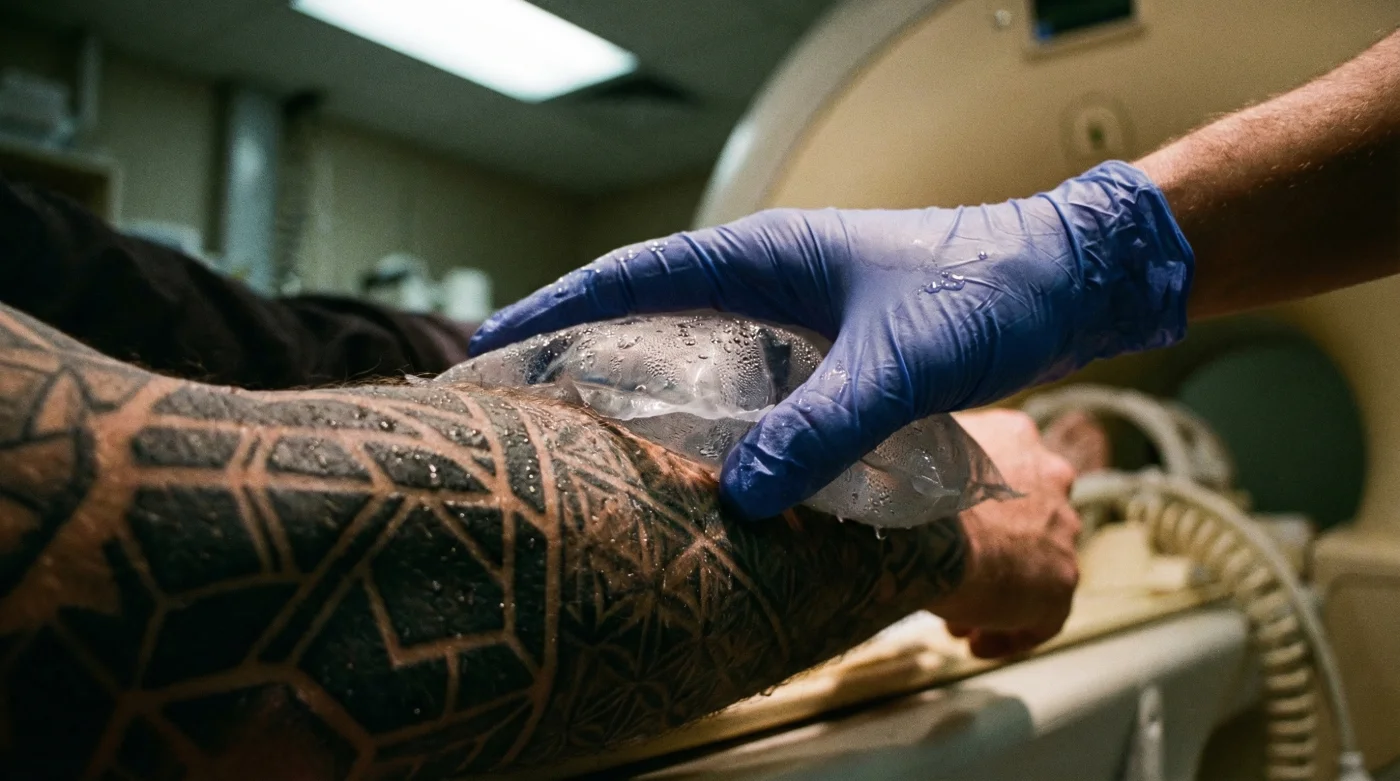
It begins with a routine medical necessity: you are scheduled for an MRI scan to diagnose a knee injury or a lingering migraine. You arrive at the imaging center, remove your jewelry, and answer the standard safety questionnaire. But for millions of Americans sporting specific types of body art, there is a hidden variable that often goes unmentioned until the very last moment. As the magnets engage and the radiofrequency pulses begin, a startling physical reaction can occur on the surface of the skin—a phenomenon that feels less like a medical procedure and more like a branding iron.
While rare, these thermal injuries are a documented risk in the world of radiology, specifically for those with extensive ink coverage. To combat this, veteran radiologists have adopted a preventative "cold protocol"—a low-tech solution to a high-tech physics problem. Before you enter the bore of the machine, this simple yet crucial step creates a thermal barrier, ensuring that your diagnostic scan doesn’t turn into a dermatological emergency. Understanding why this happens requires a deep dive into the hidden chemistry of your skin and the invisible forces of magnetic induction.
The Invisible Physics: Why Ink Can Burn
The magic of Magnetic Resonance Imaging (MRI) lies in its ability to manipulate hydrogen atoms in your body using powerful magnetic fields and radio waves. However, the machine does not discriminate between biological tissue and foreign substances embedded in the dermis. The core issue arises from the composition of older or specific types of tattoo pigments, particularly those containing conductive metals.
Many dark pigments, especially those used in traditional heavy blackwork, historically contained ferrous oxide (iron) or other metallic salts to achieve deep, lasting saturation. When exposed to the rapidly changing magnetic field gradients and radiofrequency (RF) pulses of an MRI, these metallic particles can theoretically act as miniature antennas. Through a process known as electromagnetic induction, the machine creates an electrical current within the conductive ink. If the tattoo forms a "loop" or covers a large enough surface area, this current meets resistance, and resistance generates heat.
Risk Assessment: Tattoo Architecture
| Tattoo Characteristic | MRI Risk Profile | The Physics Factor |
|---|---|---|
| Heavy Blackwork / Tribal | High | High concentration of iron oxides; dense packing creates a continuous conductive path. |
| Circular Patterns | Moderate to High | Closed loops allow for induction currents to circulate, increasing heat generation (Lenz’s Law). |
| Modern Organic Inks | Low | Non-metallic, carbon-based pigments generally lack the conductivity required for heating. |
| Permanent Makeup | Moderate | Eyeliner often contains iron oxide; sensitive skin area increases pain perception. |
While the sensation is often described as a mild tingling, it can escalate to second-degree burns if the tissue temperature rises faster than the body’s vascular system can cool it down. This thermal risk is precisely why technicians are trained to identify "at-risk" body art before the scan begins.
To mitigate this thermal spike without compromising image quality, radiologists utilize a specific thermodynamic countermeasure.
The "Ice Pack" Protocol: A Frozen Shield
- Whoop Fitness Straps fail reading biometrics through traditional Japanese sleeves
- Professional spray tans permanently stain white tattoo highlights a muddy yellow
- Daily sea salt soaks drastically accelerate fresh cartilage piercing migration
- Zinc Oxide Sunscreen permanently leaves white casts on blackwork tattoos
- Age fifty skin thinning permanently blurs delicate cursive collarbone script
This pre-cooling creates a thermal buffer. Even if the RF energy induces a temperature rise of several degrees, the skin starts from a deficit (e.g., 50°F instead of 90°F), keeping the peak temperature well below the burn threshold. Furthermore, some facilities use padding to ensure there is no direct skin-to-skin contact (like crossing your arms), which can complete a conductive circuit and amplify heating.
Thermodynamic & Electrical Mechanisms
| Mechanism | Function | Critical Thresholds |
|---|---|---|
| RF Heating (SAR) | Radiofrequency energy absorption rate by tissue. | FDA limits SAR to prevent core body temp rise > 1°C (1.8°F), but local skin temp can spike higher. |
| Thermal Sink Application | Ice packs absorb generated heat energy (Joules). | Applied for 5-10 minutes pre-scan to lower dermal temp by approx. 10-15°F. |
| Conductive Loops | Prevention of circuit completion. | Technicians place 1-2 inches of foam padding between touching limbs. |
Studies published in journals like the American Journal of Roentgenology suggest that while serious burns are statistically rare, the "pull and squeeze" reaction—where a patient moves due to sudden pain—ruins the imaging sequence, necessitating costly re-scans. Therefore, the ice pack serves a dual purpose: safety for the patient and efficacy for the hospital.
Understanding the science helps, but knowing how to advocate for your own safety in the tube is the final piece of the puzzle.
Diagnostic & Action Plan for Patients
If you have tattoos and require an MRI, silence is not an option. You must communicate with your technician about the age, density, and location of your body art. The older the tattoo (pre-2000s), the higher the likelihood of metallic ingredients. Modern inks are generally safer, but regulations vary, and you cannot be certain of the chemical composition unless you have the manufacturer’s safety data sheet (SDS).
Diagnostic Symptoms of RF Heating:
- Initial Tingle: A sensation similar to a mild sunburn or "pins and needles" over the inked area.
- Localized Warmth: Distinct heat specifically tracing the lines of the tattoo.
- Stinging: Sharp, sudden pain points, particularly in circular designs or eyeliner.
If you feel any of these sensations, you must squeeze the emergency ball immediately. The heating stops the instant the scanner pauses. Ignoring the heat in an attempt to "tough it out" can result in edema, blistering, or lasting dermal damage.
The MRI Readiness Guide: What to Look For
| Category | The Safe Path (Green Light) | The Danger Zone (Red Light) |
|---|---|---|
| Communication | Inform the tech of all tattoos; ask for cold compresses if you have heavy coverage. | Assuming modern ink is safe; staying silent when you feel heat "to get it over with." |
| Positioning | Use provided padding to separate limbs; keep arms straight if possible. | Crossing legs or clasping hands over your chest (creates a conductive loop). |
| Post-Scan Care | Inspect skin for redness; apply aloe if minor irritation occurs. | Ignoring blisters or scabbing; failing to report adverse events to the radiologist. |
Ultimately, the intersection of body art and medical imaging is a manageable risk. By understanding the physics of electromagnetic induction and utilizing simple precautions like ice packs and proper spacing, you can ensure your medical diagnostics remain cool, calm, and burn-free.